I am delighted to share news about the publication of my upcoming book, Music behind the Iron Curtain: Weinberg and his Polish Contemporaries, with Cambridge University Press. Here's the blurb:
Mieczysław Weinberg left his family behind and fled his
native Poland in September 1939. He reached the Soviet
Union, where he become one of the most celebrated
composers. He counted Shostakovich among his close
friends and produced a prolific output of works. Yet he
remained mindful of the nation that he had left. This book
examines how Weinberg’s works written in Soviet-Russia
compare with those of his Polish contemporaries; how one composer split from his national tradition and how he
created a style that embraced the music of a new homeland,
while those composers in his native land surged ahead in a more experimental vein. The points of contact between
them are enlightening for both sides. This study provides an
overview of Weinberg’s music through his string quartets,
analysing them alongside Polish composers. Composers
featured include Bacewicz; Meyer; Lutosławski; Panufnik;
Penderecki; Górecki; and a younger generation, including
Szymański and Knapik.
The book will be available from mid-Autumn; for anyone able to travel to London, there will also be a launch event at the Wigmore Hall on Saturday 26 October. More details (and tickets) available here.
I'm very excited to be able to share this research with you all, and I hope to have more posts about the book over the coming weeks and months.
On Sunday 19 May, there will be a concert in New York for Weinberg's centenary. The programme will feature long-term supporter of Weinberg's music, Yosif Feigelson, performing Weinberg's 24 Preludes for Solo Cello, as well as pianist Ilya Yakushev, and singer Daniel Singer, in a selection of Weinberg's Yiddish songs. Further details below:
MIECZYSLAW WEINBERG (1919-1996). Celebrating the centennial of one of the most prolific composer's ever who's life story reads like a novel. Please visit www.mweinberg.info to know more. Noted Latvian-born cellist,YOSIF FEIGELSON, who premiered and recorded the unique 24 Preludes opus 100in late 1990th to a wide critical acclaim, will perform them again. Also on the program, the audience beloved, Pictures at an Exhibition by Modest Mussorgsky (1839-1881) - one of his musical pictures has a prominent Jewish connection. The pianist is a world-class virtuoso, ILYA YAKUSHEV. In addition, well known cantor of SWFS, DANIEL SINGER, will perform several of Weinberg's Yiddish songs. Tickets at the door $40, $30 - in advance here, $20 - seniors and students (at the door). Children under 15 admitted free. This event is made possible by a generous gift from Elias Charitable Foundation, and by other private and business support. Visit www.improvis.org for more information.
I'm still reeling from the incredible 'Mieczysław Weinberg: East meets West' conference at my Alma mater, the University of Manchester. The conference was organised by the ever-wonderful David Fanning and Michelle Assay, who pulled everything together with their indefatigable efforts. I promise a full write-up 'report' of the proceedings, but for now, here's a selection of photos from the four days (my own, and from other delegates and audience-members).
Full programme of the Quatuor Danel concerts.
Yours truly, leading a workshop-seminar with the Quatuor Danel on my reconstruction of Weinberg's First Quartet (photo credit: Richard Pleak)
An incredible 'surprise guest' at the conference: Gidon Kremer (photo credit: Richard Pleak)
Kremer performed and then gave a talk (before flying out straight afterwards!) (photo credit: Richard Pleak)
The academic conference included a Skype Q&A session with Victoria Bishops, Weinberg's first daughter.
Roberto Carrillo-Garcia gave a phenomenal performance of Weinberg's Sonata for Double-Bass in one of the afternoon concerts (photo credit: Richard Pleak)
The conference delegates were a friendly group, seen here in a large dinner in between sessions.
The incredible Quatuor Danel (photo credit: Richard Pleak)
A wonderful group photo with the Danels, audience members and conference delegates, who all went together on the amazing journey through Weinberg's complete quartets (photo credit: The Symphonist, twitter handle: @deeplyclassical).
Weinberg
wrote his Piano Quintet between August and October 1944, at the age of 24. Barely
a year after settling in Moscow, following his double escape from Nazi invasion
(Warsaw to Minsk in September 1939 and Minsk to Tashkent in June 1941), he already
had a blossoming reputation in the musical community of the Soviet capital. His
Quintet is part of a larger group of chamber pieces written at prolific speed
during the war years. Despite his youth, it is a formidable work, cast in five
movements, similar to Shostakovich’s celebrated Piano Quintet of 1940. But
whereas Shostakovich’s work is often contemplative in character, Weinberg’s
Quintet is more extrovert as a whole. It is tempting to link the work’s serious
tone to the war itself - Weinberg had left his family behind when he fled his
native Poland – but unlike some of his later pieces, there are no concrete clues
to this effect, such as quotations or self-quotations from songs. The piano
part is particularly demanding, with several extended solos. A remarkable
recording exists of the composer performing the piece with the Borodin Quartet
– testament to his pianistic proficiency.
The work’s opening phrase is
immediately striking, with an austere tone that sets the mood for the first movement
and the whole piece. The piano is pitted against the strings, with the quartet
providing punctuating gestures to the piano’s weightier thematic statements.
The dotted rhythm of the second theme allows the strings to dominate, but only
briefly before the opening theme returns in a thunderous restatement.
The second movement alternates a
sinuous theme in the muted strings with a hectic solo from the piano. The latter’s
triplet figurations rapidly expand to the whole ensemble, before reducing to a skeletal
macabre texture, with the strings playing several eerie passages with the back
of the bow – col legno.
The third movement is a Presto that opens
with muted flurries in the strings, soon joined by octaves high in the piano that
create a feeling of tense expectation. This mood is shattered by a series of strenuous
scales and trills, before a central dance section in which elements reminiscent
of Klezmer and even a brief Chopin-esque passage for solo piano combine to
emphasise the ‘cabaret’ feel already latent in the previous movement.
The long-drawn Largo rapidly darkens
the mood, providing a sobering contrast to the previous manic jubilation; its
character is stark, verging on melancholic. A line of implacable octaves sets
the tone. The first violin delivers a mournful solo, before a strident burst of
major tonality in the piano. Energy accumulates, before a heart-rending flurry
of passion. The quasi-recitative theme once again moves to the solo piano,
before a morendo close. A
contemporary reviewer described this movement as ‘disturbingly lyrical and
deeply meditative’.
With such contrasts already
encountered, the final movement has several questions to address, which is does
with a succession of strongly characterised themes. It opens with strident,
almost machine-like pulsations, with aggressive interjections from the piano.
Syncopated rhythms abound. The second theme is unexpected: firmly in the major,
it presents a folk-like dance, playful and mischievous, like an east-European
take on an Irish jig. The piano contrasts with a jazz-like canon, before the
first violin reintroduces the opening movement’s first theme, taking up a
thread that serves to unite the whole work. This is soon combined with the folk-like
melody in an unsettling blend. The juxtaposition builds to become more jarring
before a fiery restatement of the first movement theme in full. Energy
dissipates for the work’s close, softly concluding in a troublingly
inconclusive F major.
That Shostakovich and Weinberg were good friends is well-known. They compared their works-in-progress together, and met regularly, as well as socialising almost every day. What is less well-known, however, is the extent to which Shostakovich supported Weinberg during his most dire time of need. The following is from an article by Nataliya Vovsi-Mikhoels, Weinberg's first wife, on his relationship with Shostakovich, and the events of 1953:
Although Weinberg was not a pupil of Shostakovich's, Dmitri Dmitriyevich always showed great interest in his work. From the very beginning of their acquaintance, they established a law whereby each played his compositions for the other. I remember one day Weinberg telling me of a dream he had had in which Shostakovich invited him to listen to a new work where he heard themes from many of his previous compositions. As he was telling me this story, the telephone rang; it was Shostakovich, who indeed was inviting him to come and listen to a work he had just completed. It turned out to be the Eighth Quartet, which Dmitri Dmitriyevich considered to be his musical autobiography. Weinberg returned home shaken to the very core by the music, and by his prophetic dream.
In February 1953, Weinberg was arrested. Stalin was still alive. To be arrested in those times meant departure for ever. The families of those arrested were ostracized. I rushed between the Moscow prisons, the Lyubyanka and the Butyrka, and didn't know whom to approach.
A few days after his arrest, a great friend of ours range me and suggested we meet. While we paced the dark and narrow Moscow lanes, he told me that Shostakovich was writing a letter to Beriya and needed me to come and help him edit it. It was sheer lunacy to go to Shostakovich in my situation! But I went and read the letter in which he, Shostakovich, vouched that Weinberg was an honest citizen and a most talented young composers, whose chief interest in life was music. I understood how dangerous it was for Shostakovich to vouch for an enemy of the people, a Jew, and furthermore, Mikhoels' son-in-law... I expressed these emotions as best as I could to Dmitri Dmitriyevich, but he, shy of being thanked, just continued to repeat, 'Don't worry, don't worry, they won't do anything to me'.
Apart from this letter, his wife Nina Vasilyevna suggested that I should write a statement, giving her power of attorney, thereby allowing her to take our things and sell them to support my seven-year-old daughter Vitosha [Victoria], when they came to get me and my sister... In fact, as it transpired later, she had decided that they would look after Vitosha.
But all this was not be. On 5 March Stalin died. A month later, my father was rehabilitated in the press. Soon after this Shostakovich and his wife went to the south on holiday, making me promise to send a telegram as soon as Weinberg was released.
And shortly we were able to send them this telegram: 'Enjoy your holiday. We embrace you, Tala and Metek'. Two days later the Shostakoviches were back in Moscow. That evening we celebrated. At the table, festively decked out with candles in antique candlesticks, Nina Vasileyna read out the power of attorney that I had written. Then Dmitri Dmitriyevich got up and solemnly pronounced, 'Now I should burn it over the candles'. After the destruction of the 'document', we drank vodka and sat down to supper. I rarely saw Dmitri Dmitriyevich as clam, and even merry, as he was that evening.
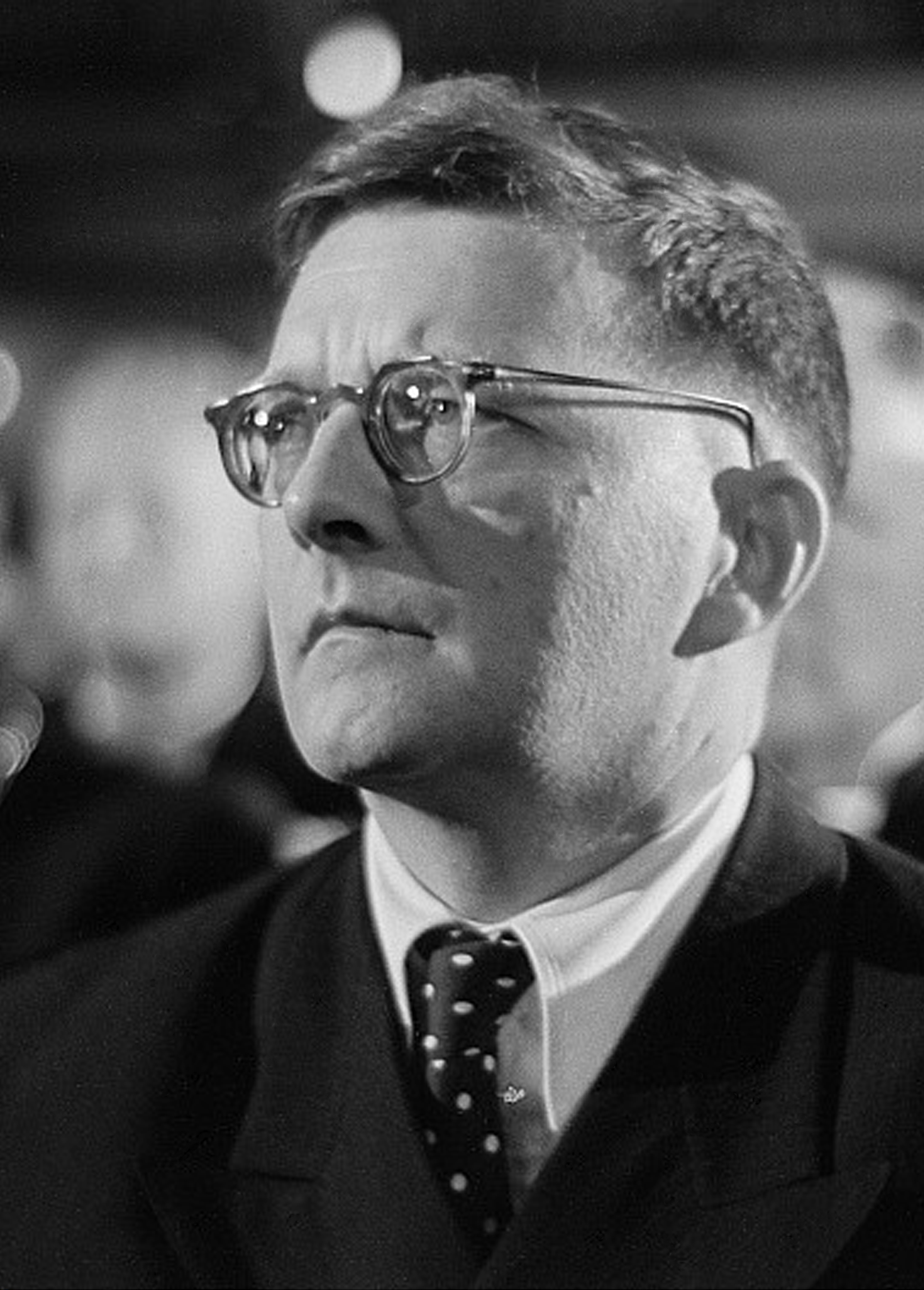
Quoted from Elizabeth Wilson (ed), Shostakovich: A Life Remembered (London: Faber and faber, 2006) 263-264. Shostakovich photograph from wikipedia commons.