Showing posts with label Kondrashin. Show all posts

Wednesday, 4 December 2013

Work focus: Fourth Symphony, Op. 61

Weinberg's path as a symphonist evolved relatively late in his career; by the time of his Fourth Symphony, 1961, he was over forty years old and had been a professional composer for more than twenty years. His preceding symphonies had shown something of a struggle to find a voice. The First Symphony, Op. 10, is a strong work, but it betrays a heavily academic approach. His Second Symphony, Op. 30, is more restrained, scored for string orchestra. The Third Symphony, Op. 45, shows an evolution, heading towards the trajectory of the Fourth, but still with some way to go. But with the Fourth Symphony, Weinberg established a powerful voice as a symphonist. The work is arresting, challenging, and unique, but also with charm.
   Work began on the work in 1957, with subsequent revisions. The manuscript dates completion to 20 June, 1961, and the symphony was premiered on 16 October of the same year, with Kirill Kondrashin and the Moscow Symphony Orchestra (just a few weeks before the belated premiere of Shostakovich's own Fourth Symphony, performed by exactly the same forces). The piece is dedicated to Revol Bunin, a student of Shostakovich and a fellow composer. Bunin was a prolific composer and teacher, particularly active in scoring for films (Weinberg would go on to dedicate his Fifth Symphony to Kondrashin).

What other writers have said about the Fourth Symphony

S. Shlifstein, 1963 (foreword to orchestral score):
Weinberg’s name has of late been attracting the attention of the musical public. Profound themes, fresh and expressive lyrical melodies in the folk style, mastery of form, brilliant virtuosity and dynamism of orchestral writing – all this makes for high artistry of his creations. Technically impeccable, his works produce the impression of great ease.
    This is particularly true of his Fourth Symphony: for all its complexity (the work abounds in polyphonic devices, unexpected tonal shifts and its harmonic idiom is quite modern), the symphony seems light, transparent and deceptively simple. But there is nothing contradictory in this: simplicity is the summit of art. Every artist, however, has his own idea of simplicity; in the words of Vsevolod Meierhold, ‘There is no general and universal simplicity, just as there is no “golden mean” in art. An artist must strive for his own kind of simplicity which will be quite unlike the simplicity of his colleagues. In art, simplicity is the result and not the starting point’. So when we speak of ‘simplicity’ in Weinberg’s music we mean just this. Like other works written in later years, his Fourth Symphony reflects the composer’s ceaseless searchings for a style and simplicity of his own. And not merely searchings but also achievements. 

Gregor Tassie, Kirill Kondrashin: His Life and Music, (2011):
Among the Soviet composers whose works were taken up by Kondrashin
during this period was the Polish-born composer Moisei Vainberg. Kondrashin gave the world premieres of several of his symphonies. All of these were immediately set down by Melodiya, including a fine setting of the Violin Concerto with Leonid Kogan as soloist. Vainberg was fortunate in being performed by the most gifted musicians in the USSR: “Regarding the role of the performer, certainly if one knows that he is waiting for your music, it does help motivate one. I have written works commissioned by L. Kogan, D. Oistrakh, M. Rostropovich, and D. Shafran. If I didn’t enjoy the friendship of
R. Barshay, there probably would not have appeared my string symphonies. I worked on the Fourth, Fifth, Sixth and Eighth Symphonies aware that they would be performed by K. Kondrashin. I thank fate that during my career I have met genuinely wonderful interpreters.” (K. P. Kondrashin, “K 60-letiy K. P. Kondrashina,” 51).
 Susan J. Regan, 1971 (notes to Melodiya release):
First performed in October 1961, Vainberg's Fourth Symphony resembles the Violin Concerto in overall construction, with two vital and forceful outer movements, a lighter second movement and a more lyrical third movement. The symphony also reveals certain characteristics of Vainberg's style: polyphonic writing, particularly in development sections, a fondness for the clarinet which is given major themes in the first three movements, and for percussive writing in the brass (especially trumpets), pizzicato accompaniments to give a feeling of moment, and a penchant for dance and march rhythms. The harmony is alternately rich and dissonant, the melody alternately smooth and angular.

The Music

For the interest of readers, the score for the Fourth Symphony is conveniently available on the ISSUU website, read-only, available here. The youtube videos are from both the Kondrashin and Chmura recordings.

First movement - Allegro
 The symphony opens with a striking unison string line, clunky and stark, recurring throughout the movement. In counterpoint to this rhythmically shifting line, a brass fanfare. Pinpointed against this is a woodwind answer, which will go later to herald the second theme of the movement, first heard in the clarinet. A restatement of the opening follows, with complex development and both themes alternating between the violins and horn, all underpinned by the unison string line. The central development introduces a march-like theme before a recapitulation of both themes. The timpani signal a shortened version of the opening, leading a hurried close.

Second movement - Allegretto
The clarinet takes centre-stage in this slower movement, leading the first theme to pizzicato accompaniment. This meandering and pastoral line moves to the strings, before a jaunty and militaristic second theme is heard in the trumpet, shifting to woodwind. Increasing in drama, the two themes are combined before a return to the opening material.

Third movement - Adagio - Andantino
This Mahlerian slow movement is perhaps the most striking passage of the whole work, showing Weinberg's lyrical mood in symphonic form for the first time. A solo horn opens the movement with a melancholic recitative, answered by the cellos with the first theme. The clarinet takes prominence again, with the second theme, ascending passionately. The central section combines both themes and increases in intensity, building up to a crushing anti-climax before the restatement of the opening. This beautiful movement paints an exquisite picture for the listener.

Fourth movement - Vivace
The finale marks a return to the fast-paced polyphony of the opening movement, with several nods to the descending brass figure that began the work. Such energy is now condensed into a whirling sequence of folk-like dances, with a particular emphasis on Jewish-like themes (several commentators have pointed out a resemblance to the Belo-russyan song 'Perepyolochka', hidden beneath troikas and mazurkas). Many themes follow one after the other, showing off Weinberg's accomplished orchestration skills, with passages for xylophone and tambourine, and others for woodwind. They give way to a broad song-like theme in warm strings, before a headlong drive towards a flurry that concludes the symphony with a punch.

Recommended recordings
To the best of my knowledge, the reader has a choice between two recordings (one of them released and re-released in many different guises).

1. Kondrashin and the Moscow Philharmonic (Melodiya)

This recording has become something of a collector's item on vinyl and on CD. It is available second hand on amazon.co.uk currently, and also available as a download from the Melodiya shop on iTunes.

2. Gabriel Chmura and the National Polish Symphony Orchestra (Chandos)


Widely available on CD and amazon download.

In my opinion, I side with the Kondrashin recording. Partly because of the biographical interest, as it features the forces that premiered the work, but also because it boasts a slightly warmer sound than the Chandos series on Weinberg's symphonies. If at all possible, try to source the Kondrashin on vinyl, paired with the Violin Concerto, Op. 67, performed flawlessly by Leonid Kogan. 


Friday, 20 September 2013

Мелодия archive goes online


Melodiya, the Soviet state music label, has recently celebrated its Fiftieth birthday, and now they have unexpectedly announced that they will begin releasing digitized versions of their enormous catalogue. 

The first batch of 350 albums was made available on Apple's iTunes store on Tuesday of this week - with more to follow in November.

Link to Melodiya store in itunes 

The distribution is being handled by a label called The Orchard. From their website:


"THE ORCHARD AND MELODIYA ANNOUNCE THE DIGITAL RELEASE OF 750 RECORDINGS FROM THE HISTORIC
MELODIYA ARCHIVE ON iTUNES

The first titles to be released exclusively on iTunes
beginning September 17, 2013
NEW YORK, NY; MOSCOW, RS – The Orchard, a pioneering music, film and video distribution company and the iconic Russian record label Melodiya (Russian: Мелодия) announce the digital release of 750 titles from Melodiya’s historic catalogue to be made available exclusively on iTunes. The first albums will be released on iTunes beginning on September 17 with a second group scheduled for early November. iTunes is also hand-selecting titles to feature in a dedicated Melodiya section of the store. Other digital service providers will begin offering Melodiya titles after the New Year. This announcement celebrates the result of a long-term initiative to digitize Melodiya’s catalogue and the first time Melodiya’s classical catalog has ever been available for download.
Since Melodiya gained ownership of its catalogue from the former Soviet Union, it has reinvigorated its imprint, which began with a strategic move in June 2013 to re-release some of their popular recordings on the vinyl format.  In addition to the reintroduction of vinyl releases, Melodiya has invested significant resources in re-mastering the original recordings, digitizing them and making them available for sale globally.
Andrey Krichevsky, CEO for Melodiya, says:
“Digitizing the catalogue for download was a natural step forward in making Melodiya’s repertoire widely available. Over time, the tape archive has become less protected from the environment, and we realized that it was critical to try and revitalize this recorded legacy for future generations.”
The newly available digital collection will feature recordings from Melodiya’s historic classical catalogue, including notable artists such as conductors Evgeny Svetlanov, Gennady Rozhdestvensky, Kirill Kondrashin, Yevgeny Mravinsky; pianists Emil Gilels, Sviatoslav Richter, Maria Grinberg, Glenn Gould, Yevgeny Kissin, Maria Yudina, and Van Cliburn; violinists David Oistrakh and Leonid Kogan; violist Yuri Bashmet; cellists Mstislav Rostropovich, Natalia Gutman, and Daniil Shafran; the Borodin and Beethoven string quartets; and opera singers Feodor Chaliapin, Galina Vishnevskaya, and Irina Arkhipova.
Brad Navin, CEO for The Orchard, says:
“Melodiya represents a wealth of the most authentic Soviet era recordings featuring the works of Tchaikovsky, Shostakovich and other greats. We are proud to work with this historic label and happy that many of the recorded masters were able to be preserved to be available to the world digitally.”
Highlights from the classical releases will include a complete set of Mahler symphonies with Kirill Kondrashin; Symphony Nos. 4 & 6 by Mieczysław Weinberg, also with Kondrashin; the complete Sibelius and Prokofiev symphonies with Gennady Rozhdestvensky and the USSR State Radio and TV Orchestra; Bruckner’s 8th and 9th symphonies with Mravinsky and the Leningrad Philharmonic; the complete string quartets of Dmitri Shostakovich with the Borodin Quartet as well as select Shostakovich quartets featuring the Beethoven Quartet (the quartet who premiered 13 out of Shostakovich’s 15 string quartets); Shostakovich violin and viola sonatas featuring David Oistrakh, Yuri Bashmet, and Sviatoslav Richter. Other highlights include Schnittke’s Faust Concerto and Concerto Grosso with Natalia Gutman, Oleg Kagan, and Raisa Kotova, led by Gennady Rozhdestvensky; the complete Beethoven sonatas with pianist Maria Grinberg; and many rare recordings by David Oistrakh, Sviatoslav Richter, Emil Gilels, Elizaveta Gilels, Leonid Kogan, Tatiana Nikolayeva, Yevgeny Kissin and others.
Non-classical titles will include popular Soviet bands such as Zemlyane, Pesnyary, Samotsvety; the Azerbaijani vocal jazz quartet “Gaya”, instrumental ensemble Melodiya, series such as Sdelano V Sssr and Musical Cocktail;  Kamarinskaya / Russian Balalaika, and representatives of Soviet funk and jazz. Melodiya also plans to release recordings of the iconic Russian artist Vladimir Vysotsky. 
ABOUT MELODIYA RECORDS
Firma Melodiya was established by the ordinance of the USSR Council of Ministers in 1964 to replace the former All-Union Studio of Gramophone Recording and unite the sound recording studios located in Moscow, Leningrad, Tallinn, Riga, Vilnius, Tbilisi, Alma-Ata and Tashkent. Being a monopoly of domestic record production and having the biggest creative musical potential in the world, for more than 25 years Firma Melodiya has accomplished a tremendous work recording and releasing records of classical, folk and popular music, as well as literary, historical and political recordings. Dozens of millions of records sold in the most remote corners of the Soviet Union and many countries of the world, and over 90 thousand archival tapes stored by Firma Melodiya are obvious evidence of the fact.
Firma Melodiya today is a modern company that holds a confident position in the Russian and world sound recording markets, and actively cooperates with its foreign partners. The nearest plans include further reissues of the most treasured recordings from the archives on CDs as well as on vinyl and digital sales.
As of 1973, Melodiya had released approximately 1,200 vinyl albums with an extensive catalogue of music by Soviet composers, musicians, theater actors, authors of fairy tales for children, and more. Melodiya also released some of the most successful western pop, jazz and rock records, including Michael Jackson, ABBA, Paul McCartney, Boney M., Dave Grusin, Amanda Lear, and Bon Jovi.
In other countries, Melodiya recordings imported from the USSR were often sold under the label MK, which stood for Mezhdunarodnaya Kniga (“International Book”, Russian: Μеждународная Книга). In the United States, many Melodiya recordings appeared on the domestically manufactured Monitor Records label. In the 1970s and 1980s, Melodiya recordings of classical and folk music appeared on Melodiya/Angel (USA) and Melodiya/HMV (other countries) as the result of an exclusive contract with EMI, the owner of both labels."

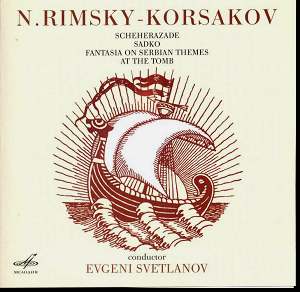
At £8 per single album (more in case of larger discs), each download doesn't come cheap compared to other online vendors, and I'm sure that some enthusiasts will miss the physical product (myself included - especially RE: liner notes!). I've started the collection with Evgeny Svetlanov and the USSR State Academic Symphony Orchestra playing Rimsky-Korsakov (image below).


Audio quality is decent, though not excellent (clearly the result from a live recording or transfer). The real shame is a lack of liner notes, simply for information on the recording, if anything. The titles don't come cheap, but it certainly beats hunting round the collector's trading centres of the internet.

Of course, readers are directed to the first Weinberg gem of the collection to be released, Kondrashin conducting the Symphony Orchestra of the Moscow State Philharmonic Society in Symphonies 4 & 6 (picture below). Stay posted for a review.