Showing posts with label Pacifica Quartet. Show all posts

Wednesday, 11 December 2013

December update

Releases (both available and upcoming)

The last few months have brought a rich variety of Weinberg-related recordings (see my recent review posts). Here are two recordings that have caught my attention recently, both of which I am eagerly awaiting in the post:
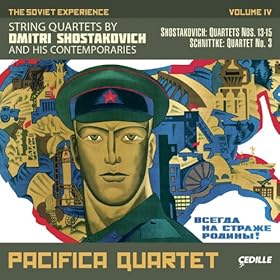
The Pacifica Quartet, 'The Soviet Experience, Vol. IV', Cedille, 2CD-set. 

The Pacifica Quartet have been attracting numerous awards and column-inches for their excellent Shostakovich cycle, unique in pairing their releases with other Soviet quartets contemporaneous to the Shostakovich works featured. Of course, their third volume included Weinberg's Sixth Quartet in a masterful interpretation. This final disc features Schnittke's Third Quartet, perfect programming alongside Shostakovich's last three quartets. Several commentators have called for the group to record the remaining Schnittke quartets as a seperate project. Of course, I invite them to record as many Weinberg quartets as possible (and Myaskovsky, for that matter). Amazon link.


Ewelina Nowicka (violin), Milena Antonewicz (piano), 'Mieczysław Weinberg: Works for Violin and Piano', RecArt, Poland.

This album adds to the considerable amount of discs already released this year dedicated to Weinberg's works for violin. Works featured include the Sonatina, Op. 46, Rhapsody on Moldavian Themes, and the Concertino, Op. 42, recorded for the first time in its arrangement for violin and piano. Available from amazon here and jpc.de here. More info available from the RecArt website: link.


UPCOMING RELEASES:
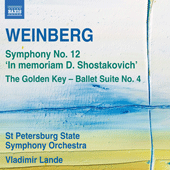
St. Petersburg State Symphony Orchestra, Vladimir Lande, 'Symphony No. 12, Golden Key Suite No. 4'

Coming in January, the next installment of Naxos' hugely successful series of Weinberg's symphonies, this release featuring his twelfth, dedicated to Shostakovich. Paired alongside is the fourth suite from Weinberg's ballet The Golden Key, an extremely charming work to go with it. More info available here: link to Naxos page.
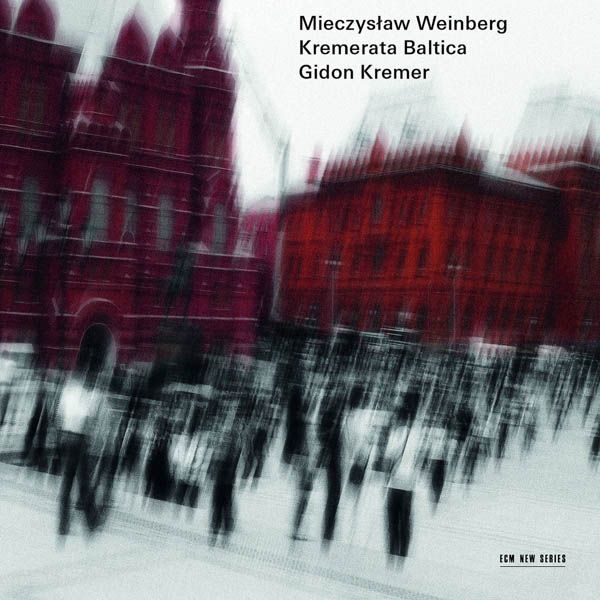


And, for the other upcoming release that I'd like mention, I have no CD cover photo, yet (UPDATE 19/12/13 - Yes I do, see above). Several websites have listed a new release by Gidon Kremer and the Kremerata Baltica, to be released in January. Information is extremely scarce, but several sources suggest that it will be a 2CD set, dedicated to orchestral works by Weinberg. I expect very good things; I shall update as and when more information becomes available.

---UPDATE---

(18/12/13)

I have found a track-listing for the Kremer double-album, with a release moved back to February 2014. The works featured will be:

Disc 1
Sonata No. 3 for solo violin Op. 126
Trio for Strings, Op. 48
Sonatina for Violin and Piano, Op. 46

Disc 2
Concertino for Violin and Orchestra, Op. 42
Symphony No. 10, Op. 98

It is interesting to see a blend of chamber and ensemble music over the course of a set, but I'm sure Kremer and his Orchestra will not disappoint.


My own work

Progress with my PhD-work is chugging along nicely, with looming chapter deadlines. I will be speaking at the RMA Research Student's conference at Birmingham University in January 2014, on the topic of 'The Influence of Anxiety', speaking on various theories on the aesthetics of influence in music. 

I'm also delighted to announce that I have been invited to speak at an international conference held at Leeds University, 'Continuities and Ruptures: Artistic Responses to Jewish Migration, Internment and Exile in the Long Twentieth Century'. The title of my paper is 'Commemorating the Past: Weinberg’s Experience as a Jewish Migrant in the USSR', and I shall be speaking on Weinberg's experience as a Jewish-Polish migrant to the Soviet Union, and the reception that he enjoyed over the course of his life. 

I shall update this post with more news/releases as and when I am aware of them. Do check back to this blog for more album reviews, work-focus posts and details of my upcoming work.


Thursday, 4 July 2013

Work Focus: String Quartet No. 6, Op. 35


     Weinberg’s String Quartet No. 6 in E minor, Op. 35, was written in 1946, 20 July–24 August. It represents a culmination of all that Weinberg had achieved in the genre thus far, and it remained a high water-mark for many years. This large six-movement work, lasting over half an hour in performance, condensed all of his previous work in large-scale forms and mastery of the quartet medium. The Sixth Quartet is dedicated to Georgy Sviridov, a pupil of Shostakovich’s who wrote in a neo-romantic vein, and with whom Weinberg was close friends at the time of writing. Sviridov’s diaries, published posthumously, revealed him to be a vicious anti-semite, but it appears this was not a barrier to his friendship with Weinberg. Some have suggested that Sviridov’s views could explain Shostakovich’s sudden break with him in the 1960s.

     The Sixth Quartet was almost immediately recognised as a significant work, and Myaskovsky intervened to secure its publication. Myaskovsky and Weinberg had been friends since 1940, and at one period shared an exchange of each other’s works similar to that between Weinberg and Shostakovich. The Composer's Union in the USSR was undoubtedly a peculiar organisation, one which allocated performance and publication rights to each composer. As a result, a work could be successfully published but never performed. This directly led to a ban on the Sixth Quartet in 1948, as it was named, along with several other works by Weinberg, in the infamous 'Prikaz No. 17' (Order No. 17), which featured works barreed from broadcast and performance. This order was revoked a year later, but its effects lasted for several years, and the Sixth Quartet never secured a performance during Weinberg’s lifetime, despite being republished in 1979. The world premiere would not occur for many years, with the first performance by the Quatuor Danel in Manchester, January 2007. Only following this has the Sixth Quartet come to be recognised as one of Weinberg's masterpieces, a work to rival the quartets of Shostakovich.

First movement, 'Allegro semplice'

First movement on youtube 

The quartet opens with a subdued movement in sonata form, with a distinctive lightness of form from the outset. Indeed, in his Fifth and Sixth Quartets, Weinberg preceded Shostakovich, achieving a lightness of texture that would go on to to characterise Shostakovich's later quartets, particularly his Fifth Quartet of 1952.

   The first theme is distinct, with its long minim notes and semiquaver flurries, elements that become focal points in the development. This apparently melancholic theme undergoes a process of 'roughening up', returning in a highly aggressive state after the development. The opening movement also introduces what will become a focal point for melodic and harmonic organisation in the quartet: the emphasis on expanded modes, rather than major or minor scales. (The somewhat unusual Locrian mode features prominently across the work).

Second movement, 'Presto agitato'
Link for second movement

    The second movement is the opposite of its predecessor in tone and energy. Marked ‘Presto Agitato’, it can be compared to the middle movement of the Fifth Quartet and the macabre tone of the Fourth Quartet, though the tendency here is more akin to the Fifth Quartet.

The 'roughening up' observed in the first movement erupts into full violence here, with a stormy mood throughout this movement. This can be heard in the rapid semiquaver movement throughout, combined with a regular pulse (in an almost Stravinskian fashion). Listen out for the rapid triplet figurations that descend through the parts at key cadential markers. The 'B' section material is distinct with its focus on quavers rhythms and a steadily increasing chromatic density. A 'C' section ruminates on both themes, before a lop-sided recapitulation of the 'B' section brings the movement to a close. As such, the work is in a somewhat unbalanced arch-form structure, with no recapitulation of the opening 'A' material'. However, this can perhaps be explained by the third movement.

Third movement, 'Allegro con fuoco'
Link 

   The second and third movement link attacca, and the opening of the third shares much of its character with its predecessor. They have identical metronome markings, and are only separated in performance by a quaver rest. This movement is extremely short, only extended by the lengthened solo passages in the first violin. As such, it can be viewed as a brief linking passage between the second and fourth movements.

   The opening material is derived straight from the second movement, while the quasi-candenza passages in the first violin come to be crucial marking points later in the quartet. It is tempting to suggest that in the Sixth Quartet, Weinberg approaches mastery of the genre, if we choose to read this movement as a commentary on what precedes and follows it. If we do, this would make it comparable to techniques scholars have observed in the late quartets of Beethoven, particularly Op. 131 (which is similarly outside the standard four-movement model for quartets, having seven movements). [N.B. - I do not wish to elevate Weinberg here to the status or quality of Beethoven's late quartets, I wish merely to point out several similarities that can be observed between the two composer's works. D.E.]

Fourth movement, 'Adagio'
Link 

   The fourth movement returns to a focus on textural lightness, and another break in character, as it opens in a slow fugato texture. The parts enter in a textbook-like manner, before ruminations on the theme. Again, the theme undergoes a process of 'darkening' or 'roughening' as heard in the first movement, before a restatement of the quasi-candenza passage from the third movement. This passage can now be understood to be transforming into a uniting cyclical aspect of the work.

Fifth movement, 'Moderato'
Link 

   This movement introduces a Schubert-like play between major and minor modes, first heard in the opening phrase, with an alternation between major and minor third in the accompanying parts. Relatively straight-forward tonal passages are linked by more chromatically complex bridging sections, in a manner already observed in much of Weinberg's writing up to 1946.

   The most distinctive motif in this movement can be heard in the middle section, where the cello takes the limelight, with a line full of dotted minims, bridged with links dominated by semiquavers. Above this, the accompanying parts give a frantic accompaniment, providing the harmony above the cello. Each of these gestures finishes with a violent sforzando pizzicato chord in the viola, providing a hint of violence in what is otherwise an ethereal and tender movement.

Sixth movement, 'Andante maestoso'
Link 

   The final movement can be read as a neat summary of the whole quartet, as well as incorporating several techniques that pervade Weinberg's quartets from the Third onwards. These include violent pizzicato chords as accompaniment, melodies harmonised in thirds across parts, chromatic ‘slips’ in melodic lines to give a suggestion of cheekiness, and flattened modality.

   The Locrian mode, as mentioned above, here provides a main focus, before several cyclical passages recall the previous movements of the quartet. Most strikingly, this includes the candenza passage that has proven so pervasive throughout the work since the Third movement. Weinberg combines this with an ascending major passage that becomes the main non-cyclical motif for the movement. The combination of recalled themes brings the movement, and the quartet to a gentle close.

--------------------------------------------------

Following the Sixth Quartet, Weinberg took a break from the genre, not writing another for some eleven years. Despite its lack of a performance, the work gained notoriety at the Composer's Union, primarily through published scores and piano four-hands private performances. As a result, it was banned from performances, and was later held up against Weinberg as too bold for its time. Only now is the Sixth Quartet coming to enjoy the reputation it deserves.

Recommended recordings:

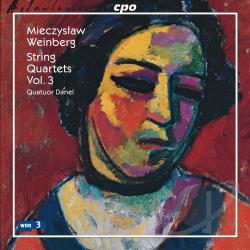
Quatuor Danel, Mieczysław Weinberg, Complete String Quartets, Vol. 3, CPO label

Quatuor Danel on Amazon.co.uk
An excellent rendition by the ensemble that premiered the work, Manchester's own quartet-in-residence.


Pacifica Quartet, The Soviet Experience, Vol. 3, Cedille label

Pacifica Quartet on Amazon.co.uk
The Pacifica Quartet's 'Soviet Experience' project sees them combining Shostakovich quartets with contemporary Soviet works, and their third release features Weinberg's Sixth Quartet in an exhilarating performance. Can't recommend enough.