Showing posts with label Mieczysław Weinberg. Show all posts

Thursday, 15 August 2019

Boris Schwarz on Weinberg

For many years, Boris Schwarz's magisterial Music and Musical Life in Soviet Russia was the authoritative text on Soviet music. It was a considerable achievement of scholarly work, touching on a huge range of authors, subjects, and pieces.


Schwarz was born in St Petersburg, but his family emigrated to Berlin in his youth. Schwarz emigrated to the US in 1936. Starting from the 1950s, he made several extended trips back to Russia to conduct musicological research. The result is his mammoth book. It was greatly celebrated, including an award from the American Society of Composers, Authors, and Publishers' in 1973.

Perhaps the most impressive detail is how comprehensive Schwarz managed to be; he includes details on just about every Soviet composer you could think of.

For many decades, Schwarz's paragraphs on Weinberg were the sole extent of public knowledge of his life and music (including its many inaccuracies!) Thankfully, this has long since not been the case. That said, I reproduce below the page or so that Schwarz included on Weinberg. It is something of a curio to consider that for decades, this was the most known about Weinberg and his music:

Another composer who deserves wider attention abroad is Moissei Vainberg [sic]. Born in 1919 in Warsaw, he received his musical education in Poland. When his country was overrun by the Germans in 1941, Vainberg sought refuge in the Soviet Union and eventually settled in Moscow. He is one of the few Soviet composers of Jewish origin who has achieved genuine equality among his colleages: he is extremely well liked and receives many commissions and performances. In contrast to the older generation of Jewish-Russian composers who stressed their Jewishness (among them Engel, Achron, Krein, Veprik, Gnessin), the younger generation does not limit itself ethnically. Composers like Lev Knipper, Yulian Krein, Boris Kliusner, and Vainberg have acquired a Russian or international musical idiom. In Vainberg's music, there is neither avoidance of, nor stress on, Jewishness; some of his works contain elements of Jewish folklore, while others employ a musical idiom related to Shostakovich and Bartók.
After the 1948 decree, Vainberg enjoyed the doubtful privilege of being praise by Khrennikov for his 're-orientation' - enough to ruin anyone's career - when he reviewed the accomplishments of the year 1948:
'A shining proof of the fruitfulness of the realistic path is the Sinfonietta by Vainberg. As a composers, Vainberg was strongly influenced by modernist music which badly mangled his undoubted talent. Turning to the sources of Jewish folk music, Vainberg created a bright, optimistic work dedicated to the theme of the shining, free working life of the Jewish people in the land of Socialism. In this work Vainberg has shown uncommon mastery and a wealth of creative imagination'. 
Among Vainberg's best works is his Second Sinfonietta, composed in 1958 for Rudolf Barshai and the Moscow Chamber Orchestra. In addition, Vainberg has written eight smyphonies, eleven string quartets, some twenty sonatas for various instruments, several concertos, and various chamber music works with piano, including an impressive piano quintet. Whether his style is strong and personal enough to win acceptance abroad is still untested since hardly any of his music has been heard in the West'.  
Boris Schwarz, Music and Musical Life in Soviet Russia: Enlarged Edition, 1917-1981 (Bloomington, Indiana: Indiana University Press, 1983) 294-295. 
 

Monday, 28 January 2019

Photos from Manchester Weinberg Quartet Cycle and Conference

I'm still reeling from the incredible 'Mieczysław Weinberg: East meets West' conference at my Alma mater, the University of Manchester. The conference was organised by the ever-wonderful David Fanning and Michelle Assay, who pulled everything together with their indefatigable efforts. I promise a full write-up 'report' of the proceedings, but for now, here's a selection of photos from the four days (my own, and from other delegates and audience-members).

Full programme of the Quatuor Danel concerts.
Yours truly, leading a workshop-seminar with the Quatuor Danel on my reconstruction of Weinberg's First Quartet (photo credit: Richard Pleak)
An incredible 'surprise guest' at the conference: Gidon Kremer (photo credit: Richard Pleak)

Kremer performed and then gave a talk (before flying out straight afterwards!) (photo credit: Richard Pleak)

The academic conference included a Skype Q&A session with Victoria Bishops, Weinberg's first daughter.

Roberto Carrillo-Garcia gave a phenomenal performance of Weinberg's Sonata for Double-Bass in one of the afternoon concerts (photo credit: Richard Pleak)

The conference delegates were a friendly group, seen here in a large dinner in between sessions. 

The incredible Quatuor Danel (photo credit: Richard Pleak)

A wonderful group photo with the Danels, audience members and conference delegates, who all went together on the amazing journey through Weinberg's complete quartets (photo credit: The Symphonist, twitter handle: @deeplyclassical).  

Tuesday, 22 January 2019

Weinberg Piano Quintet, Op. 18, programme note


Mieczysław Weinberg (1919-1996)
Piano Quintet, Op. 18 (1944)
I – Moderato con moto
II – Andante
III  – Presto
IV – Largo
V – Allegro agitato


Weinberg wrote his Piano Quintet between August and October 1944, at the age of 24. Barely a year after settling in Moscow, following his double escape from Nazi invasion (Warsaw to Minsk in September 1939 and Minsk to Tashkent in June 1941), he already had a blossoming reputation in the musical community of the Soviet capital. His Quintet is part of a larger group of chamber pieces written at prolific speed during the war years. Despite his youth, it is a formidable work, cast in five movements, similar to Shostakovich’s celebrated Piano Quintet of 1940. But whereas Shostakovich’s work is often contemplative in character, Weinberg’s Quintet is more extrovert as a whole. It is tempting to link the work’s serious tone to the war itself - Weinberg had left his family behind when he fled his native Poland – but unlike some of his later pieces, there are no concrete clues to this effect, such as quotations or self-quotations from songs. The piano part is particularly demanding, with several extended solos. A remarkable recording exists of the composer performing the piece with the Borodin Quartet – testament to his pianistic proficiency.
            The work’s opening phrase is immediately striking, with an austere tone that sets the mood for the first movement and the whole piece. The piano is pitted against the strings, with the quartet providing punctuating gestures to the piano’s weightier thematic statements. The dotted rhythm of the second theme allows the strings to dominate, but only briefly before the opening theme returns in a thunderous restatement.
            The second movement alternates a sinuous theme in the muted strings with a hectic solo from the piano. The latter’s triplet figurations rapidly expand to the whole ensemble, before reducing to a skeletal macabre texture, with the strings playing several eerie passages with the back of the bow – col legno.
            The third movement is a Presto that opens with muted flurries in the strings, soon joined by octaves high in the piano that create a feeling of tense expectation. This mood is shattered by a series of strenuous scales and trills, before a central dance section in which elements reminiscent of Klezmer and even a brief Chopin-esque passage for solo piano combine to emphasise the ‘cabaret’ feel already latent in the previous movement.
            The long-drawn Largo rapidly darkens the mood, providing a sobering contrast to the previous manic jubilation; its character is stark, verging on melancholic. A line of implacable octaves sets the tone. The first violin delivers a mournful solo, before a strident burst of major tonality in the piano. Energy accumulates, before a heart-rending flurry of passion. The quasi-recitative theme once again moves to the solo piano, before a morendo close. A contemporary reviewer described this movement as ‘disturbingly lyrical and deeply meditative’.
            With such contrasts already encountered, the final movement has several questions to address, which is does with a succession of strongly characterised themes. It opens with strident, almost machine-like pulsations, with aggressive interjections from the piano. Syncopated rhythms abound. The second theme is unexpected: firmly in the major, it presents a folk-like dance, playful and mischievous, like an east-European take on an Irish jig. The piano contrasts with a jazz-like canon, before the first violin reintroduces the opening movement’s first theme, taking up a thread that serves to unite the whole work. This is soon combined with the folk-like melody in an unsettling blend. The juxtaposition builds to become more jarring before a fiery restatement of the first movement theme in full. Energy dissipates for the work’s close, softly concluding in a troublingly inconclusive F major.


Thursday, 17 January 2019

Shostakovich and Weinberg


That Shostakovich and Weinberg were good friends is well-known. They compared their works-in-progress together, and met regularly, as well as socialising almost every day. What is less well-known, however, is the extent to which Shostakovich supported Weinberg during his most dire time of need. 

The following is from an article by Nataliya Vovsi-Mikhoels, Weinberg's first wife, on his relationship with Shostakovich, and the events of 1953: 


Although Weinberg was not a pupil of Shostakovich's, Dmitri Dmitriyevich always showed great interest in his work. From the very beginning of their acquaintance, they established a law whereby each played his compositions for the other. I remember one day Weinberg telling me of a dream he had had in which Shostakovich invited him to listen to a new work where he heard themes from many of his previous compositions. As he was telling me this story, the telephone rang; it was Shostakovich, who indeed was inviting him to come and listen to a work he had just completed. It turned out to be the Eighth Quartet, which Dmitri Dmitriyevich considered to be his musical autobiography. Weinberg returned home shaken to the very core by the music, and by his prophetic dream.  

In February 1953, Weinberg was arrested. Stalin was still alive. To be arrested in those times meant departure for ever. The families of those arrested were ostracized. I rushed between the Moscow prisons, the Lyubyanka and the Butyrka, and didn't know whom to approach.  

A few days after his arrest, a great friend of ours range me and suggested we meet. While we paced the dark and narrow Moscow lanes, he told me that Shostakovich was writing a letter to Beriya and needed me to come and help him edit it. It was sheer lunacy to go to Shostakovich in my situation! But I went and read the letter in which he, Shostakovich, vouched that Weinberg was an honest citizen and a most talented young composers, whose chief interest in life was music. I understood how dangerous it was for Shostakovich to vouch for an enemy of the people, a Jew, and furthermore, Mikhoels' son-in-law... I expressed these emotions as best as I could to Dmitri Dmitriyevich, but he, shy of being thanked, just continued to repeat, 'Don't worry, don't worry, they won't do anything to me'.  

Apart from this letter, his wife Nina Vasilyevna suggested that I should write a statement, giving her power of attorney, thereby allowing her to take our things and sell them to support my seven-year-old daughter Vitosha [Victoria], when they came to get me and my sister... In fact, as it transpired later, she had decided that they would look after Vitosha.  

But all this was not be. On 5 March Stalin died. A month later, my father was rehabilitated in the press. Soon after this Shostakovich and his wife went to the south on holiday, making me promise to send a telegram as soon as Weinberg was released.  

And shortly we were able to send them this telegram: 'Enjoy your holiday. We embrace you, Tala and Metek'. Two days later the Shostakoviches were back in Moscow. That evening we celebrated. At the table, festively decked out with candles in antique candlesticks, Nina Vasileyna read out the power of attorney that I had written. Then Dmitri Dmitriyevich got up and solemnly pronounced, 'Now I should burn it over the candles'. After the destruction of the 'document', we drank vodka and sat down to supper. I rarely saw Dmitri Dmitriyevich as clam, and even merry, as he was that evening. 


Quoted from Elizabeth Wilson (ed), Shostakovich: A Life Remembered (London: Faber and faber, 2006) 263-264. 

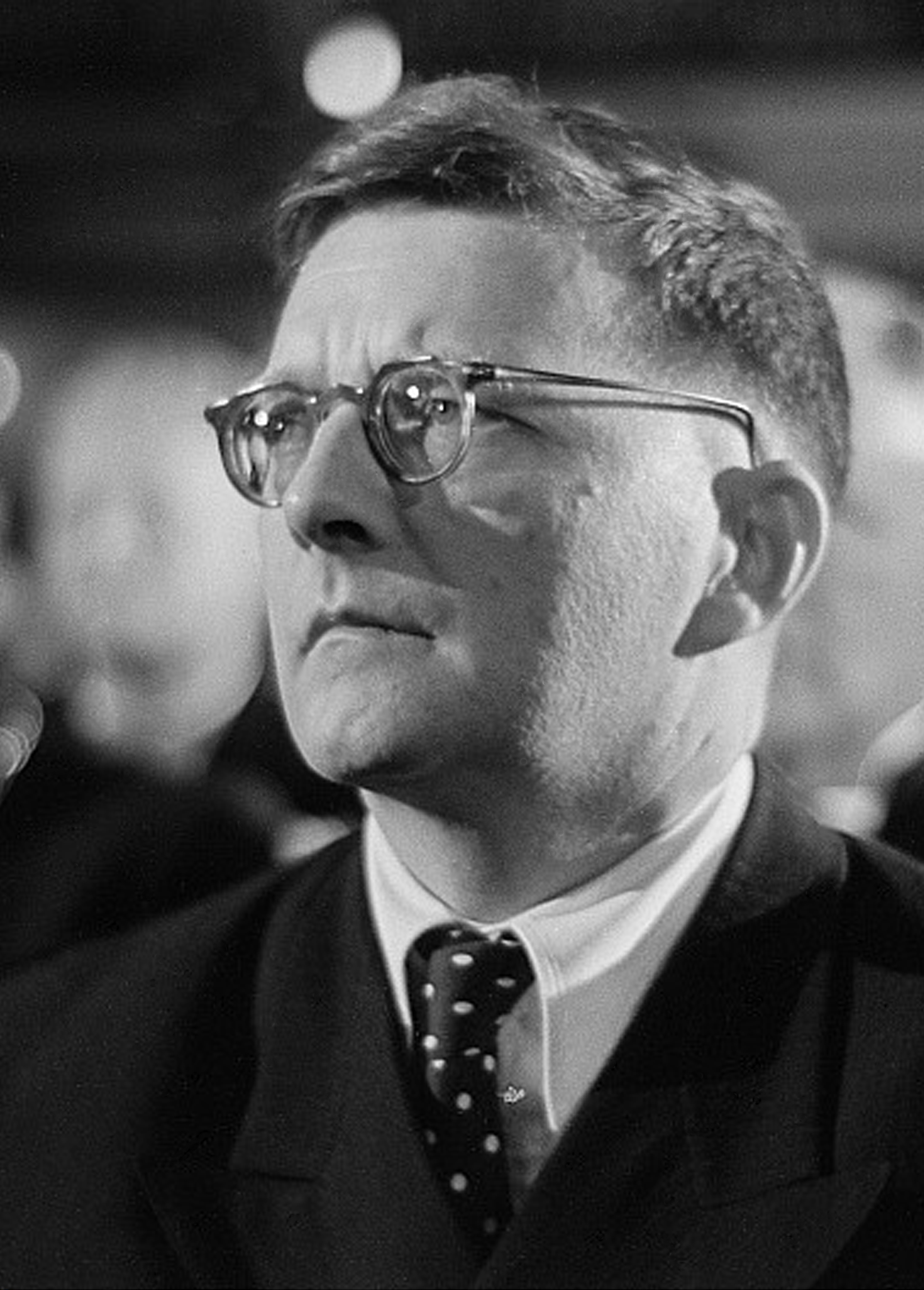
Shostakovich photograph from wikipedia commons. 

Saturday, 12 January 2019

Weinberg's date of birth

On which day of the year should we be celebrating Weinberg's centenary in 2019?

That might seem like a straight-forward question, but the answer is complex. The date that Weinberg and his family celebrated his birthday was 8 December, and this is the date on most of the surviving documents relating to the composer.

His date of birth can be brought into question, however, since his original birth certificate was lost during the destruction of Warsaw in the Second World War. He went to great lengths to receive a replacement in the 1980s, which also officially corrected his name to 'Mieczysław' (it had been changed to 'Moisey' by a border guard in 1939, but that's a separate story). This later document also gives the date of birth as '8 December 1919'.

Recent research has thrown doubt on this, however. Prof. Danuta Gwizdalanka, respected Polish musicologist and biographer of Weinberg, went through the archives of the Warsaw Conservatoire, where Weinberg was a student in the years 1931-1939.

Located there, Gwizdalanka found two documents that bring Weinberg's date of birth into question: his conservatoire application, and a birth certificate, seemingly copied from the original. Both documents list his date of birth as '12 January 1919', a sizeable difference from the acknowledged date (both also use the original Polish spelling for his surname, 'Wajnberg').

Images taken from culture.pl website.

The birth certificate states: 'This birth certificate has been transcribed into the Jewish Faith Metrical Books at the 7th police station of Warsaw on the 17th of January 1919 under no. 28'. The duplicate document was issued in May 1936. 

The application for entry to the Conservatoire is dated November 1931. 

Weinberg's second daughter has confirmed several times that Weinberg celebrated his birthday on 8 December. He was given a Polish medal for services to culture on his 75th birthday, and a small ceremony took place on 8 December 1994. What's more, the later Moscow birth certificate, dated 1981, also gives the 8 December date.

So why the discrepancy?

Aside from these two documents, all other evidence points to the 8 December date. The 12 January version can perhaps be explained when we examine the date that the application was submitted to the conservatoire. In November 1931, Weinberg would have been eleven years old, according to his acknowledged date of birth. The minimum age of entrants to the Warsaw Conservatoire was, however, twelve. The 12 January date conveniently raises Weinberg's age to be sufficient for entry.

If this is the case, Weinberg would hardly be unique in this respect (there are several other composers who misled about their age to gain conservatoire entry). The 1936 duplicate of the birth certificate is more difficult to account for, though it may have been a consequence of new laws on work permits for Jews in Warsaw 1936, which may have extended to continuing study at the conservatoire.

With that said, there is an outside chance that these two documents could be proof that we ought to be celebrating Weinberg's birth much earlier in the year. Or perhaps the discrepancy lends weight to the idea of celebrating his birth all year long (or, at the very least, between 12 January and 8 December)?

Or, perhaps, today should be the date for 'Happy Birthday, Weinberg'?

Further information (and images taken) from Danuta Gwizdalanka, 'Unknown Facts from Mieczysław Wajnberg's biography' - https://culture.pl/en/article/unknown-facts-from-mieczyslaw-wajnbergs-biography

Thursday, 3 January 2019

Weinberg 100: 1


2019 marks the centenary of Weinberg's birth, with numerous events, concerts, and recordings set to mark the event. On this blog, I will begin a series of posts to mark the centenary, with 100 throughout the year. Some of these will be short features, such as photos, key works, or re-posts of older articles on this blog. Others will be previously unpublished sources and photos, posted here to promote further research and scholarship on Weinberg and his music.

For now, watch this space. Here's a performance of Weinberg's first opus-numbered work, the Lullaby for piano:


Monday, 26 November 2018

Review: CBSO Weinberg Weekend


Thanks to the ongoing efforts of conductor Mirga Gražinytė-Tyla, the City of Birmingham Symphony Orchestra are continuing their exploration of Weinberg’s music. It was a pleasure for me to stay in the city, as it is my ‘home turf’ from childhood (well, I’m from between Dudley and Wolverhampton, but the CBSO was the nearest orchestra in my formative years). Ahead of next year’s centenary, they hosted a series of concerts and talks last weekend, featuring sterling performances from all concerned. Here’s my brief review of the concerts:

Friday 23 November:
Gidon Kremer plays Weinberg’s 24 Preludes for Solo Cello (arr. Kremer)


Kremer has an outstanding reputation, closely associated with composers like Schnittke, Silvestrov, and Gubaidulina. He has been promoting Weinberg’s music for several years now, with several excellent recordings on the ECM label. Kremer himself has arranged Weinberg’s 24 Preludes for solo violin, resulting in an extremely demanding work. The Preludes themselves are tightly structured, ascending chromatically through the keys. Kremer maintains this structure, though this makes the act of arrangement more difficult (the easy route might have been to transpose the key to suit the violin better; as it stood, Kremer merely changes octave, preserving Weinberg’s original design). Kremer’s performance was accompanied by a slideshow of photos by Lithuanian photographer Antanas Sutkus, which alternate between humour and tragedy of Soviet life, with a significant focus on childhood. Kremer’s performance was virtuosic and often moving, and the combination with images was convincing (though I was left wondering whether it was absolutely necessary – the Preludes could arguably ‘stand’ on their own).


Saturday 24 November:
11am: Gidon Kremer and Kremerata Baltica: Bach, Weinberg, Schubert, and Silvestrov


The Saturday morning concert was given by Kremerata Baltica, a youthful ensemble led by Kremer, though he describes it ‘a musical democracy’. They continue to be one of the most innovative and exciting ensembles performing today: you can expect surprise at every concert. They began with Bach’s Chaconne in D minor for violin, arranged for string orchestra by Kremer (itself an arrangement of Ferruccio Busoni’s famous piano transcription of the piece). The opening was immediately surprising: the orchestra took their seats, but a recorded solo violin began with those infamous double-stopped chords. The orchestra continued, but the ghostly recording interjected at key moments throughout. The connection with Weinberg is apparent, as the Chaconne figures at the dramatic climax of his opera The Passenger. They then moved into Weinberg’s Concertino for Violin and String Orchestra, with Kremer giving a fine performance as soloist, though their ECM recorded version offers far greater warmth (perhaps a reflection of Birmingham Town Hall’s dry acoustic). The concert then concluded with an intriguing arrangement: combining Schubert with Silvestrov. That is, alternating, movement-by-movement, between the movements of two pieces by two very different composers. It helped that the Schubert was for the full ensemble of Kremerata Baltica, and the Silvestrov was for violin and piano (his Five Pieces for Violin and Piano, dedicated to Kremer), so a clear contrast was provided, in addition to the massive contrast in character between the two pieces. The effect was mixed, though the Silvestrov arguably came out the better in my opinion, helped by Georgijs Osokins sensitive piano accompaniment. Overall, this provided a more contemplative start to the day.


Saturday 24 November:
7pm: CBSO with Kremerata Baltica, Gidon Kremer, Maria Makeeva, cond. Mirga Gražinytė-Tyla: Weinberg and Shostakovich


By far the most substantial event of the weekend was a colossal orchestral concert, with the CBSO and Kremerata Baltica joining forces. The programme was immediately striking, as the CBSO paired Weinberg’s Symphony No. 21 with Shostakovich’s Symphony No. 15, two symphonies that present extremely bleak and sombre themes. Weinberg’s 21st, subtitled ‘Kaddish’, is dedicated to the victims of the Warsaw Ghetto, and various quotations support this, from use of Mahler’s Des Knaben Wunderhorn, through to a reworking of Weinberg’s Fourth String Quartet of 45 years earlier, and haunting solo piano quotes from Chopin’s First Ballade that permeate a brooding canvas of mourning. The Chopin reference and clear Klezmer sections strengthen the depiction of pre-war Warsaw, and the piece’s dedication to the victims of the Ghetto. Various other quotes from Weinberg’s oeuvre surface, and can surely be read as reflective of his life’s work, especially as it is explicitly a memorial piece. One of the key moments comes in the final section, as a wordless boy soprano intones a mournful sighing motif, answered by a wordless soprano (Maria Makeeva) (itself suggestive of loss between mother and child). The work was certainly positively received by the audience, with a huge number of ovations and curtain calls. The work was recorded for the option of future release, so watch this space.
            Usually, it would be alarming to think that Shostakovich’s Fifteenth Symphony could be the ‘light relief’ of any concert, but it proved to be such here. The opening movement, described as a ‘Toyshop’ by the composer, was performed with remarkable aplomb the by the gathered forces of the CBSO and Kremerata Baltica, while the quotations from Rossini'sWilliam Tell were handled with a subtlety that is unusual in most performances. The following movements switch to a far bleaker outlook, with star turns for solo cello and trombone in between Mahler-esque funeral dirges by the brass. The Scherzo was taken at something of a ‘safe’ tempo, though its sarcastic character was still easily conveyed. The finale of the Shostakovich is perhaps the most baffling movement of all, with Wagner and Glinka quotes contained within, presenting a culmination of his recognisably ‘Shostakovichian’ mode of despondency through major-key (or ‘happy’) music.
            The concert itself was a triumph, and Gražinytė-Tyla was captivating as leader of the orchestra. Every cue was flawless in execution, and the orchestra (and audience) are clearly held in awe with every movement.


The Weinberg weekend itself was a great success, and I look forward to future CBSO concerts with his music (next is 31 March 2019, with Kremer in Weinberg’s Violin Concerto, and the Fourth Suite from the Ballet The Golden Key - further info here). Long may Gražinytė-Tyla’s leadership of the CBSO continue, as well as their engagement with Weinberg’s music.

D.E.