Showing posts with label Vainberg. Show all posts

Monday, 26 November 2018

Review: CBSO Weinberg Weekend


Thanks to the ongoing efforts of conductor Mirga Gražinytė-Tyla, the City of Birmingham Symphony Orchestra are continuing their exploration of Weinberg’s music. It was a pleasure for me to stay in the city, as it is my ‘home turf’ from childhood (well, I’m from between Dudley and Wolverhampton, but the CBSO was the nearest orchestra in my formative years). Ahead of next year’s centenary, they hosted a series of concerts and talks last weekend, featuring sterling performances from all concerned. Here’s my brief review of the concerts:

Friday 23 November:
Gidon Kremer plays Weinberg’s 24 Preludes for Solo Cello (arr. Kremer)


Kremer has an outstanding reputation, closely associated with composers like Schnittke, Silvestrov, and Gubaidulina. He has been promoting Weinberg’s music for several years now, with several excellent recordings on the ECM label. Kremer himself has arranged Weinberg’s 24 Preludes for solo violin, resulting in an extremely demanding work. The Preludes themselves are tightly structured, ascending chromatically through the keys. Kremer maintains this structure, though this makes the act of arrangement more difficult (the easy route might have been to transpose the key to suit the violin better; as it stood, Kremer merely changes octave, preserving Weinberg’s original design). Kremer’s performance was accompanied by a slideshow of photos by Lithuanian photographer Antanas Sutkus, which alternate between humour and tragedy of Soviet life, with a significant focus on childhood. Kremer’s performance was virtuosic and often moving, and the combination with images was convincing (though I was left wondering whether it was absolutely necessary – the Preludes could arguably ‘stand’ on their own).


Saturday 24 November:
11am: Gidon Kremer and Kremerata Baltica: Bach, Weinberg, Schubert, and Silvestrov


The Saturday morning concert was given by Kremerata Baltica, a youthful ensemble led by Kremer, though he describes it ‘a musical democracy’. They continue to be one of the most innovative and exciting ensembles performing today: you can expect surprise at every concert. They began with Bach’s Chaconne in D minor for violin, arranged for string orchestra by Kremer (itself an arrangement of Ferruccio Busoni’s famous piano transcription of the piece). The opening was immediately surprising: the orchestra took their seats, but a recorded solo violin began with those infamous double-stopped chords. The orchestra continued, but the ghostly recording interjected at key moments throughout. The connection with Weinberg is apparent, as the Chaconne figures at the dramatic climax of his opera The Passenger. They then moved into Weinberg’s Concertino for Violin and String Orchestra, with Kremer giving a fine performance as soloist, though their ECM recorded version offers far greater warmth (perhaps a reflection of Birmingham Town Hall’s dry acoustic). The concert then concluded with an intriguing arrangement: combining Schubert with Silvestrov. That is, alternating, movement-by-movement, between the movements of two pieces by two very different composers. It helped that the Schubert was for the full ensemble of Kremerata Baltica, and the Silvestrov was for violin and piano (his Five Pieces for Violin and Piano, dedicated to Kremer), so a clear contrast was provided, in addition to the massive contrast in character between the two pieces. The effect was mixed, though the Silvestrov arguably came out the better in my opinion, helped by Georgijs Osokins sensitive piano accompaniment. Overall, this provided a more contemplative start to the day.


Saturday 24 November:
7pm: CBSO with Kremerata Baltica, Gidon Kremer, Maria Makeeva, cond. Mirga Gražinytė-Tyla: Weinberg and Shostakovich


By far the most substantial event of the weekend was a colossal orchestral concert, with the CBSO and Kremerata Baltica joining forces. The programme was immediately striking, as the CBSO paired Weinberg’s Symphony No. 21 with Shostakovich’s Symphony No. 15, two symphonies that present extremely bleak and sombre themes. Weinberg’s 21st, subtitled ‘Kaddish’, is dedicated to the victims of the Warsaw Ghetto, and various quotations support this, from use of Mahler’s Des Knaben Wunderhorn, through to a reworking of Weinberg’s Fourth String Quartet of 45 years earlier, and haunting solo piano quotes from Chopin’s First Ballade that permeate a brooding canvas of mourning. The Chopin reference and clear Klezmer sections strengthen the depiction of pre-war Warsaw, and the piece’s dedication to the victims of the Ghetto. Various other quotes from Weinberg’s oeuvre surface, and can surely be read as reflective of his life’s work, especially as it is explicitly a memorial piece. One of the key moments comes in the final section, as a wordless boy soprano intones a mournful sighing motif, answered by a wordless soprano (Maria Makeeva) (itself suggestive of loss between mother and child). The work was certainly positively received by the audience, with a huge number of ovations and curtain calls. The work was recorded for the option of future release, so watch this space.
            Usually, it would be alarming to think that Shostakovich’s Fifteenth Symphony could be the ‘light relief’ of any concert, but it proved to be such here. The opening movement, described as a ‘Toyshop’ by the composer, was performed with remarkable aplomb the by the gathered forces of the CBSO and Kremerata Baltica, while the quotations from Rossini'sWilliam Tell were handled with a subtlety that is unusual in most performances. The following movements switch to a far bleaker outlook, with star turns for solo cello and trombone in between Mahler-esque funeral dirges by the brass. The Scherzo was taken at something of a ‘safe’ tempo, though its sarcastic character was still easily conveyed. The finale of the Shostakovich is perhaps the most baffling movement of all, with Wagner and Glinka quotes contained within, presenting a culmination of his recognisably ‘Shostakovichian’ mode of despondency through major-key (or ‘happy’) music.
            The concert itself was a triumph, and Gražinytė-Tyla was captivating as leader of the orchestra. Every cue was flawless in execution, and the orchestra (and audience) are clearly held in awe with every movement.


The Weinberg weekend itself was a great success, and I look forward to future CBSO concerts with his music (next is 31 March 2019, with Kremer in Weinberg’s Violin Concerto, and the Fourth Suite from the Ballet The Golden Key - further info here). Long may Gražinytė-Tyla’s leadership of the CBSO continue, as well as their engagement with Weinberg’s music.

D.E.

Tuesday, 15 August 2017

Summer 2017 Update

Apologies for 'Radio Silence' on this blog over the last few months; I've been busy with work and several other projects. I'm afraid that posts on this blog are likely to be much more infrequent than during my PhD - though I will endeavour to pick up the pace as I move onto my next piece of research (see below).

Here is an update on all things Weinberg related that have happened in recent months, or are upcoming later this year.

News
Preparations are afoot for several exciting events for 2019, Weinberg's centenary. It's early days for planning at the moment, but I can confirm that there are major celebrations planned for Manchester and London over 2019.

Performances of Weinberg's music continue to increase in frequency, especially in the United States, where his chamber music is enjoying special attention.

February's Moscow Conference was a fantastic success, featuring four days of talks and presentations, along with concerts and opera performances. For an excellent write-up of the event, see Michelle Assay's review in DSCH Journal, issue 47.

This year has seen new productions of The Passenger in Moscow, and also a new production of Congratulations ['Mazl' Tov!'] in Heidelberg.

Concerts
Later this year, Weinberg's Violin Concerto will receive several outings from several different touring ensembles. First, there is Gidon Kremer, continuing his passionate support for Weinberg's music. Secondly, there is Linus Roth, who has recently completed his project to record all of Weinberg's violin music. Finally, there is Mirga Gražinytė-Tyla, who will be conducting the work with the Los Angeles Philharmonic.

The Novaya Opera in Moscow have further performances of their hugely successful production of The Passenger - with more information available here. Also, see trailer below.

In October, Weinberg's Second Piano Sonata will be heard in the UK on two consecutive evenings, though by different pianists in different cities. Katya Apekisheva will perform the work on Fri 5 October, as part of the London Piano Festival at Kings Hall, and Murray McLachlan will perform it on Sat 6 October at the Stoller Hall in Manchester (McLachlan, of course, recorded a much-loved cycle of Weinberg's piano sonatas in the late 1990s).

In addition to all this, the Musikverein in Vienna will see a performance of Weinberg's Piano Trio by the Altenberg Trio with Christopher Hinterhuber.

Videos

The Semperoper Dresden supplied this extended preview of their production of The Passenger from earlier this year. 


Similarly, the Moscow Novaya Opera supplied this trailer for their superb production of the same opera.

CDs
A number of exciting CDs are upcoming, or have just been released. Here is a selection:

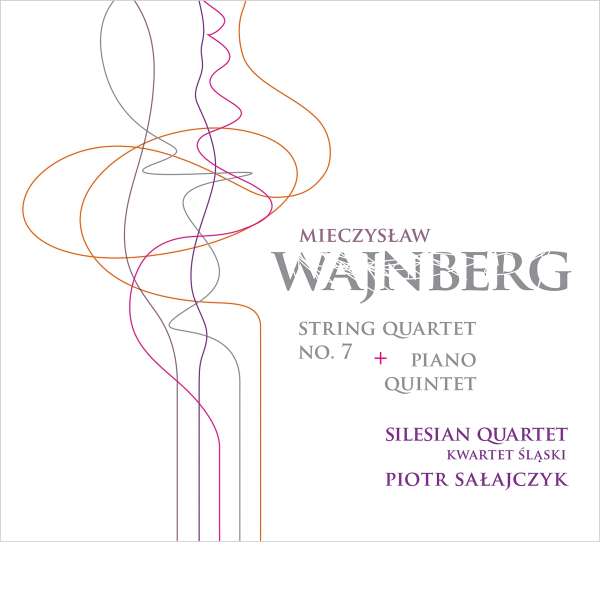
The Silesian Quartet, Wajnberg, String Quartet 7 + Piano Quintet (Accord)

This disc is the first in a new cycle of Weinberg's String Quartets, performed by the excellent Silesian Quartet. If this CD is anything to go by, it will be a superb cycle. They are joined by pianist Piotr Sałajczyk for Weinberg's Piano Quintet.

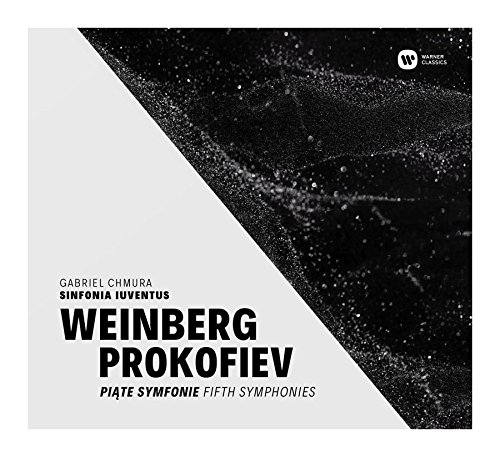
Gabriel Chmura, Sinfonia Iuventus, Weinberg Fifth Symphony (Warner Classics)


The Polish Simfonia Iuventus, conducted by Gabriel Chmura, opt to combine Weinberg's Fifth Symphony with Prokofiev's Fifth in their first disc on the Warner Classics Label. This is sure to be an interesting combination, and I certainly look forward to this release.

Grigory Kalinovsky and Tatiana Goncharova, Weinberg Complete Sonatas for Violin and Piano (Naxos)
Naxos continue their steady stream of Weinberg releases with this excellent set of Weinberg's sonatas for violin and piano - a welcome addition to the extensive range of options for this repertoire. 

Publications
In terms of academic work on Weinberg, several upcoming releases are in preparation, though the majority are expected for the 2019 centenary. Several academic theses on Weinberg's music have been completed recently, including Anna Voskoboynikova on the piano works, and A.S. Conway on his Flute music.

As for myself, as well as regularly teaching at Royal Holloway, I am currently beginning work on a large-scale project that will result in a monograph on Weinberg in his Polish context(s). More details to follow soon.

As always, if readers wish to promote any new recordings, concerts, or any new research, please don't hesitate to get in contact.

All best,

D.E.

Wednesday, 26 October 2016

Vinni Pukh

Weinberg wrote a considerably large amount of film music; indeed, he was one of the most prolific film composers in Russia, and this success allowed him the freedom to avoid the teaching or editing jobs that hampered the composition efforts of other composers. 

Alongside his more than 40 film scores, Weinberg also wrote for children's animated films. His greatest success by far was for a series that is a household name in Russia, but virtually unknown to Western audiences. Most Russians of a certain-age will be able to at least hum you the some of the music from this film, but very few would be able to tell you the composer. The films continue to be loved to this day, and a 2013 DVD re-release sold out within days.


This is Vinni Pukh, a famed Russian adaptation of A.A. Milne’s loved Winnie-the-Pooh stories, directed by Fyodor Khitruk, based on the translations by Boris Zakhoder. While Westerners may be familiar with E.H. Shepard’s charming illustrations for the original books (and the subsequent soporific Disney adaptations from the 1960s onwards), the Russian version has taken on a life of its own, with huge success.

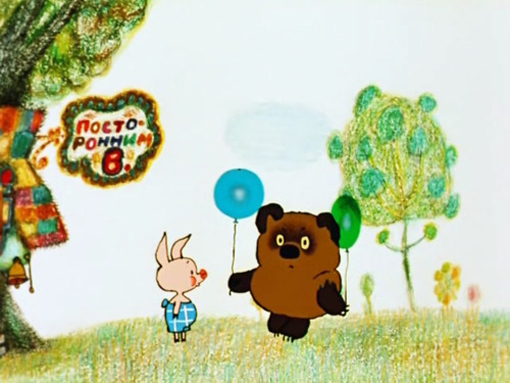
Newcomers might be disconcerted by Vinni Pukh, based on their previous assumptions about the ‘Pooh’ characters. For one thing, Khitruk’s Vinni is much more bear-like than any other representation, with a large black band around his eyes, long claws (on paws that don’t actually attach to his body when he skips along), and a rather small, squat shape. In addition, his facial expressions vary widely, ranging from child-like awe, philosophical pondering, through to mild existential angst (of sorts). Some of the other characters also appear, including Piglet, Rabbit, and Eeyore, but no Tigger, Kanga, or Roo; notably, there is no Christopher Robin, quite a large departure from Milne’s stories.

Instead, Khitruk opted for a child-like setting of only the animal characters, setting the same stories as Milne’s books, but questioning events in a rather ‘deep’ manner throughout. In short, Khitruk’s Vinni Pukh is radically different to the comparatively bland Disney version.

The series started with three films, starting with Vinni Pukh (1969), and followed by two sequels, Vinni Pukh pays a visit (1971), and Vinni Pukh and a busy day (1972). Weinberg provided music for all three, but it was the in the first that he had the most success.

Fortunately for non-Russian speakers, the series has been uploaded onto Youtube with English subtitles (though some of varying quality in their translation).

The first installment can be seen here:


Khitruk’s animation style was something of a breakthrough for Soviet cartoons. Before this point, the vast majority of Soviet children’s animations had been copying the visual style of Disney’s films, especially that of Snow White and the Seven Dwarfs (1937).

Khitruk’s child-like style of bold shapes and broken-up forms (such as Vinni Pukh’s paws that don’t actually attach to his body) proved both heartwarming and instantly recognisable to children.

Weinberg’s music complements this approach. The opening titles are accompanied by a meandering nursery-rhyme-style tune played on Harpsichord, still something of a novelty instrument in the Soviet Union at this point (Weinberg had used the instrument in a soloist role in his Seventh Symphony, in 1964).

This is followed by opening narration, and shortly afterwards we are introduced to Vinni Pukh himself, as he sings to himself strolling through the woods. The manner in which he actually does this is rather boisterous, described by one reviewer for the Independent as ‘[striding] around the forest like he is marching on Berlin’. He sings a song with lots of ‘Tramp-pa-pam-pa’ and ‘ruump-pa-puump-pa’ nonsense lyrics, which Weinberg sets to a charming melody. Vinni was voiced by Yevgeny Leonov, the famed Soviet comedian. Leonov had a rather deep bass voice, so the recording engineers sped it up by 30%, giving Vinni Pukh his distinctively surreal voice.


Yevgeny Leonov, voice of Vinni Pukh
Weinberg’s song is arguably one of the most famous in Russia, and it appeared in one guise or another in all of the subsequent Vinni Pukh films. While the song has something of a ‘sprechgesang’ quality about its notation, it is arguably Leonov’s inspired delivery that really makes the song successful.

The remainder of the film, and its two sequels, features inspired background music supplied by Weinberg, as well as one or two other songs, but it is the opening credit music and Vinni’s theme that is the most easily recognisable and the most instantly loveable (in my experience as a public speaker, it is Vinni Pukh that I play to Western audiences to help them warm to Weinberg’s music).

The three Vinni Pukh films went on to win the USSR State Prize in 1976 (included as part of a group of seven films).  

The two other films can be viewed here (with subsequent 'parts' leading off from these videos):


A playful comparison of Khirtuk vs. Disney can be found here: via buzzfeed


Further links/bibliography:

Marissa Fessenden for the Smithsonian

Phil Reeves for the Independent

David MacFayden, Yellow Crocodiles and Blues Oranges: Russian Animated Film since World War II (Ontario: McGill-Queen's University Press, 2005).

Laura Ponteiri, Soviet Animation, and the Thaw of the 1960s: not only for children (New Barnet: John Libbey, 2012).