For many years, Boris Schwarz's magisterial Music and Musical Life in Soviet Russia was the authoritative text on Soviet music. It was a considerable achievement of scholarly work, touching on a huge range of authors, subjects, and pieces.
Schwarz was born in St Petersburg, but his family emigrated to Berlin in his youth. Schwarz emigrated to the US in 1936. Starting from the 1950s, he made several extended trips back to Russia to conduct musicological research. The result is his mammoth book. It was greatly celebrated, including an award from the American Society of Composers, Authors, and Publishers' in 1973.
Perhaps the most impressive detail is how comprehensive Schwarz managed to be; he includes details on just about every Soviet composer you could think of.
For many decades, Schwarz's paragraphs on Weinberg were the sole extent of public knowledge of his life and music (including its many inaccuracies!) Thankfully, this has long since not been the case. That said, I reproduce below the page or so that Schwarz included on Weinberg. It is something of a curio to consider that for decades, this was the most known about Weinberg and his music:
Another composer who deserves wider attention abroad is Moissei Vainberg [sic]. Born in 1919 in Warsaw, he received his musical education in Poland. When his country was overrun by the Germans in 1941, Vainberg sought refuge in the Soviet Union and eventually settled in Moscow. He is one of the few Soviet composers of Jewish origin who has achieved genuine equality among his colleages: he is extremely well liked and receives many commissions and performances. In contrast to the older generation of Jewish-Russian composers who stressed their Jewishness (among them Engel, Achron, Krein, Veprik, Gnessin), the younger generation does not limit itself ethnically. Composers like Lev Knipper, Yulian Krein, Boris Kliusner, and Vainberg have acquired a Russian or international musical idiom. In Vainberg's music, there is neither avoidance of, nor stress on, Jewishness; some of his works contain elements of Jewish folklore, while others employ a musical idiom related to Shostakovich and Bartók.
After the 1948 decree, Vainberg enjoyed the doubtful privilege of being praise by Khrennikov for his 're-orientation' - enough to ruin anyone's career - when he reviewed the accomplishments of the year 1948:
'A shining proof of the fruitfulness of the realistic path is the Sinfonietta by Vainberg. As a composers, Vainberg was strongly influenced by modernist music which badly mangled his undoubted talent. Turning to the sources of Jewish folk music, Vainberg created a bright, optimistic work dedicated to the theme of the shining, free working life of the Jewish people in the land of Socialism. In this work Vainberg has shown uncommon mastery and a wealth of creative imagination'.
Among Vainberg's best works is his Second Sinfonietta, composed in 1958 for Rudolf Barshai and the Moscow Chamber Orchestra. In addition, Vainberg has written eight smyphonies, eleven string quartets, some twenty sonatas for various instruments, several concertos, and various chamber music works with piano, including an impressive piano quintet. Whether his style is strong and personal enough to win acceptance abroad is still untested since hardly any of his music has been heard in the West'.
Boris Schwarz, Music and Musical Life in Soviet Russia: Enlarged Edition, 1917-1981 (Bloomington, Indiana: Indiana University Press, 1983) 294-295.
That Shostakovich and Weinberg were good friends is well-known. They compared their works-in-progress together, and met regularly, as well as socialising almost every day. What is less well-known, however, is the extent to which Shostakovich supported Weinberg during his most dire time of need. The following is from an article by Nataliya Vovsi-Mikhoels, Weinberg's first wife, on his relationship with Shostakovich, and the events of 1953:
Although Weinberg was not a pupil of Shostakovich's, Dmitri Dmitriyevich always showed great interest in his work. From the very beginning of their acquaintance, they established a law whereby each played his compositions for the other. I remember one day Weinberg telling me of a dream he had had in which Shostakovich invited him to listen to a new work where he heard themes from many of his previous compositions. As he was telling me this story, the telephone rang; it was Shostakovich, who indeed was inviting him to come and listen to a work he had just completed. It turned out to be the Eighth Quartet, which Dmitri Dmitriyevich considered to be his musical autobiography. Weinberg returned home shaken to the very core by the music, and by his prophetic dream.
In February 1953, Weinberg was arrested. Stalin was still alive. To be arrested in those times meant departure for ever. The families of those arrested were ostracized. I rushed between the Moscow prisons, the Lyubyanka and the Butyrka, and didn't know whom to approach.
A few days after his arrest, a great friend of ours range me and suggested we meet. While we paced the dark and narrow Moscow lanes, he told me that Shostakovich was writing a letter to Beriya and needed me to come and help him edit it. It was sheer lunacy to go to Shostakovich in my situation! But I went and read the letter in which he, Shostakovich, vouched that Weinberg was an honest citizen and a most talented young composers, whose chief interest in life was music. I understood how dangerous it was for Shostakovich to vouch for an enemy of the people, a Jew, and furthermore, Mikhoels' son-in-law... I expressed these emotions as best as I could to Dmitri Dmitriyevich, but he, shy of being thanked, just continued to repeat, 'Don't worry, don't worry, they won't do anything to me'.
Apart from this letter, his wife Nina Vasilyevna suggested that I should write a statement, giving her power of attorney, thereby allowing her to take our things and sell them to support my seven-year-old daughter Vitosha [Victoria], when they came to get me and my sister... In fact, as it transpired later, she had decided that they would look after Vitosha.
But all this was not be. On 5 March Stalin died. A month later, my father was rehabilitated in the press. Soon after this Shostakovich and his wife went to the south on holiday, making me promise to send a telegram as soon as Weinberg was released.
And shortly we were able to send them this telegram: 'Enjoy your holiday. We embrace you, Tala and Metek'. Two days later the Shostakoviches were back in Moscow. That evening we celebrated. At the table, festively decked out with candles in antique candlesticks, Nina Vasileyna read out the power of attorney that I had written. Then Dmitri Dmitriyevich got up and solemnly pronounced, 'Now I should burn it over the candles'. After the destruction of the 'document', we drank vodka and sat down to supper. I rarely saw Dmitri Dmitriyevich as clam, and even merry, as he was that evening.
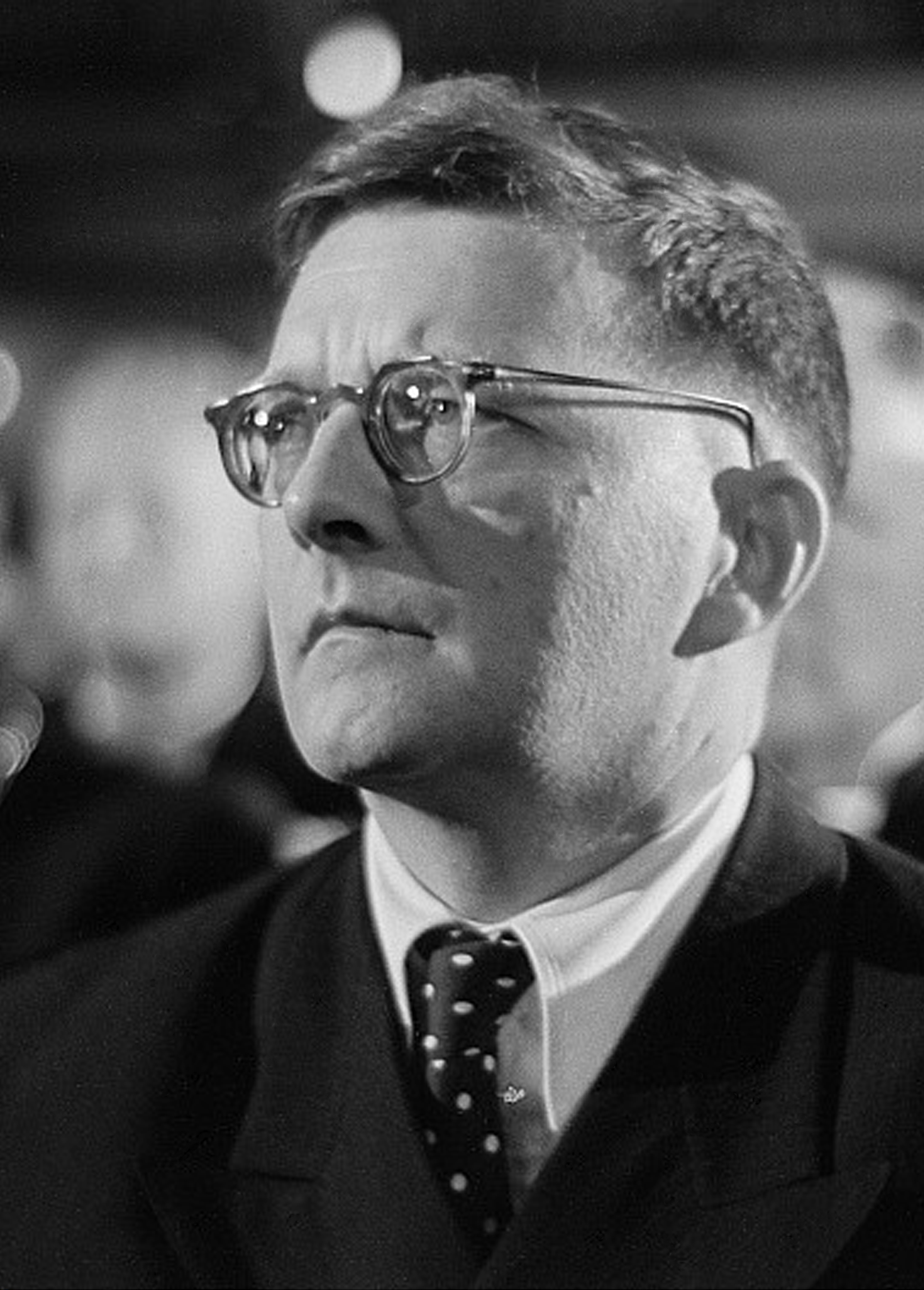
Quoted from Elizabeth Wilson (ed), Shostakovich: A Life Remembered (London: Faber and faber, 2006) 263-264. Shostakovich photograph from wikipedia commons.
In my report from my trip to Warsaw, I included a photograph of Weinberg's childhood home, 66 Żelazna street (on the corner of Krochmalna). Since then, I have researched more of the history of the building, how it came to be still standing, and I also found several more photographs from various sources.
History
The tenement house was built in 1911, designed by one Henryk Spigelmann. Elements of an original 'art-nouveau' style can be seen in some of the tilework detail in the entranceway (shown in photos below). Before the war, the street was full of similar buildings. The street itself is in the 'Wola' district, the heart of the old Jewish district of the city. Szmuel Weinberg and his wife, Sarra, moved here some time before the First World War (some accounts claim 1914).
During the Second World War, the building became part of the Warsaw Ghetto. It was only a few metres away from the infamous 'bridge crossing' of the ghetto, which linked the large and small sections of the ghetto with a walkway over the busy Chłodna street. The buildings in this district were filled with the city's Jewish population from late 1939-1943. The Ghetto uprising ended with the burning of almost the entire district, block-by-block. Considering the violence that occurred in the larger Warsaw Uprising and the following destruction of almost the entirety of Warsaw by retreating Nazi forces, it is near-miraculous that the building survives at all.
Author Leopold Tyrmand described the building in his 1955 novel Zly:
He stopped at the corner of Żelazna and Krochamalna, he looked around, then looked up. The shabby wall of the house was strewn with iron balconies; it was wide and high here (...) In the door, behind the glass, hung a glass plaque, in blue letters: "Warsaw e Gastronomic Establishments - 'Słodycz' Bar - IV.
During his 1966 return trip to Poland as a foreign visitor to the Warsaw Autumn Festival (one of only two visits outside the USSR), Weinberg returned to his childhood home, shown in this photo:
Writing in 2002, Weinberg's friend composer Grigori Frid describes this picture:
In front of me is a black and white amateur photo. An old stone house with peeling paint in some places. The door is closed. In the dark aperture, stair steps are visible. It is visibly autumn: in the foreground - a stunted tree with sparse leaves. Before the entrance there is Metek in an unbuttoned raincoat, without a tie, looking slightly to the side. Next to him is an unknown man in a dark suit. On the back of the photo with is handwritten the inscription in Polish: 'Warszawa, Zelazna ul. 66', and in parentheses in Russian: 'the house where I was born'.
Weinberg's experience during his 1966 visit was an upsetting one, in that it brought the realisation that extremely little of the city that he grew up in had actually survived the war.
In the present day, the building lies dilapidated, though listed in the city's list of monuments. It is marked 'unsafe', though there were apparently plans to modernise and convert the flats, with an intial proposed deadline of 2013.
The fate of this building remains unclear. Were it to be converted, however, I would suggest that it would be appropriate to install some kind of plaque to Weinberg's memory.
Here's several more photos from the building, inside and outside.
Weinberg wrote a considerably large amount of
film music; indeed, he was one of the most prolific film composers in Russia,
and this success allowed him the freedom to avoid the teaching or editing jobs
that hampered the composition efforts of other composers.
Alongside
his more than 40 film scores, Weinberg also wrote for children's animated
films. His greatest success by far was for a series that is a household name in
Russia, but virtually unknown to Western audiences. Most Russians of a
certain-age will be able to at least hum you the some of the music from this film,
but very few would be able to tell you the composer. The films continue to be loved
to this day, and a 2013 DVD re-release sold out within days.
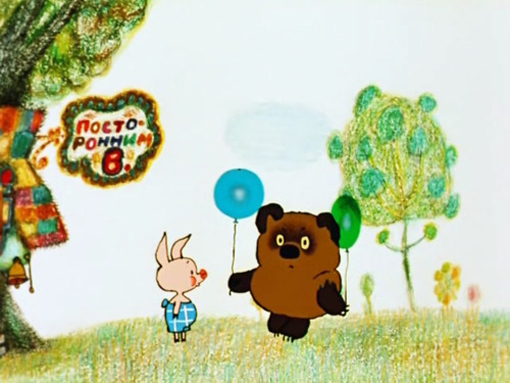
This is Vinni Pukh, a famed Russian
adaptation of A.A. Milne’s loved Winnie-the-Pooh stories, directed by
Fyodor Khitruk, based on the translations by Boris Zakhoder. While Westerners
may be familiar with E.H. Shepard’s charming illustrations for the original
books (and the subsequent soporific Disney adaptations from the 1960s onwards),
the Russian version has taken on a life of its own, with huge success.
Newcomers might be disconcerted by Vinni Pukh,
based on their previous assumptions about the ‘Pooh’ characters. For one thing,
Khitruk’s Vinni is much more bear-like than any other representation, with a
large black band around his eyes, long claws (on paws that don’t actually
attach to his body when he skips along), and a rather small, squat shape. In addition, his facial
expressions vary widely, ranging from child-like awe, philosophical pondering,
through to mild existential angst (of sorts). Some of the other characters also appear,
including Piglet, Rabbit, and Eeyore, but no Tigger, Kanga, or Roo; notably, there is no Christopher Robin,
quite a large departure from Milne’s stories.
Instead, Khitruk opted for a child-like setting
of only the animal characters, setting the same stories as Milne’s books, but
questioning events in a rather ‘deep’ manner throughout. In short, Khitruk’s Vinni
Pukh is radically different to the comparatively bland Disney version.
The series started with three films, starting
with Vinni Pukh (1969), and followed by two sequels, Vinni Pukh pays
a visit (1971), and Vinni Pukh and a busy day (1972). Weinberg
provided music for all three, but it was the in the first that he had the most
success.
Fortunately for non-Russian speakers, the series
has been uploaded onto Youtube with English subtitles (though some of varying
quality in their translation).
The first installment can be seen here:
Khitruk’s animation style was something of a
breakthrough for Soviet cartoons. Before this point, the vast majority of
Soviet children’s animations had been copying the visual style of Disney’s
films, especially that of Snow White and the Seven Dwarfs (1937).
Khitruk’s child-like style of bold shapes and
broken-up forms (such as Vinni Pukh’s paws that don’t actually attach to his
body) proved both heartwarming and instantly recognisable to children.
Weinberg’s music complements this approach. The
opening titles are accompanied by a meandering nursery-rhyme-style tune played
on Harpsichord, still something of a novelty instrument in the Soviet Union at
this point (Weinberg had used the instrument in a soloist role in his Seventh
Symphony, in 1964).
This is followed by opening narration, and
shortly afterwards we are introduced to Vinni Pukh himself, as he sings to
himself strolling through the woods. The manner in which he actually does this
is rather boisterous, described by one reviewer for the Independent as ‘[striding]
around the forest like he is marching on Berlin’. He sings a song with lots of ‘Tramp-pa-pam-pa’
and ‘ruump-pa-puump-pa’ nonsense lyrics, which Weinberg sets to a charming
melody. Vinni was voiced by Yevgeny Leonov, the famed Soviet comedian. Leonov
had a rather deep bass voice, so the recording engineers sped it up by 30%,
giving Vinni Pukh his distinctively surreal voice.
Yevgeny Leonov, voice of Vinni Pukh
Weinberg’s song is arguably one of the most
famous in Russia, and it appeared in one guise or another in all of the
subsequent Vinni Pukh films. While the song has something of a ‘sprechgesang’
quality about its notation, it is arguably Leonov’s inspired delivery that really
makes the song successful.
The remainder of the film, and its two sequels,
features inspired background music supplied by Weinberg, as well as one or two
other songs, but it is the opening credit music and Vinni’s theme that is the
most easily recognisable and the most instantly loveable (in my experience as a
public speaker, it is Vinni Pukh that I play to Western audiences to
help them warm to Weinberg’s music).
The three Vinni Pukh films went on to win
the USSR State Prize in 1976 (included as part of a group of seven films).
The two other films can be viewed here (with subsequent 'parts' leading off from these videos):
A playful comparison of Khirtuk vs. Disney can
be found here: via buzzfeed
The following biographies are taken from the six-volume book 'Leksikon fun Yidishn Teater', edited by Zalmen Zylbercweig, published between 1931 and 1969. There is an online project to translate the whole work into English, which can be found at the following website. The biographies make for fascinating reading, though they should be read with the following warning. Zylbercweig's book is well-known for its inaccuracies, reflecting the difficult circumstances with which it was written. The Yivo Encyclopedia page on Zylbercweig has the following caveat about the book:
Zylbercweig’s encyclopedia, a monument to his extraordinary dedication,
reflects both his scholarly limitations and the difficult conditions of
his work. The volumes have been insufficiently edited and contain errors
and imprecise data. Even more problematic is the matter of sources.
Although he provides bibliographies of varying degrees of accuracy at
the end of each article, much of Zylbercweig’s information is based on
his subjects’ personal communications, often about their own careers.
The longer articles typically consist of lengthy citations from
insufficiently identified sources that can be traced, if at all, only
with great effort. However, the Leksikon is also a vast source of social and cultural documentation.
Michael C. Steinlauf, writting for the Yivo Encyclopedia of Jews in Eastern Europe - link.
Bearing that in mind, I here reproduce both biographies in their English translation, with a few of my own notes afterwards.
Shmuel Weinberg (1882-1943) was born in Chișinău, Moldova. He taught himself to play violin from the age of 7, and joined a touring theatre group in 1899, serving as violinist, conductor, and chorus master. The group toured round Eastern Europe, including an extended residency in Vilna. In 1914, Shmuel took up an invitation to join a troupe in Lodz, and two years later joined the Warsaw Jewish Theater. With this company, Shmuel conducted the orchestra for plays, evenings of music hall songs, and comedy revues. Shmuel wrote the music for several of the theatre's productions.
The Orchestra was of a good standard and focused mainly on incidental music, song accompaniments, and settings of Yiddish folk songs.
Here's the programme note that I provided for the Quatuor Danel's concert at the Manchester Grammar School, 27/02/15:
Mieczysław
Weinberg (1919-1996)
Quartet No. 16, Op. 130
I. Allegro
II. Allegro
III. Lento
IV. Moderato
The
last time Weinberg saw his younger sister, Ester, she was limping into the
distance, heading back to their parents’ house. In September 1939, the two
siblings had fled from the Nazi invasion of Warsaw, heading east towards the
USSR. Ester soon turned back because her shoes hurt her feet. Weinberg
continued alone, and went on to reach the safety of the USSR. His parents and
sister were later murdered in the holocaust.
When Weinberg came to write his
Sixteenth Quartet in 1981, he dedicated it to the memory of his sister, who
would have turned sixty that year. It features a marked return to his Jewish
heritage, as well as a new renewed interest in Bartók. The first movement opens
with a striking passage for first violin and the lower voices give a
chorale-like accompaniment that recurs throughout. The viola gives the second
theme, with emphasised minor inflections. A process of thematic ‘darkening’
threatens to disintegrate the development section, an agitated feeling that
lingers into the recapitulation. Even towards the movement’s close, ‘darkened’
versions of both themes provide a fractured sense of unease.
A contorted scherzo and trio is
presented in the second movement, with a character reminiscent of Bartók’s late
quartets. The scherzo consists almost entirely of Weinberg’s signature musical
motif, alternating fourths, with staggered entries evoking a clockwork
mechanism. Towards the scherzo’s close, a contrasting lyrical theme with
Lombard rhythms is given in the first violin. The trio section that follows is
comparatively restrained and nostalgic. A ghost-like quality is sustained by an
unusually wispy articulation - sul tasto,
senza vibrato. The scherzo repeat interrupts this moment of tranquility,
reintroducing the clock-like ticking from the movement’s opening.
Weinberg’s mastery for solo string
writing is deployed to full effect in the third movement. The first violin
opens with a mournful singing line. The cello enters in a fugato-like texture,
before the remaining two parts join also. A brief climax is reached before the
procedure is repeated, with the first violin and cello starting once more. The
viola and second violin enter in a similar manner, though with no climactic
trajectory the second time round. A sombre sense of moral outrage is suggested during
the movement, only to ebb away towards its close.
The finale provides an uneven conclusion
and brings Jewish thematic elements to the centre of attention. It opens with a
sprightly waltz, together with an ‘Oom-pah-pah’ accompaniment. The waltz theme
reaches a screaming climax, before the cello harks back to the second
movement’s Lombard rhythm. The waltz and Lombard themes are juxtaposed
together, before the music subsides to leave just the first violin – harking
back to the beginning of the piece. A series of slow alternating chords brings
the work to a gentle yet uneasy close.
Daniel
Elphick
The performance was a great success - the programme included Mendelssohn's Sixth Quartet (also dedicated to the memory of his sister) - and Schubert's Death and the Maiden - a rather nifty bit of programming!
A new article has been released and the kind people at culture.pl have brought it to my attention. Authored by the brilliant Prof. Danuta Gwizdalanka, the article features new documentary evidence that brings several aspects of Weinberg's biography into question.
Gwizdalanka will be well-known to Shostakovich fans - she has authored several books on his life and music. She is also married to the composer Krzysztof Meyer, who has himself written widely on Shostakovich. Both of them have also written on Weinberg's music - Meyer has spoken often about his respect for Weinberg, while Gwizdalanka is the author of the Polish-language book Mieczysław Wajnberg: kompozytor z trzech światów [Mieczysław Wajnberg: Composer of three worlds]. Her book is an excellent introduction to Weinberg's biography and it documents several new discoveries on Gwizdalanka's part - new evidence that is included in this culture.pl article.
Her book also catalogues the various discrepancies between spellings of his name - see my article here on the same topic. To summarise, the 'Wajnberg' option appears to be becoming more and more compelling the deeper I dig.
Weinberg's birth certificate and conservatoire application - courtesy UMFC archives, posted on culture.pl.
In addition to this spelling, Gwizdalanka also found evidence that throws Weinberg's date of birth into question - his application to join the Warsaw conservatoire, which lists his birthday as 17 January 1919 - instead of the more familiar 8 December 1919. She also found the copy of Weinberg's birth certificate that he requested in the the 1980s (the building that housed the original was destroyed during the war).
All of this is certainly extremely interesting (though I am perhaps tempted to conclude that Weinberg lied about his age in order to join the Warsaw conservatoire - especially since he celebrated his birthday on the 8 December date throughout his life).
Whatever you think of these documents, and the 'Wajnberg' spelling (I find myself increasingly tempted), Gwizdalanka's article certainly provides great food for thought.
The story of Weinberg's music since his death in 1996 has often started with one key issue: how to spell his name. This might seem obvious, but in Weinberg's case, it is wrought with problems. There are several options, each with their own line of reasoning:
Weinberg
Wajnberg
Vainberg
Vajnberg
Wainberg
This might not seem like much of an issue, but when it comes to things like searching archives or record labelling, the significance becomes apparent. As you might have noticed, I stick to the 'Weinberg' spelling, but even I am beginning to have my doubts about this option.
Of course, David Fanning's monograph on the composer uses the 'Weinberg' spelling, as does the Osteuropa 2010 issue, and the majority of western CD releases.
In this article, I'll quote several authors on their reasoning behind their choice of spelling, before providing some further examples. The final choice, I believe, rests with the reader.
It gives me great pleasure to announce the publication of my first academic article, 'Weinberg, Shostakovich, and the influence of Anxiety'. It appears in the Winter issue of The Musical Times, alongside several esteemed authors from Musicology, including Barry Cooper, Arnold Whittall, and Leo Black. Details for ordering copies can be found on the Musical Times website - here.
The article explores instances of mutual influence in the string quartets of Weinberg and of Shostakovich. While Shostakovich's influence on Weinberg is apparent on first listen, the reverse process is more subtle - and is particularly apparent in some of Shostakovich's earlier quartets. After several examples, the case of Weinberg and Shostakovich is explored in the context of theories of influence itself - especially Harold Bloom's The Anxiety of Influence. I conclude that Weinberg and Shostakovich's relationship of mutual influence is a rather unique one in the history of music.
This publication is the first extended article on Weinberg to appear in an English-language, non-specialised journal. As such, I hope that it can provide an impetus for many further discussions of Weinberg's music in academic print.
Weinberg's music was widely performed during his lifetime, largely inside in the Soviet Union. Even more of it was published - below are some scans from three scores in my possession, all dating from the Soviet era. I'm particularly keen to hear from anyone who owns any other Soviet Weinberg scores.
First Symphony, Op. 10, (Moscow: Soviet Kompozitor, 1972)
I recently read about a Russian-language film, entitled 'Скрипка Ротшильда'-'Rothschild's Violin'. Released in 1996, the Edgardo Cozarinsky film is based around Shostakovich's completion of Fleischman's opera 'Rothschild's Violin'. Since the opera itself last only 40 minutes, the filmmaker pads the rest of the film with biography of Shostakovich and Fleischman, how Fleischman was a Jewish pupil of Shostakovich's, who died in combat in WWII. Shostakovich completed the opera, which was subsequently disapproved of by official authorities.
In this clip, from the epilogue at the end of the film, the year is 1948. Shostakovich has received his warning from the authorities, who are now following him around Moscow. He meets Weinberg, and they join a food queue in order to discuss their latest affairs without the government agents listening in.
Here are a few photographs of Weinberg, all of them found from various sources online. I have reproduced any information included with the photos - but many of them are a mystery. I welcome any input from readers.
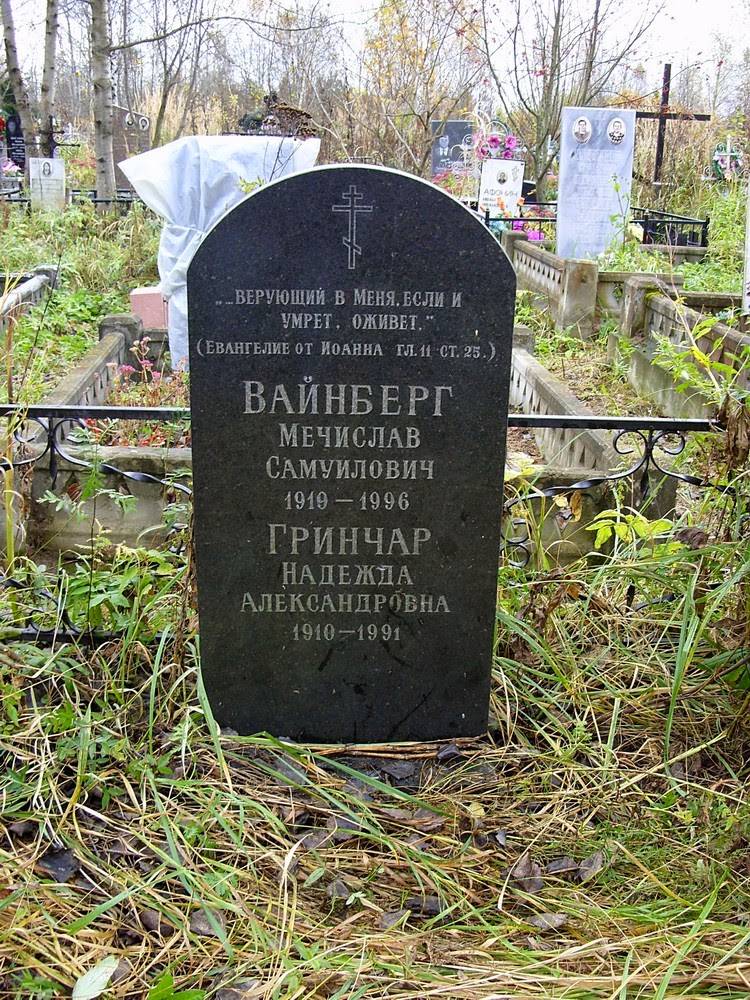
The Grave of Mieczysław Weinberg, with Nadezhda Grinchar (Weinberg's Mother-in-Law), 49, Domodedovo Cemetery.
In a quiet cemetery outside of Moscow lies Weinberg's final resting place in a Russian Orthodox grave, in accordance with his final wishes. The plot is also the resting place of Nadezhda Grinchar, mother of Olga Rakhalskaya, Weinberg's second wife.
The inscription quotes the Gospel of St. John, Chapter 11, Verse 25:
'He that believeth in me, though he were dead, yet shall he live'.
A lot of my writing on Weinberg's opera The Passenger has focused on critical reception, including my blog-article here and my colloquium article 'Weinberg and The Passenger', to be found on my academia.edu page here. Over the years that I have spent researching Weinberg's life and music, I have paid particular attention to the reception of The Passenger, being arguably his best, and (potentially) most controversial work. The Russian premiere in 2006 heralded Weinberg as 'a new direction for Russian opera', while David Pountney's Bregenz production in 2010 drew rave reviews across the board (the London reception, however, was noticeably mixed). Eyebrows were raised at the question of 'appropriateness' of the material, while others were quick to react to some author's labelling of the work as a 'masterpiece'.
The American premiere in Houston in January of this year attracted a similar mix of reactions, though predominantly more positive. Thursday 10th July sees the New York premiere, at Park Avenue Armory. Before the opera has even opened, it appears to have divided critics, both freelance and online commentators. Some of this writing begins with an outright angry tone before moving to vitriol, and I couldn't avoid throwing my two cents into the debate (hence my choice of title, 'Wading in...').
The initial reactions appear to be based upon Park Avenue Armory's publicity for the opera, in particular, the loaded phrase 'Holocaust opera' (a phrase itself lifted from out of John Allison's 2011 review for the Daily Telegraph, link). The Park Avenue Armory landing page for the production grandly sells the 'landmark work' link, while their assistant artistic director Mena Mark Hanna produced an enthusiastic programme note, released on Huffington Post: (full link here)
'Mieczysław Weinberg's The Passenger... stands apart in its bold attempt to reenact the savagery of World War
II on the musical stage. The Polish composer and his Russian librettist,
Alexander Medvedev, produced an opera that not only seeks to write
poetry after Auschwitz, but also attempts to confront the grotesque
terror head-on. This opera is unlike any other work.'
Against this background of enthusiastic plugging for an upcoming production, I stumbled across the following article by Allan M. Jalon, writing for Tablet magazine, with the headline 'Lincoln Center presents an opera without Jews, set in Auschwitz' (full link). Jalon takes issue with the 'Holocaust opera' phrase used in various parts of the production's promotion materials to launch a thorough attack against the opera and its creators. Jalon's argument is set out in the opening paragraph:
'Beyond a few lines given to a Jewish character,
there’s no explicit Jewish presence in this concentration camp. Seeing
the work, it’s hard to believe: An opera set in the killing factory
known for subtracting Jews from the world, and it subtracts Jews.'
Jalon, of course, is right to point this out. And, for Western audiences unfamiliar with the conditions of Soviet life, this must come as a shock. All credit to Jalon, he has thoroughly researched the work, and is right to point out the near-minimal representation of the Jewish people in The Passenger. Jalon raises the wide-reaching questions, ones that The Passenger cannot answer on its own:
'Can art that excises the full picture of the
Nazis’ main group of victims be respected as a work of responsible
witness? Are there no limits to art’s freedom to navigate a subjective
path through its subject, when that subject is documented history?'
I strongly advise my readers to read Jalon's article in its entirety, for it presents a consistently adverse reaction to the opera, however well-researched it may be. Where I take strong issue is on two points: among Jalon's research, he interviewed Zofia Posmysz, author of the original book of The Passenger. Posmysz is now 91. Jalon's issue with the lack of Jewish representation of the novel is unleashed upon her during this interview:
Both the interviewer for OSTEUROPA and I asked Posmysz about the general absence of Jews in the various versions of her Aufseherin
Franz-Marta-Tadeusz story. “In your story, Jews just aren’t there,” the
German interviewer says pointedly. He or she—I couldn’t find a
byline—notes the scene with the Jewish baby in the barracks but presses
about why “both protagonists in the camp are stereotypical Poles:
Tadeusz and Marta.”
The characters in the novel, she added in the German interview, were
based on “the people whom I was closest to in the camp. I was very
closely bound to Marta and Tadeusz. That was my experience... Auschwitz was a horrible experience for mankind. I don’t deny that the
Jews were treated the worst, but many other people were sent to the gas
chambers. Think of the Romani.”
In Posmysz’s email to me, she stresses that “the only thing I have
the right to speak of” was the women’s camp, adding: “From the
perspective of a prisoner, Auschwitz was limited to the barracks, the
work brigade, to a cell in a bunker. People lived in small groups, going
back and forth between barracks was unsafe.” Writing her novel, she
says, she “presented the environment I knew best.”
Following this cornering by interview, Jalon goes on to mention Prof. Fanning's work on Weinberg's biography, detailing Weinberg's religious beliefs (or lack thereof) which, when combined with his attack on the non-Jewish perspective of The Passenger amounts to a crude attack on Weinberg himself:
'Fanning talks at length about the amount of music Weinberg wrote with Jewish content: symphonies and vocal work. After The Passenger,
he made an opera based on “Mazel Tov,” a comic tale by Sholem Aleichem.
It finally premiered in 1983. He apparently gave no indication of a
commitment to Judaism as a faith, engaged as he was with Jewish culture.
Meanwhile, he converted to the Russian Orthodox faith of his second
wife shortly before he died, at 76, in 1996, though Fanning says his
reason for his conversion remains unclear.'
Jalon's biting article prompted me to wade into the murky territory of online commenting on the article. I reproduce my response here in full:
I worry that your article is a 'simple response' to Weinberg's opera. The Passenger's success lies in its subtlety. The opera does not need
to overstate the almost exclusively Jewish-targeted nature of the
Holocaust; that is a fact of history. As a work of stage-drama, literal
depiction of atrocities is at best inappropriate, and at worst,
offensive. Your article appears to be demanding that The Passenger
would only be successful if it focused on explicitly depicting
Jewish-directed Nazi cruelty, rather than the more subtle multicultural
representation seen in the opera.
It is true that The Passenger does
not portray an exclusively Jewish experience; there are many
circumstances around its creation that influenced this fact. As you
rightly pointed out, Posmysz's background as a Catholic informed the
viewpoint that she imparted in her book
(could she have done anything but that, a narrative on her own
experiences?). Your rather subtle attack on Weinberg's absence of
practicing faith risks becoming a personal swipe on the composer
himself, rather than the opera. Weinberg's situation in the Soviet Union
strongly influenced any chance of portraying a Jewish experience. Many
of his works do reflect his Jewish heritage, but they only do so
explicitly into the late 1970s and after. Before then, Weinberg made
occasional use of Jewish melodies and some Jewish texts (texts which
were often altered afterwards, increasing the chances of publication in
the antisemitic Soviet state).
Weinberg had experienced Soviet
antisemitism first-hand, having been arrested in 1953, and having had
his Father-in-Law (Solomon Mikhoels) murdered by Stalin in 1948.
Weinberg had witnessed other composers, such as Alexander Weprik, being
arrested on charges of Jewish nationalism and being imprisoned for years
- Weinberg was lucky to have gotten away with only a few months
imprisonment. The chances of being sent to the Gulag in the late 1960s
when Weinberg was writing The Passenger were still relatively high. It
is understandable that he downplayed an exclusively Jewish identity -
if not to avoid suspicion, but also to increase the chances of it being
performed.
The multi-cultural viewpoint expressed through the opera
represents the multi-national team that produced it. Weinberg alone held
strong associations with Jewish, Polish and Russian identities. The
fact Weinberg had lost his close family to the Holocaust is a rather
crucial point of his biography, contributing to the emotional power of The Passenger - a fact that you only casually mention until the end of
your article. It stands to reason that if Weinberg had portrayed a
strongly Jewish viewpoint in the opera, he would have been effectively
portraying the deaths of his family on stage. By avoiding this, and
opting for a more subtle multinational perspective is, in my opinion, no
flaw whatsoever.
Of course, Jalon's thoughts were based on well-documented research, and his article is commendable on this point. However, monitoring the subsequent comments, other reader's thoughts on Jalon's article and The Passenger proved shocking. I shall quote these online comments below (though I will not credit their authors).
'...taking jews out of the production is just a big lie. The many Holocaust
deniers in the world will use this as proof that Jews were not special
victims of Nazi germany [sic].'
A rather amazing assumption, that Holocaust deniers would rely on a fictional work to get their 'proof'. While Holocaust denial is obviously an extremely serious issue, some of the rhetoric around the debate has lurched into fear of the denial itself in an effort to limit antisemitism in those territories at the frontline of an ongoing battle (in a very real sense). This stance echoes the Met's recent decision on John Adams' The Death of Klinghoffer
(where a broadcast was abandoned, on the grounds that the opera, while
judged not to be antisemitic, could 'encourage' antisemitism elsewhere -
see link here). In the 'Comments' box at the end of Jalon's article, one member of the public wrote:
'The opera is a lie and should be protested and boycotted. it attempts to
supplant the tragedy of european Jews and make believe that it was
chiefly gentiles that were the victims. this is a lie.'
Another gave the same thoughts in a slightly more eloquent summing up:
'Making the opera multinational would not have been a flaw - others
suffered at the hands of the Nazis as well - but limiting the portrayal
of the Jewish experience to one character is a huge flaw. Perhaps
Mieczyslaw Weinberg was comfortable with this portrayal at the time and
in the place in which he lived but to describe this as a Holocaust
opera definitely seems to be a misrepresentation. Removing or
minimizing the uniquely Jewish experience of the Holocaust is just one
form of Holocaust denial.'
These are by far the most extreme reactions to The Passenger so far; accusations of antisemitism and even Holocaust denial. I anticipate that my responses to such reactions will stimulate lively debate.
----------------------
For any readers interested, I shall be speaking at the conference 'Continuities and Ruptures: Artistic Responses to Jewish Migration, Internment and Exile in the Long Twentieth Century', on Tuesday 8 July, with a paper titled 'Commemorating the Past: Weinberg's experience as a Jewish migrant in the USSR' (Conference programme link). The full conference will be streamed for the general public to watch online (I shall provide a link soon), and hopefully to be watched back again the future. My talk will be at 9:30am (British time). I hope that several of the opinions that I have outlined above will start a stimulating discussion.
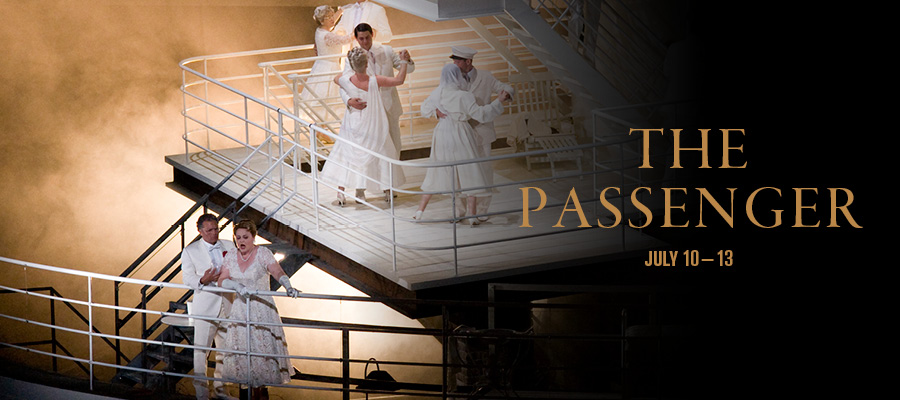
'The Passenger', in David Pountney's production at the Bregenz festival, 2010.