I'm still reeling from the incredible 'Mieczysław Weinberg: East meets West' conference at my Alma mater, the University of Manchester. The conference was organised by the ever-wonderful David Fanning and Michelle Assay, who pulled everything together with their indefatigable efforts. I promise a full write-up 'report' of the proceedings, but for now, here's a selection of photos from the four days (my own, and from other delegates and audience-members).
Full programme of the Quatuor Danel concerts.
Yours truly, leading a workshop-seminar with the Quatuor Danel on my reconstruction of Weinberg's First Quartet (photo credit: Richard Pleak)
An incredible 'surprise guest' at the conference: Gidon Kremer (photo credit: Richard Pleak)
Kremer performed and then gave a talk (before flying out straight afterwards!) (photo credit: Richard Pleak)
The academic conference included a Skype Q&A session with Victoria Bishops, Weinberg's first daughter.
Roberto Carrillo-Garcia gave a phenomenal performance of Weinberg's Sonata for Double-Bass in one of the afternoon concerts (photo credit: Richard Pleak)
The conference delegates were a friendly group, seen here in a large dinner in between sessions.
The incredible Quatuor Danel (photo credit: Richard Pleak)
A wonderful group photo with the Danels, audience members and conference delegates, who all went together on the amazing journey through Weinberg's complete quartets (photo credit: The Symphonist, twitter handle: @deeplyclassical).
On which day of the year should we be celebrating Weinberg's centenary in 2019?
That might seem like a straight-forward question, but the answer is complex. The date that Weinberg and his family celebrated his birthday was 8 December, and this is the date on most of the surviving documents relating to the composer.
His date of birth can be brought into question, however, since his original birth certificate was lost during the destruction of Warsaw in the Second World War. He went to great lengths to receive a replacement in the 1980s, which also officially corrected his name to 'Mieczysław' (it had been changed to 'Moisey' by a border guard in 1939, but that's a separate story). This later document also gives the date of birth as '8 December 1919'.
Recent research has thrown doubt on this, however. Prof. Danuta Gwizdalanka, respected Polish musicologist and biographer of Weinberg, went through the archives of the Warsaw Conservatoire, where Weinberg was a student in the years 1931-1939.
Located there, Gwizdalanka found two documents that bring Weinberg's date of birth into question: his conservatoire application, and a birth certificate, seemingly copied from the original. Both documents list his date of birth as '12 January 1919', a sizeable difference from the acknowledged date (both also use the original Polish spelling for his surname, 'Wajnberg').
Images taken from culture.pl website.
The birth certificate states: 'This birth certificate has been transcribed into the Jewish Faith Metrical Books at the 7th police station of Warsaw on the 17th of January 1919 under no. 28'. The duplicate document was issued in May 1936. The application for entry to the Conservatoire is dated November 1931.
Weinberg's second daughter has confirmed several times that Weinberg celebrated his birthday on 8 December. He was given a Polish medal for services to culture on his 75th birthday, and a small ceremony took place on 8 December 1994. What's more, the later Moscow birth certificate, dated 1981, also gives the 8 December date.
So why the discrepancy?
Aside from these two documents, all other evidence points to the 8 December date. The 12 January version can perhaps be explained when we examine the date that the application was submitted to the conservatoire. In November 1931, Weinberg would have been eleven years old, according to his acknowledged date of birth. The minimum age of entrants to the Warsaw Conservatoire was, however, twelve. The 12 January date conveniently raises Weinberg's age to be sufficient for entry.
If this is the case, Weinberg would hardly be unique in this respect (there are several other composers who misled about their age to gain conservatoire entry). The 1936 duplicate of the birth certificate is more difficult to account for, though it may have been a consequence of new laws on work permits for Jews in Warsaw 1936, which may have extended to continuing study at the conservatoire.
With that said, there is an outside chance that these two documents could be proof that we ought to be celebrating Weinberg's birth much earlier in the year. Or perhaps the discrepancy lends weight to the idea of celebrating his birth all year long (or, at the very least, between 12 January and 8 December)?
Or, perhaps, today should be the date for 'Happy Birthday, Weinberg'?
2019 marks the centenary of Weinberg's birth, with numerous events, concerts, and recordings set to mark the event. On this blog, I will begin a series of posts to mark the centenary, with 100 throughout the year. Some of these will be short features, such as photos, key works, or re-posts of older articles on this blog. Others will be previously unpublished sources and photos, posted here to promote further research and scholarship on Weinberg and his music.
For now, watch this space. Here's a performance of Weinberg's first opus-numbered work, the Lullaby for piano:
While my activity on this blog has slowed considerably, I can promise that my research activity has not ceased. That is why I am writing this to announce research and work on my next project, a monograph study on Weinberg and his Polish contemporaries, titled 'Parallel Worlds'.
This book will examine how Weinberg left Poland behind and delved into the mid-century Soviet style of composition, while also retaining influences and contacts in post-war Poland. I will continue my analytic focus on String Quartets, though taking in a wider focus of composition.
Research and writing are in early days yet, but I have made a start on initial progress, with my first research visit in Katowice in a few weeks. I will post updates on this page, including a 'diary' of sorts of my research visits.
As a preview, here's the first abstract for the book:
Mieczysław Weinberg fled his native Warsaw in September 1939, leaving
behind a burgeoning career as a composer and pianist. He eventually reached the
Soviet Union, where he made a name for himself, eventually becoming one of the
USSR’s most celebrated composers, with a prolific output including twenty-two
symphonies and seventeen string quartets. He worked alongside Shostakovich, and
his works were performed by Rostropovich, Rozhdestvensky, Oistrakh, and the
Borodin Quartet. Throughout his career, however, he was mindful of the nation
that he had left behind, with constant references to Poland in his works. He
only revisited Poland once in his adult life, for the 1966 Warsaw Autumn
festival. Despite this apparent lack of contact, he frequently wrote works to
Polish texts and with Polish themes. He also maintained correspondence with
several Polish composers, including Krzysztof Penderecki and Krzysztof Meyer.
As the Weinberg revival
has thrown his works into an international spotlight, this book takes the
occasion of his centenary to examine how his works written in Russia compare
with his Polish colleagues; how one composer split off from his national
tradition and created a style that embraced the music of a new homeland, while
those composers in his native land surged ahead in a more experimental vein.
More often than not, the points of contact between them are enlightening for
both sides. This study provides an overview of Weinberg’s music through his
String Quartets, analysing them alongside a host of Polish composers (many of
them featured for the first time in an English-language publication). Through
these comparisons, Weinberg’s distinct style drawn from parallel worlds is
thrown into a new light.
There is a tight schedule for publication in 2019, Weinberg's centenary year. I'll keep you posted.
Apologies for 'Radio Silence' on this blog over the last few months; I've been busy with work and several other projects. I'm afraid that posts on this blog are likely to be much more infrequent than during my PhD - though I will endeavour to pick up the pace as I move onto my next piece of research (see below).
Here is an update on all things Weinberg related that have happened in recent months, or are upcoming later this year.
News
Preparations are afoot for several exciting events for 2019, Weinberg's centenary. It's early days for planning at the moment, but I can confirm that there are major celebrations planned for Manchester and London over 2019.
Performances of Weinberg's music continue to increase in frequency, especially in the United States, where his chamber music is enjoying special attention.
February's Moscow Conference was a fantastic success, featuring four days of talks and presentations, along with concerts and opera performances. For an excellent write-up of the event, see Michelle Assay's review in DSCH Journal, issue 47.
This year has seen new productions of The Passenger in Moscow, and also a new production of Congratulations ['Mazl' Tov!'] in Heidelberg.
Concerts
Later this year, Weinberg's Violin Concerto will receive several outings from several different touring ensembles. First, there is Gidon Kremer, continuing his passionate support for Weinberg's music. Secondly, there is Linus Roth, who has recently completed his project to record all of Weinberg's violin music. Finally, there is Mirga Gražinytė-Tyla, who will be conducting the work with the Los Angeles Philharmonic.
The Novaya Opera in Moscow have further performances of their hugely successful production of The Passenger - with more information available here. Also, see trailer below.
In October, Weinberg's Second Piano Sonata will be heard in the UK on two consecutive evenings, though by different pianists in different cities. Katya Apekisheva will perform the work on Fri 5 October, as part of the London Piano Festival at Kings Hall, and Murray McLachlan will perform it on Sat 6 October at the Stoller Hall in Manchester (McLachlan, of course, recorded a much-loved cycle of Weinberg's piano sonatas in the late 1990s).
In addition to all this, the Musikverein in Vienna will see a performance of Weinberg's Piano Trio by the Altenberg Trio with Christopher Hinterhuber.
Videos
The Semperoper Dresden supplied this extended preview of their production of The Passenger from earlier this year.
Similarly, the Moscow Novaya Opera supplied this trailer for their superb production of the same opera.
CDs
A number of exciting CDs are upcoming, or have just been released. Here is a selection:
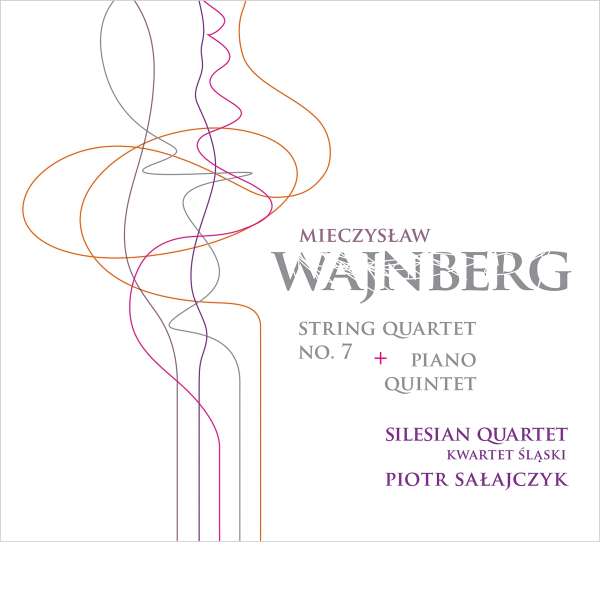
The Silesian Quartet, Wajnberg, String Quartet 7 + Piano Quintet (Accord)
This disc is the first in a new cycle of Weinberg's String Quartets, performed by the excellent Silesian Quartet. If this CD is anything to go by, it will be a superb cycle. They are joined by pianist Piotr Sałajczyk for Weinberg's Piano Quintet.
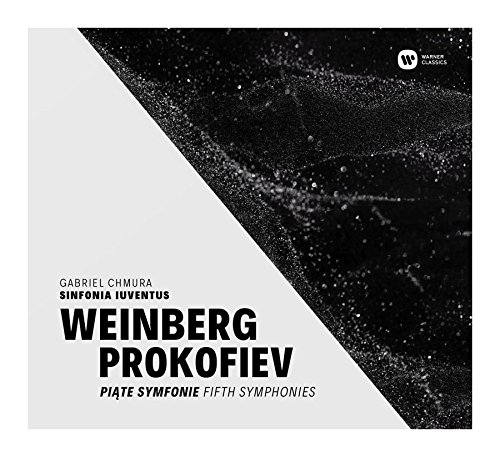
Gabriel Chmura, Sinfonia Iuventus, Weinberg Fifth Symphony (Warner Classics)
The Polish Simfonia Iuventus, conducted by Gabriel Chmura, opt to combine Weinberg's Fifth Symphony with Prokofiev's Fifth in their first disc on the Warner Classics Label. This is sure to be an interesting combination, and I certainly look forward to this release.
Grigory Kalinovsky and Tatiana Goncharova, Weinberg Complete Sonatas for Violin and Piano (Naxos)
Naxos continue their steady stream of Weinberg releases with this excellent set of Weinberg's sonatas for violin and piano - a welcome addition to the extensive range of options for this repertoire.
Publications
In terms of academic work on Weinberg, several upcoming releases are in preparation, though the majority are expected for the 2019 centenary. Several academic theses on Weinberg's music have been completed recently, including Anna Voskoboynikova on the piano works, and A.S. Conway on his Flute music.
As for myself, as well as regularly teaching at Royal Holloway, I am currently beginning work on a large-scale project that will result in a monograph on Weinberg in his Polish context(s). More details to follow soon.
As always, if readers wish to promote any new recordings, concerts, or any new research, please don't hesitate to get in contact.