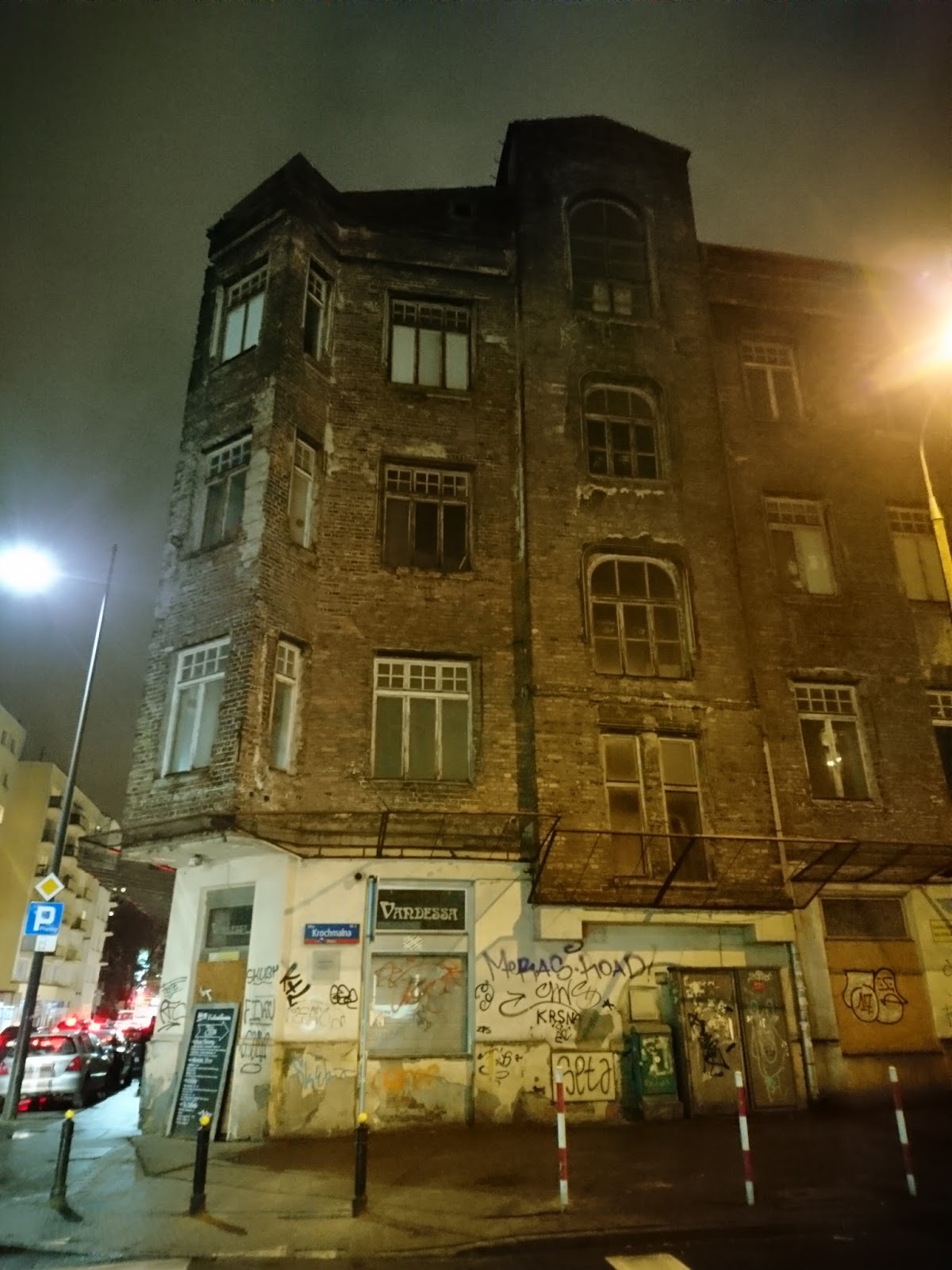
In my report from my trip to Warsaw, I included a photograph of Weinberg's childhood home, 66 Żelazna street (on the corner of Krochmalna). Since then, I have researched more of the history of the building, how it came to be still standing, and I also found several more photographs from various sources.
History
The tenement house was built in 1911, designed by one Henryk Spigelmann. Elements of an original 'art-nouveau' style can be seen in some of the tilework detail in the entranceway (shown in photos below). Before the war, the street was full of similar buildings. The street itself is in the 'Wola' district, the heart of the old Jewish district of the city. Szmuel Weinberg and his wife, Sarra, moved here some time before the First World War (some accounts claim 1914).
During the Second World War, the building became part of the Warsaw Ghetto. It was only a few metres away from the infamous 'bridge crossing' of the ghetto, which linked the large and small sections of the ghetto with a walkway over the busy Chłodna street. The buildings in this district were filled with the city's Jewish population from late 1939-1943. The Ghetto uprising ended with the burning of almost the entire district, block-by-block. Considering the violence that occurred in the larger Warsaw Uprising and the following destruction of almost the entirety of Warsaw by retreating Nazi forces, it is near-miraculous that the building survives at all.
Author Leopold Tyrmand described the building in his 1955 novel
Zly:
He stopped at the corner of Żelazna and Krochamalna, he looked around, then looked up. The shabby wall of the house was strewn with iron balconies; it was wide and high here (...) In the door, behind the glass, hung a glass plaque, in blue letters: "Warsaw e Gastronomic Establishments - 'Słodycz' Bar - IV.
During his 1966 return trip to Poland as a foreign visitor to the Warsaw Autumn Festival (one of only two visits outside the USSR), Weinberg returned to his childhood home, shown in this photo:
Writing in 2002, Weinberg's friend composer Grigori Frid describes this picture:
In front of me is a black and white amateur photo. An old stone house with peeling paint in some places. The door is closed. In the dark aperture, stair steps are visible. It is visibly autumn: in the foreground - a stunted tree with sparse leaves. Before the entrance there is Metek in an unbuttoned raincoat, without a tie, looking slightly to the side. Next to him is an unknown man in a dark suit. On the back of the photo with is handwritten the inscription in Polish: 'Warszawa, Zelazna ul. 66', and in parentheses in Russian: 'the house where I was born'.
Weinberg's experience during his 1966 visit was an upsetting one, in that it brought the realisation that extremely little of the city that he grew up in had actually survived the war.
In the present day, the building lies dilapidated, though listed in the city's list of monuments. It is marked 'unsafe', though there were apparently plans to modernise and convert the flats, with an intial proposed deadline of 2013.
The fate of this building remains unclear. Were it to be converted, however, I would suggest that it would be appropriate to install some kind of plaque to Weinberg's memory.
Here's several more photos from the building, inside and outside.
 |
| Żelazna in 1942. |
Links for photographs:
http://warszawskieunikaty.blox.pl/t/621496/Henryk-Spigelman.html
http://warszawawobiektywie.waw.pl/2008/10/zelazna-66/
https://chlodna20.wordpress.com/2007/01/30/zelazna-66/
http://warszawa.fotopolska.eu/1178367,foto.html
http://fotoblog.marchewka.waw.pl/?p=374
https://www.facebook.com/pg/fotografiawarszawy/photos/?tab=album&album_id=1218540218272568