Showing posts with label Adam Mickiewicz Institute. Show all posts

Friday, 9 February 2018

Warsaw photos

I've just got back from another research trip, this time to Warsaw.

Of course, this is a city with strong links for Weinberg research, in that Weinberg lived the first nineteen years of his life here, before fleeing the Nazi invasion in 1939. See below for a few photos from my trip.

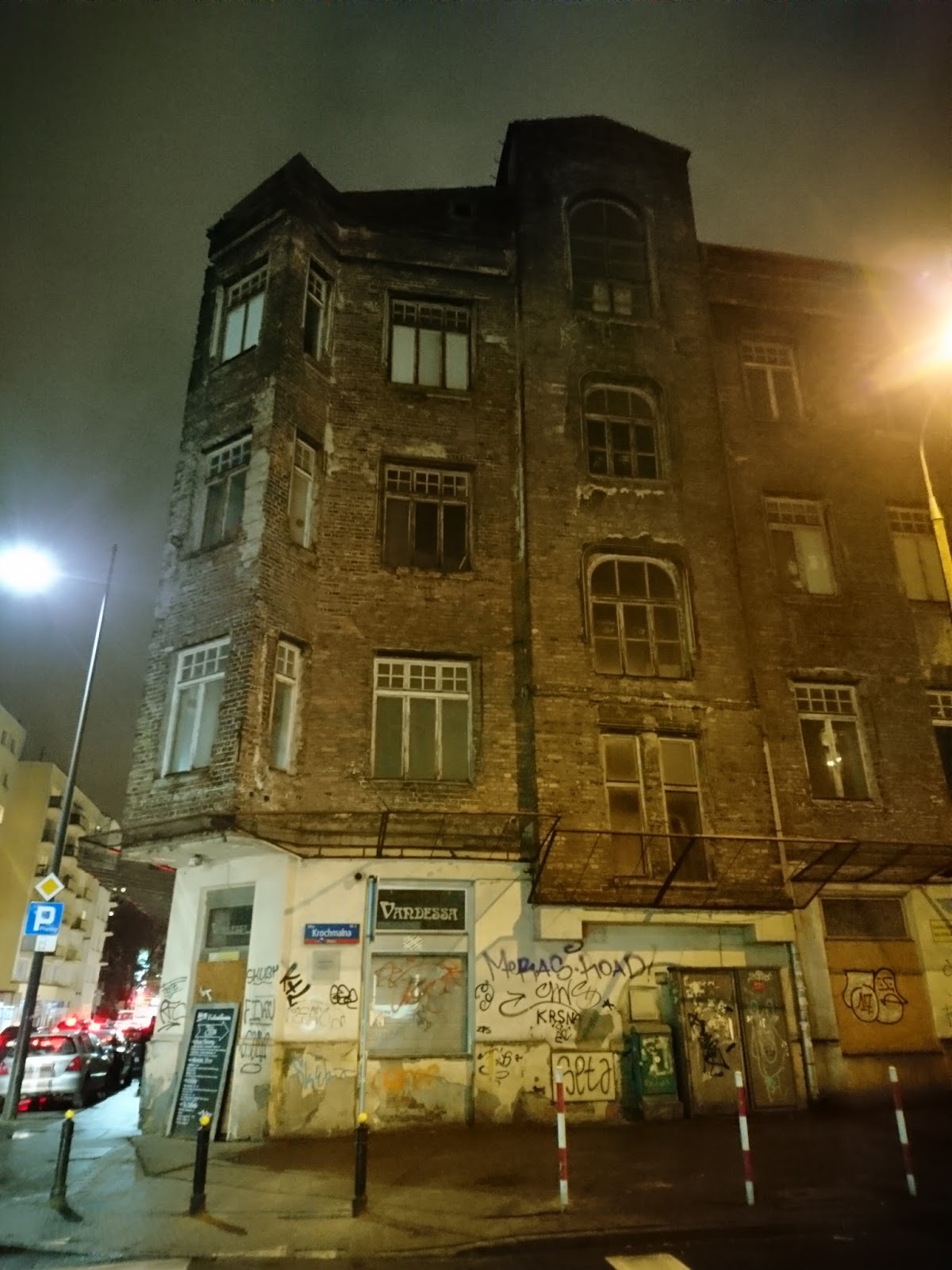
This is 66 Żelazna Street in Warsaw, the building where Weinberg lived 1919-1939. It's near the Wola district, an area that became part of the Warsaw Ghetto during the war. It's remarkable that it's still standing today, seeing as how much of Warsaw was flattened by the end of the war. It's looking in a sorry state, and is marked as an 'unsafe building'. I anticipate that it will be knocked down soon.




The flat where Grażyna Bacewicz lived, 35 Koszykowa Street.


The flat where Karol Szymanowski lived, 47 Nowy Świat (Joseph Conrad actually lived in the same building, several decades earlier).


During my research trip, I was lucky to meet with two composers, Paweł Szymański, and Paweł Mykietyn. Both were extremely kind in agreeing to meet, and generous with their time. Combine this with several library visits, and I have plenty of material to be getting on with for the 'Parallel Worlds' Weinberg book.

Perhaps the most exciting part of my trip was a rare opportunity to visit Lutosławski's home at 39 Śmiała Street. I was very honoured to meet with Marcin Bogusławski (Lutosławski's stepson) and his wife Gabriela Bogusławska. We had a long discussion, with Marcin reminiscing about his stepfather and his working methods. Here are a few photos from the house:

The plaque outside Lutosławski's house. 
Lutosławski's desk (and some of his books). 
The other end of Lutosławski's study. 

All-in-all, an extremely exciting trip. Watch this space for further photos/news.


Sunday, 29 January 2017

Moscow Weinberg Conference, February 2017


In February 2017, the conference 'Mieczysław Weinberg (1919-1996): A Rediscovery' will take place in Moscow, arguably the largest ever event devoted to Weinberg's life and music. The conference will unite performers, theatre directors and stage designers, academics, and figures from Weinberg's life, in an extended programme over two weeks. The core of this revolves around 16-19 February, with four days of papers, talks, and interviews. All of this is hosted in the Bolshoi Theatre, a venue that imparts a high level of prestige to the proceedings. The wider conference programme includes concerts, film screenings, and three stagings of Weinberg operas (including two separate stagings of The Passenger).

The conference is co-presented by the Bolshoi Theatre and the newspaper Muzykalnoe obozrenie.

The operas presented are:


The Idiot - Directed by Evgeny Arye, musical direction by Michał Klauza (in a production receiving its premiere on 13 February).


The Passenger - Directed by Sergey Shirokov, musical direction by Jan Latham-Koenig (a new production that received its premiere on 27 January).


The Passenger - Directed by Thaddeus Strassberger, conducted by Oliver van Dohnányi (presented by the Yekaterinburg State Academic Opera and Ballet Theatre, in a production that premiered in September 2016).


The academic side of the conference brings together over 40 scholars from across the world (the conference languages are Russian and English). The four days of the conference are organised as follows:

16 February
'Staging History of Mieczysław Weinberg's operas - The Idiot in Russia today'

17 Feburary
'The Passenger: Past and Present'

18 February
'The Life and Legacy of Mieczysław Weinberg: Chamber Works'
(followed by an evening concert of Weinberg's chamber music)

19 February
'Mieczysław Weinberg: Identity, Biography, Personality'

Highlights of the panel sessions include:
- the creative team behind the Bolshoi Theatre's production of The Idiot
- A roundtable on The Passenger
- An interview and discussion with Zofia Posmysz, author of the novel, The Passenger, and herself a former Auschwitz prisoner.
- An interview and discussion with David Pountney, celebrated stage director, and main creative force behind the 2010 Bregenz Festival.
-  A roundtable discussion with Weinberg's friends, colleagues, and family. The panel includes Weinberg's widow, Olga Rakhalskaya, and his second daughter, Anna Weinberg, as well as Tommy Persson, who has been a driving force behind much of the Weinberg revival in recent decades.

I am honoured to be speaking on 18 February, as part of a day of talks on Weinberg's Chamber Music. I will be presenting a paper titled '"An Encyclopedia of the Genre": Weinberg's String Quartets', which summarises some of the findings from my doctoral thesis.

For a full listing of the Conference schedule, please see the following link:
Conference programme

Any questions should be directed to the conference email address: weinberg.moscow2017@gmail.com

Watch this space for a full conference report.