Tuesday, 12 November 2013

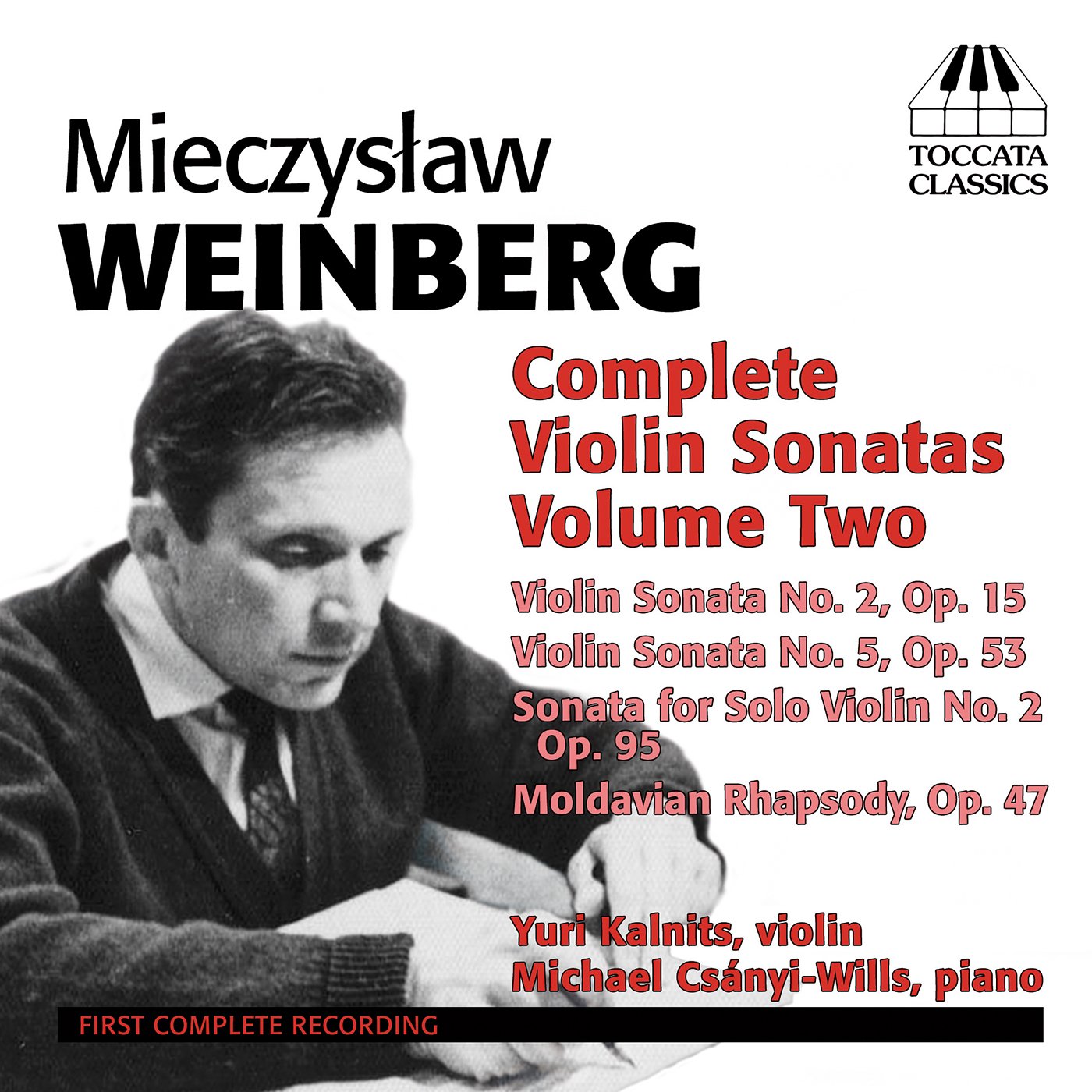
Review: Complete Violin Sonatas, Volume Two (Yuri Kalnits and Michael Csányi-Wills, Toccata Classics)


This new release sees the long-awaited second volume in the Toccata Classics series of Weinberg's Violin Sonatas, with Yuri Kalnits on violin and Michael Csányi-Wills on piano (link to the Toccata website - complete with audio samples - here). On first impressions, the disc is attractively packaged and after several listens, I am more than convinced that this series is the one to opt for when it comes to Weinberg's violin works.


The first volume was released to rave reviews in 2011, and went on to win the prestigious Diapson d'Or award. The showcasing of excellent playing and choice of programming is extended onto this disc. With a third and final volume expected, the real strength of this series lies in its scope; the discs feature not only Weinberg's sonatas for violin and piano, but also the sonatas for solo violin, and several smaller works for good measure. 

This second volume features the second and fifth sonatas for Violin and Piano, the second solo sonata and the Rhapsody on Moldavian Themes for Violin and Piano. This huge variety gives Kalnits great opportunity to demonstrate his virtuosity on his instrument, while Csányi-Wills proves a sensitive and supporting accompanist.

The music

Weinberg wrote some thirty sonatas in total, a mixture of solo and ensemble with piano. Weinberg's writing for the violin was masterful from early on in his career, perhaps since his Father was a violin-player. Over the course of his life, Weinberg was able to work with some of the very best Soviet violinists, including David Oistrakh and Leonid Kogan.

- The first work featured on this disc is the Rhapsody on Moldavian Themes, Op. 47, No. 3. The original version was scored for orchestra, but Weinberg also produced this version. The published score features fingerings by Oistrakh himself. It is one of Weinberg's most appealing works, widely recorded and a favourite encore of Oistrakh.

At just under ten minutes, the work opens with an elegaic piano line. For the hushed opening, Kalnits and Csányi-Wills strike up a perfect balance, creating a hushed anticipation. A folk-inflected song theme emerges, the first of many to be elaborated on through the work. A slow but steady increase in tempo sees the violin soaring up to the heights for the first time on this disc - which Kalnits takes utterly in his stride. Indeed, these passages stand testament to the high recording quality - the balance is nothing below perfect throughout. At 4:15, the frantic and giddy scherzo-like central section of the work begins. The duo do justice to the near-manic mood, powering through to an ecstatic finish.

- Next up is the Second Sonata for Violin and Piano, Op. 15. The connections with Oistrakh continue here: the manuscript bears a dedication to him (almost certainly added years after it was first written) and Oistrakh gave the premiere performance in 1962. The language is similar to the First Sonata, written the previous year, though there are several indicators of an increasing sense of ambition. The piano has several opportunities to shine, such as at 2:30 in the first movement and Csányi-Wills does not neglect them. Following this passage a near-fugato dialogue between the duo begins, with effortless transition - this is clearly an excellent musical pairing. The introspective and searching Lento movement is here performed with energy, giving respite yet never failing to be gripping in interpretation. The lyrical mood is continued, now extended with a slightly more energetic folk-like episode. Fanning's liner notes point to similarities with the Third Quartet, Op. 14, immediately preceding the sonata. These include an ending that appears to lack conviction - Weinberg's full mastery of cyclic forms would be reached in a few years time.

- Compared with his First Sonata for solo violin, the second, Op. 95 is much more approachable. The first takes a caustic attitude, first heard in the Sonata for Two Violins, Op. 69. It takes a structure similar to a suite, to be noted from the movement titles. Kalnits has ample opportunity to showcase his talent as he weaves several lines at once, across several different techniques and textures. The work is dedicated to another great Soviet violinist, Mikhail Fikhtengolts. The seven movements of the work are inter-linked and named as follows:
Monody - Rests - Intervals - Repliques - Accompaniment - Invocation - Syncopations
They can accurately be described as a series of inter-linked studies - though it is much less demanding than Weinberg's first solo sonata - perhaps to the soloist's relief! (Though, of course, that work is tackled with full mastery on the First Volume).

- The final work on the disc is the Fifth Sonata for Violin and Piano, Op. 53, arguably the greatest of Weinberg's sonata works. Its mournful yet optimistic character can be ascribed to the fact that it was the first work Weinberg wrote after his release from prison in 1953. The work is dedicated to Shostakovich, perhaps as a result of his intervention on Weinberg's behalf during his imprisonment. The modal-inflected melody of the opening is portrayed tenderly by Csányi-Wills, as Kalnits soars high above later in the movement. The Allegro molto that follows is more fiendish, with a scurrying piano part that re-emphasises the modal inflection from beforehand. The third movement opens with a distinctive passage of complex violin double-stopping, soon joined by aggressive accents in the piano part. For the finale, Weinberg juxtaposes several tempo changes, beginning with a light and frantic violin line, before a funereal piano line interrupts, with hints of the opening movement, and a nod to Schubert and Debussy. An intense fugue for piano takes centreplace of this movement, similar to the Preludes and Fugues of Shostakovich, Op. 87. A heartfelt coda follows, rounding off this well-balanced work, and providing a moving close to this disc.

Overall, this disc represent a fantastic continuation of the series, with the partnership of Kalnits and Csányi-Wills continuing onto new heights. Comes highly recommended. 

Further Listening

- The obvious choice for further listening would be the first volume in the series, to be found here.


- Of further interest, see the Challenge Classics release of the near-complete works for Violin and Piano, with Linus Roth and José Gallardo (see my review here). While an excellent release, the Toccata series has the upper hand, with a sensitive balance, and the addition of the solo works alongside.


Monday, 11 November 2013

November update

This is a brief post, just to update with some details of my goings-on and some pieces of Weinberg-related news.

Festival Voix Etouffees, Strasbourg


I've just returned from the colloquium 'Festival Voix Etouffees', at the Council of Europe, Strasbourg. I was invited to speak on the topic of Holocaust commemoration in Weinberg's music. I received very encouraging feedback afterwards, and I very much enjoyed the rest of the colloquium. I'm pleased to announce that my paper will be published in the conference proceedings in the new year.

The colloquium featured many excellent papers, as well as several concerts, including music by Hans Gal and Alexandr Mosolov. In particular, I was lucky enough to attend an extremely rare live performance of Mosolov's First Piano Concerto - an utter assault on the ears, which left several members of the audience visibly shaken!


I extend my deepest thanks to the staff of the colloquium and the Council of Europe for making me feel most welcome, especially to Amaury du Closel, director of the Strasbourg Philharmonic, and to Carole Reich, co-ordinator of the Council's anti-discrimination campaign.

The Festival continues with concerts, including several performances of Weinberg's First Flute Concerto, Op. 75. See this interview with Amaury du Closel: Link

New Release

There has been a new release on the Toccata label, 'Weinberg Complete Violin Sonatas, Vol. 2', with Yuri Kalnits on Violin and Michael Csányi-Wills on piano. 


Available to buy from the Toccata website - Link. My review will follow shortly.

The Passenger in Houston, Texas

Weinberg's masterpiece The Passenger will be receiving its American premiere in January 2014, at the hands of the Houston Grand Opera. From their website:

Memory can comfort, torment-even terrify-but it is always with us. As Faulkner wrote, "The past isn't dead. It isn't even past."
The horrors of the Second World War, still raw today, were fresh in 1959 when Auschwitz survivor Zofia Posmysz wrote a play titled The Passenger from Cabin 45 for Polish radio. The play became the basis of the opera by Mieczyslaw Weinberg in 1967.
   En route to a new post with her husband, a German diplomat, Lisa is unnerved by the sight of a woman-another passenger-who eerily resembles Martha, one of the inmates Lisa tormented when she was an SS overseer at Auschwitz. 
   The action of the drama takes us from the stylish gentility of a luxury liner's deck to the squalor of a death camp where cruelty, despair, and unspeakable courage are evident in equal measure. This American premiere will be one of the most important musical events of the year.
The production is a revival of David Pountney's acclaimed staging of the opera, first seen at the Bregenz Festival, 2010. Michelle Breedt will be reprising her excellent performance as Liese, the ex-camp guard. Tickets are still available from the Houston Grand Opera website here.
 

PeerMusic Weinberg scores -  previews available online

It has come to my attention that PeerMusic has been uploading several items from their catalogue for preview online, on the 'issuu' website. PeerMusic's profile, with a full list of all their previews, can be found here. Please see below for a list of Weinberg works available, with links. 

Symphony No. 2, Op. 30 Link
Violin Concertino, Op. 42 Link 
Cello Concerto, Op. 43 Link
Symphony No. 3, Op. 45 Link
Rhapsody on Moldavian Themes, Op. 47, No. 1 Link
Symphony No. 4, Op. 61 Link 
Flute Concerto No. 1, Op. 75 Link
Symphony No. 5, Op. 76 Link  
Chamber Symphony No. 1, Op. 145 Link 
Chamber Symphony No. 2, Op. 147 Link  
Chamber Symphony No. 3, Op. 151 Link 
Symphony No. 21, Op. 152 Link 
Chamber Symphony No. 4, Op. 153 Link  

These scores represent a real treasure for Weinberg enthusiasts, giving a small overview of Weinberg's Orchestral works, from almost his entire career.  


Thursday, 31 October 2013

Review: Amsterdam Sinfonietta and Candida Thompson - Weinberg Concertino, Shostakovich Chamber Symphonies


For their 25th Anniversary, the Amsterdam Sinfonietta have chosen to record an album of Russian music, under the leadership of Artistic Director, Candida Thompson. The SACD disc comes in a handsome package, along with a 'making of' DVD as an extra (which I am yet to watch - I may add a note here if anything interesting arises). Excellent sound comes as a standard with this ensemble, who have previously recorded string orchestra arrangements of Shostakovich's 2nd and 4th Quartets. The Weinberg concertino has been recorded elsewhere, to be found on the Naxos label's 2011 release, with the Bournemouth Symphony Orchestra under Thomas Sanderling, with Sergey Ostrovsky as soloist. This rendition is clearly the stronger option, if only as a document from the ensemble that gave the West-European premiere of the work in 2009.

Weinberg's Concertino, Op. 42

The Concertino for Violin and String Orchestra was written at the beginning of July 1948, while Weinberg was on holiday. This may perhaps explain the pastoral nature of the work. The three movements never stray far from the lyrical vein. The solo part is demanding throughout, particularly in the finale, but the ensemble writing is not particularly taxing. These factors combined would go to suggest the work may have been written as a holiday-relaxation exercise, while the accessibility and tunefulness might suggest an ambition to please official requirements for composers, particularly following the Composers' Union debacle witnessed at the start of the year. The Concertino can be viewed as a sister-work to the full-blown Concerto for Cello and Orchestra, Op. 43, written immediately afterwards. Indeed, the two share a lyrical mood, but the cello concerto is a near-symphonic work, with passages of heightened drama.
   The Concertino appears to have been 'written for the drawer' (i.e. Weinberg never heard it performed during his lifetime). It was certainly performed in Moscow in 1999, with a festival celebrating the 80th anniversary of the composer's birth. PeerMusic published the score in 2007, and it was the Amsterdam Sinfonietta who gave the Western premiere in 2009.

Recording

With this in mind, the handling of the Concertino is excellent. The Amsterdam Sinfonietta have a keen reputation for attention to detail, above all, dynamic control and balance. This is on full display throughout this recording - the pastoral mood of the Weinberg is communicated beautifully. The remaining pieces on the disc follow a recent trend of pairing a Weinberg work with Shostakovich that outdates it by some twenty years or so. In this case, Rudolf Barshai's arrangements of the Eighth and Tenth Quartets. The choice of the latter is perhaps obvious - Shostakovich's Tenth Quartet is dedicated to Weinberg, reflective of their quartet-writing 'competition' during the 1960s. The Eighth quartet is arguably Shostakovich's most famous work, a good for an opener for this disc.
   I myself have never been a great fan of Barshai's arrangements, dubbed 'Chamber Symphonies', even though they were made with Shostakovich's blessing. Perhaps I just enjoy the more intimate instrumentation of the string quartet. However, the renditions on this disc serve to change my mind; at least, for the duration of the album. Their approach to balance brings out many subtle shades in the Eighth Quartet, ones that are just not achievable in the quartet genre.

Overall, I rate this disc excellent, for the craftsmanship on display throughout and the sensitive approach to the music itself. For other recommended listening, I advise the Naxos 2011 rendition of the Concertino for comparison, and Rostropovich in the Weinberg Concerto.


Naxos Link


Saturday, 12 October 2013

1966 photo - Kondrashin


Warsaw 1966 (Left to right: Weinberg, Nina Kondrashina and Kirill Kondrashin).

[N.B. Gregor Tassie's book 'Kondrashin, his Life and Music' dates this photograph to 1962, but Weinberg did not return to Poland until 1966, as part of the Soviet delegation for the Warsaw Autumn Festival of that year.]


Wednesday, 2 October 2013

Why Weinberg?


Now that I find myself beginning the second year of my doctoral studies, I feel it is time to create something of a mission statement for this blog, and for my work in general. I have now been writing solely on Weinberg for the last two years, and been enjoying his music for little over four years. Before then, I was unaware. I draw the reader to an important question, both for new listeners, and for critics of Weinberg's music:

"Why Weinberg?"
I hope to give an introduction and a defence for Weinberg's music. I absolutely welcome any conversation and comments, so do please get in contact with your thoughts. 

My own reasons
As listeners, we are drawn to particular styles. It's only natural for us to enjoy music that is stylistically similar to that which we already enjoy. But when we approach the wide-reaching genre of 'Classical Music' for the first time, this may be daunting. Some of us are lucky enough to be raised in an atmosphere of listening and performing, working through a wide range of repertoire. Others come to listen later in life. Each listener shares one thing in common, however. A belief instilled that there is a pinnacle, a pantheon of greatness that is untouched, sealed and even sacred.
    I don't wish to get bogged down in arguments around the musical 'canon'. My own gut reactions include terms like 'Elitist' and 'Exclusive' – such debates are well-worn in musicology. One thing is certain. Individual composers can and do get left behind. Music that is perhaps mediocre at best is bizarrely preserved, while pieces that were never given the attention they deserve are forgotten.  Great music goes unheard, and great artists are lost forever. Such an issue is fundamental to our ways of thinking about Classical music, and revealing for how to challenge such notions in the future. There are a huge number of people fighting for the causes of a vast number of such 'under-appreciated' composers. And I rooted for Weinberg. Here's why I think you should too.


As a performer, and as a listener, I have a wide range of tastes. Outside of Art music, I heartily enjoy classic rock and English folk music. My favourite composers include Bach, Steve Reich and Stockhausen. My own listening in Art music has trended towards music of the Twentieth Century. No special reason, I just found myself drawn towards the comparatively exciting and daring sounds. As a result, I adore the music of Ives, Berg, Gershwin, Bartók, Stravinsky, Shostakovich, Britten, Prokofiev, Copland, Messiaen, Stockhausen, Cage, Schoenberg, Reich, Lutosławski, Martinů and a host of others. All this in addition to my loves from the pre-Twentieth-Century era. So why was I drawn to Weinberg in particular?

I was attracted by the similarity to several of my favourite composers. Weinberg's music frequently displays its influences in great clarity, making it readily accessible for lovers of Shostakovich and Bartók. There's also plenty to satisfy fans of Prokofiev, Britten and Berg. Even touches of Debussy and Zemlinsky. See my previous writing on works to introduce listeners to the wide world of Weinberg's music: 'Weinberg for beginners' (also contains a brief biography)

Weinberg and Shostakovich.

And this takes us to the first criticism to defend against. Critics have singled out Weinberg's clear influences as a sign of weakness or unoriginality. I have sought to dismiss these claims in several ways. Firstly, Weinberg was writing in the aggressive climate of the USSR Composer's Union, an organisation which imposed certain expectation upon artists. Tasked with producing socially useful art, composers were encouraged to write towards a standard of music exemplified by approved works. So if Weinberg's music is sometimes strikingly similar in sound, this can be excused as a result of the requirement for it to sound as such.
   The case for defence is even greater with the similarity to Shostakovich's music. I have already written about the two composer's great friendship and interest in each other's works. An upcoming paper that I am working on seeks to set out mutual influence between the pair, often originating from Weinberg as opposed to Shostakovich. See my previous post, 'Weinberg and Influence'.

Another query to defend – "Why should I listen to Weinberg?" or "What makes this music so special?". I defend this quite simply: this music is frequently quite beautiful. It represents a continuation of a tradition long-thought to have abruptly stopped with the death of Shostakovich. This can be summed up as an observation of traditional means and forms, while seeking to express present-day anxieties with a great focus on melodic expansiveness. (That might seem overly complicated - just listen to some of the youtube clips in my above posts, and my meaning should become apparent). Instead of some kind of imitation of other great masters, Weinberg's music fights its own corner in a manner that demands attention. His opera 'The Passenger' is a demanding work, attracting audiences from all around the world. See this post on 'The Passenger', with clips.
   His opera 'The Idiot' has been enjoying sell-out audiences since its Western premiere in Mannheim earlier this year. Weinberg's music is undergoing an undeniable renewal, with more and more releases and performances lined up.

In my own work, I hope to have several papers published shortly, and I will continue speaking at conferences, introducing and exalting the music of Weinberg. Over the short time that I have been writing on his music, I have borne witness to a change in opinion. The question that people have been asking has changed. Originally, it started with "Why Weinberg?". I hope that this blog has gone some way to address that. Now, the question has reversed to "Why haven't we heard this before?". With this change of attitude, I feel I do not have to apologise for writing on an obscure composer. Instead, I readily enjoy hearing new reactions to this music. They encourage me that it is music worth fighting for.


Weinberg's Clarinet Sonata, Op. 28.