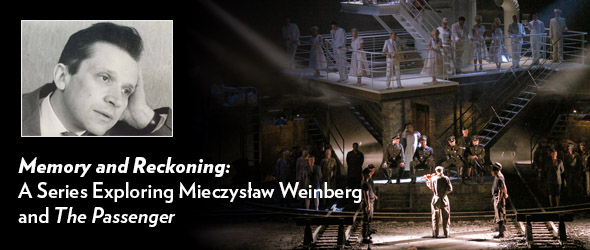
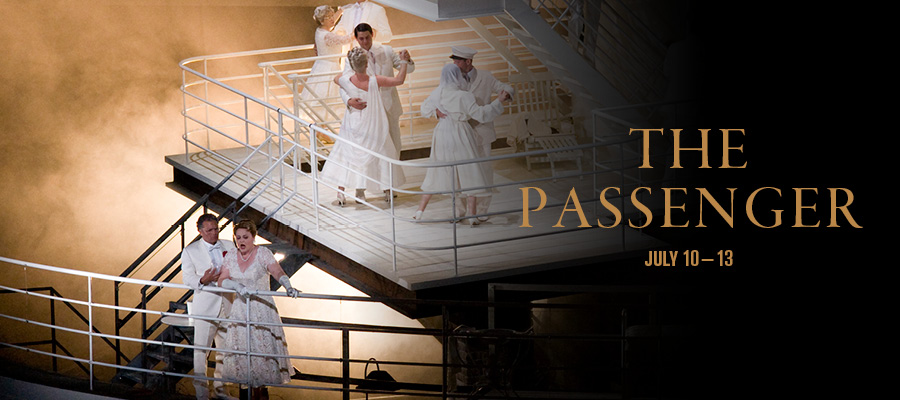
In February 2017, the conference 'Mieczysław Weinberg (1919-1996): A Rediscovery' will take place in Moscow, arguably the largest ever event devoted to Weinberg's life and music. The conference will unite performers, theatre directors and stage designers, academics, and figures from Weinberg's life, in an extended programme over two weeks. The core of this revolves around 16-19 February, with four days of papers, talks, and interviews. All of this is hosted in the Bolshoi Theatre, a venue that imparts a high level of prestige to the proceedings. The wider conference programme includes concerts, film screenings, and three stagings of Weinberg operas (including two separate stagings of The Passenger).
The conference is co-presented by the Bolshoi Theatre and the newspaper Muzykalnoe obozrenie.
The operas presented are:
The Idiot - Directed by Evgeny Arye, musical direction by Michał Klauza (in a production receiving its premiere on 13 February).
The Passenger - Directed by Sergey Shirokov, musical direction by Jan Latham-Koenig (a new production that received its premiere on 27 January).
The Passenger - Directed by Thaddeus Strassberger, conducted by Oliver van Dohnányi (presented by the Yekaterinburg State Academic Opera and Ballet Theatre, in a production that premiered in September 2016).
The academic side of the conference brings together over 40 scholars from across the world (the conference languages are Russian and English). The four days of the conference are organised as follows:
16 February
'Staging History of Mieczysław Weinberg's operas - The Idiot in Russia today'
17 Feburary
'The Passenger: Past and Present'
18 February
'The Life and Legacy of Mieczysław Weinberg: Chamber Works'
(followed by an evening concert of Weinberg's chamber music)
19 February
'Mieczysław Weinberg: Identity, Biography, Personality'
Highlights of the panel sessions include:
- the creative team behind the Bolshoi Theatre's production of The Idiot - A roundtable on The Passenger
- An interview and discussion with Zofia Posmysz, author of the novel, The Passenger, and herself a former Auschwitz prisoner.
- An interview and discussion with David Pountney, celebrated stage director, and main creative force behind the 2010 Bregenz Festival.
- A roundtable discussion with Weinberg's friends, colleagues, and family. The panel includes Weinberg's widow, Olga Rakhalskaya, and his second daughter, Anna Weinberg, as well as Tommy Persson, who has been a driving force behind much of the Weinberg revival in recent decades.
I am honoured to be speaking on 18 February, as part of a day of talks on Weinberg's Chamber Music. I will be presenting a paper titled '"An Encyclopedia of the Genre": Weinberg's String Quartets', which summarises some of the findings from my doctoral thesis.
For a full listing of the Conference schedule, please see the following link: Conference programme
Any questions should be directed to the conference email address: weinberg.moscow2017@gmail.com
Hello folks - apologies for any lack of updates on this page, my thesis work has become extremely busy (see below). Here's some Weinberg-related news for the last few weeks.
Upcoming releases
Toccata Classics - Mieczysław Weinberg, Orchestral Music, Volume Two (Dmitry Vasilyev, Siberian Symphony Orchestra). Available from 4 December.
I'm tremendously looking forward to this release - featuring two premiere recordings, with Weinberg's last symphony, and an earlier symphonic work (recorded here in its premiere performance). The 22nd Symphony itself is fascinating - finished in the final few months of Weinberg's life, when he was bed-ridden with illness. It is dedicated to his wife, Olga Rakhalskaya, who approached the composer Kirill Umansky to orchestrate the work (Weinberg only managed to complete a piano short score, with a few instructions about orchestration). The Six Ballet Scenes paired on this disc is a fascinating work, containing some of the only surviving versions of several whole works that are now considered lost. Considering the success of the previous Toccata release of orchestral works, this CD is keenly anticipated.
Performances
The Detroit premiere of The Passenger has met with rave reviews - for a taste, see this interview with the conductor:
Conductor Steven Mercurio has tackled plenty of tough projects in his career, but Mieczyslaw Weinberg’s opera “The Passenger” posed a uniquely emotional challenge.
An opera about the Holocaust can do that.
Mercurio found that he couldn’t spend more than three hours at a time learning the score.
“Concentrating on life at Auschwitz was very fatiguing,” he says. “It was so disturbing that it weighed heavily on me, so I never worked on it at night because it would keep me up.”
While preparing it, Mercurio also was working on Verdi’s fire-and-brimstone laced “Requiem.”
“It was the only time I considered the ‘Requiem’ light,” Mercurio says. “It was like a sorbet after a heavy meal.”
The above video contains a concert and an excellent talk by Yuval Waldman, on Shostakovich and Weinberg's friendship. The event was organised by the YIVO foundation.
My own work
I am pleased to announce that my latest publication has been released - an article entitled 'Mieczysław Weinberg: Lines that have escaped destruction'.
The article is part of a volume released by the Council of Europe, based in Strasbourg, following an event in November 2013 titled 'Music in Concentration Camps'. The full title is:
Colloque 'Musique et camps de concentration', Amaury du Closel (ed.) (Strasbourg: Conseil de l'Europe, 2015).
It is initially released on a PDF-CD, in a handsome release:
As soon as I receive further information about how to acquire a copy, I'll be sure to post them on this page.
Other than that, my thesis goes well. One more chapter left to tackle - then it'll be on a home-stretch of editing and revising, heading towards the final submission! In an effort to promote more scholarly work on Weinberg, I've uploaded a select bibliography of sources on his life and music - see here. It is my hope that scholars and researchers can share vital texts, and so start a dialogue.
Upcoming releases
The coming months promise a flurry of new and exciting recordings, with several attractive releases on offer.
Perhaps the most exciting of these is an upcoming release of a concert recording of Weinberg's opera The Idiot, based on Dostoevsky's classic novel. The opera was premiered in Germany in 2013 and has proven a surprise runaway success. I say 'surprise' owing to the opera's sheer length - this recording spreads across 3 CDs, and a full performance of the opera runs to just under four hours.
However, with this release, the first commercially available recording of the opera, it is hoped that the work will receive more attention in English-speaking countries: it over-due a performance in the UK or US.
Dear readers - apologies for any lack of input on this blog over recent weeks - my academic work has started to fill almost all of my time (see below!). However, here's a few links to relevant events, releases and general titbits from the world of Weinberg to keep you going.
Releases
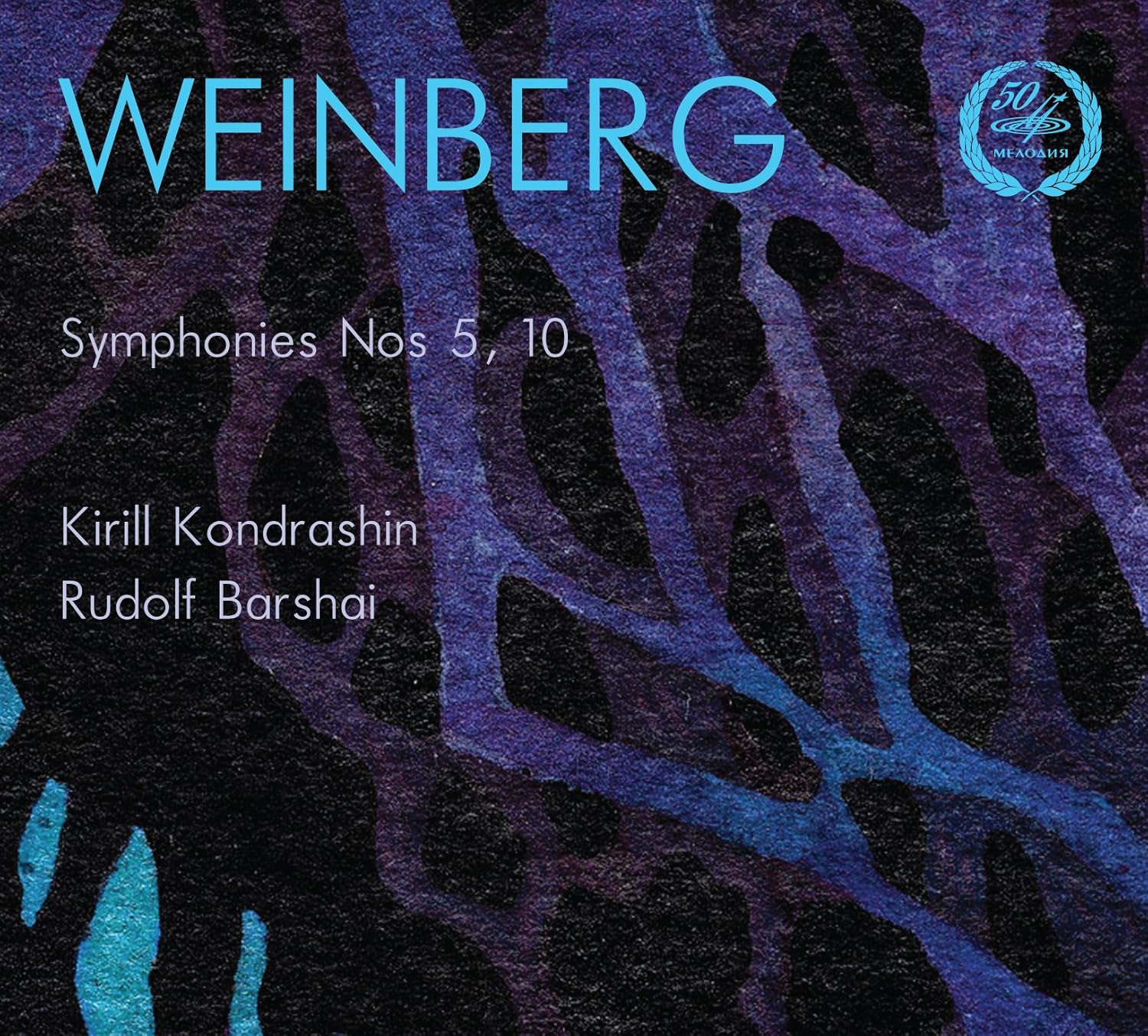
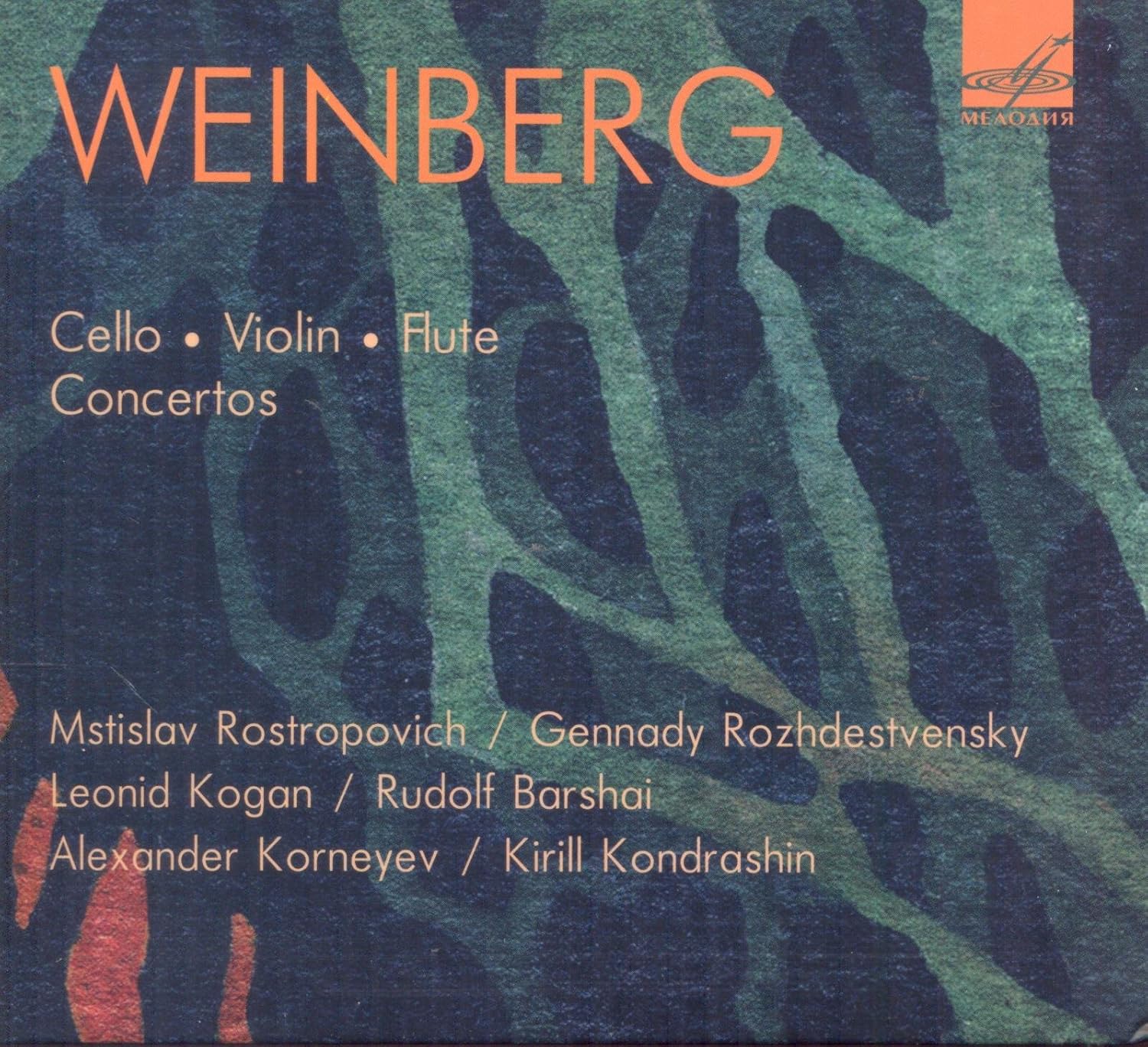
Probably the biggest story in recent Weinberg releases is the Russian label Melodiya opening their archives further, with two new CDs that are well worth investigating:
Melodiya - Weinberg Symphonies 5 & 10
Melodiya - Weinberg Concertos for Cello, Violin, and Flute
Of course, all of this music has previously been released long ago by Melodiya, but such releases have since become collector's items. With these new editions with an affordable price and attractive packaging, there is much to enjoy. The star factor of such artists as Kondrashin, Rostropovich, Kogan, Barshai, and more, is the icing on the cake.
This is just a quick post to link to some relevant news, photos, and an update on my work.
Performances
Perhaps the biggest news story in Weinberg circles is the success of 'The Passenger', with two different productions currently playing around the world at the moment. One is in Frankfurt, which been playing to rave reviews.
The other is at the Lyric Opera in Chicago, and has been receiving enormous amounts of praise. Quotes include:
'...the most amazing opera I have ever seen'.
'What a gift Zofia Posmysz and Mieczyslaw Weinberg have given to the world...'
'An overwhelmingly powerful production and performance'.
- Link to a wonderful storify collection of tweets and posts here.
The last performance in Chicago will be on 15 March - the next US run will be in Florida, 2016. The Passenger's wave of success continues.
Reviews include:
'Weinberg's music is most impressive in the quiet moments... while there are reservations to be had about the opera itself, the Lyric Opera has done itself proud with this show...'
- Lawrence A. Johnson, writing for Chicago Classical review - link.
'Miecyzslaw Weinberg, the most famous, prolific composer you’ve probably never heard of (1919-96), achieves something that in my many years of working with the Spielberg Shoah Project, I never imagined I would encounter: a work that, on the one hand, gets the cruel facts right, and, on the other, uses them to address universal ideas of morality, memory and love.'
- Anon, The Times Weekly - link.
'Nothing in Lyric Opera's searing production of Mieczyslaw Weinberg's The Passenger is more dramatic than the cover of the program, with its strip of three photos of writer Zofia Posmycz, whose novel was the opera's inspiration. '
- Deanna Isaacs, writing for Chicago Reader - link.
(For a much more negative review...)
'The question on my mind as I listened to the second act of Mieczyslaw Weinberg’s opera “The Passenger” at the Lyric Opera Tuesday night was: Am I listening to great musical art? The answer, unfortunately, was “no.”'
- Bill Sweetland, writing for Newcity Stage - here.
An interesting point that I've picked up on - and that I'd love confirmation for from any readers who've attended the Lyric Opera performances - is that Marta appears to be billed as 'Marta/Zofia'. The portrayal of Marta literally as Zofia Posmysz always struck me as a flaw in Pountney's otherwise brilliant production - if they've now been so blatant as to write this in the programme, I'm surprised.
Photographs
Two previously unknown photos of Weinberg:
From a Sovetskaya Muzïka article, published 1960
From a Muzïkalnaya Akademiya article, published 1994
My own work
Progress on my thesis is going well (four chapters down out of six!). In addition, I have two different writing projects on the go at the moment - a report on Weinberg research for the DSCH journal, to be published in July, and a review of several recent Weinberg scores, to be released by Winter 2015.
I've been enjoying my teaching commitments this semester - including the chance to finally lecture on Weinberg's quartets! I've also been writing programme notes for the Quatuor Danel - including for a performance of Weinberg's Sixteenth Quartet, and for an upcoming performance of Tchaikovsky's String Sextet.
I also recently spoke at the Manchester PubHD event - where Doctoral Researchers get to summarise their work to a room of listeners in a pub. See their charming summary of my work below:
Our first speaker was Daniel Elphick, who spoke for ten minutes on Weinberg’s String Quartets.
We got to hear a brief history of Weinberg’s life, the society in which
he grew up, and how the culture of the time reflected his music, and
how his music is in turn culturally relevant. Some of Daniel’s work is
about making Weinberg’s work available to present-day musicians, so that
we can hear his music played again now. Speaking of which, Daniel
played excerpts from the String Quartets during his talk to illustrate
the concepts he was presenting – this really livened things up, and
thanks to the understanding nature of the landlord, we were allowed to
play some more of this music during the interlude before the next
speaker.
See the full report here. My thanks go to the organisers of the event - there are branches of PubHD in Manchester, Nottingham, and Leicester.
The
question on my mind as I listened to the second act of Mieczyslaw
Weinberg’s opera “The Passenger” at the Lyric Opera Tuesday night was:
Am I listening to great musical art?
The answer, unfortunately, was “no.”
- See more at: http://newcitystage.com/2015/02/27/review-the-passengerlyric-opera-of-chicago/#sthash.447cwLv4.dpuf
The
question on my mind as I listened to the second act of Mieczyslaw
Weinberg’s opera “The Passenger” at the Lyric Opera Tuesday night was:
Am I listening to great musical art?
The answer, unfortunately, was “no.”
- See more at: http://newcitystage.com/2015/02/27/review-the-passengerlyric-opera-of-chicago/#sthash.447cwLv4.dpuf
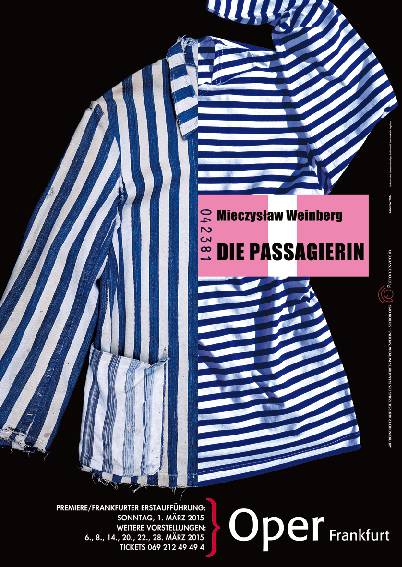
There is an upcoming premiere for a new production of Weinberg's opera The Passenger, by Opera Frankfurt. The first performance will be on 1 March 2015. The production is directed by Anselm Weber and conducted by Leo Hussain.
From PeerMusic's press release:
A new production of the opera The Passenger by Mieczyslaw Weinberg is being premiered at the Opera Frankfurt on 1 March 2015.
Beforehand, a particular event has been arranged with Zofia Posmysz about her story the libretto is based on: The woman who has been the "Passenger" on 28 February 2015. 70 years after the rescue of concentration camp Auschwitz, this moving drama is newly staged as a plea against oblivion. Mieczyslaw Weinberg set in music what is rather beyond expression. "All who listen to a witness are going to be witnesses themselves." Elie Wiesel, Nobel peace laureate.
On the other side of the Atlantic The Passenger reaches after the Houston Grand Opera and the Lincoln Center Festival in New York in 2014, the Lyric Opera of Chicago now with its premiere on 24 February 2015.
David Pountney called his production "my most important cultural act". The director, who has been awarded the Cavalier Cross of the Republic of Poland, premiered the opera at the Bregenz Festival in 2010. Until its arrival in the US "his" passenger traveled over the Wielki Teatr in Warsaw and the English National Opera in London, where it was nominated for the Lawrence Olivier Award in the category of best new opera production.
The Baden National Theatre in Karlsruhe already presented a very successful new production of the opera The Passenger as German first performance in 2013.
We are wishing the Frankfurt staged Passenger a likewise huge success.
Further details for the production, including ticket bookings, can be found here.
Here's a list of upcoming recordings, events, and other Weinberg-related news for December 2014.
Recordings
Chandos - Weinberg Chamber Symphonies No. 3 & 4
Helsingborg Symphony Orchestra, Thord Svedlund
Continuing their long association with Weinberg's music, the Chandos label are bringing out a new disc in collaboration with conductor Thord Svedlund. Like the last few discs in the series, this one will be released on a SACD high-quality disc (which will also play in standard CD players). This is a eagerly-anticipated album, if the previous discs are anything to go by. Coming January 2015 - see this link for further details.
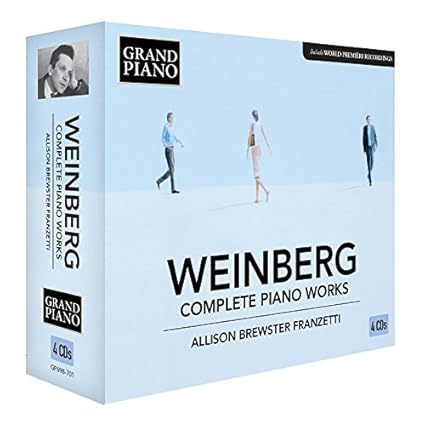
Grand Piano - Weinberg, complete piano works
Allison Brewster Franzetti
Franzetti's four volume series of Weinberg's complete works for solo piano is to be brought together into this attractively packaged set, scheduled to be released in January 2015. The series represents premiere recordings of many of these works, and also provides refreshingly new interpretations on several pieces that have become over-familiar. More details here. (Perhaps a perfect partnering with the Quatuor Danel's boxset of Weinberg's complete String Quartets? A perfect present this festive season! - details here).
Events
Following on from my November post, which included details for the upcoming Chicago Lyric Opera production of Weinberg's The Passenger (see here) - the company has announced details for a festival themed around the opera and Weinberg's music. The series is called 'Memory and Reckoning' and full details can be found here.
Highlights of the series include various talks and discussions on The Passenger and Weinberg's life and music, as well as the premiere of a newly-commissioned opera The Property, by Wlad Marhulets, libretto by Stephanie Fleischmann. Described as a 'klezmer opera', The Property is based on a graphic novel by Rutu Modan, and explores similar themes to those opened by Weinberg in The Passenger. Further details of The Property can be found here.
The series also includes several concerts, of both orchestral and chamber music by Weinberg. Highlights include:
29 January 2015 - Rhapsody on Moldavian Themes, Trumpet Concerto
31 January 2015 - Symphony No. 18
12 February 2015 - Quartet No. 4
15 February 2015 - Piano Quintet
1 March 2015 - String Trio, Trio for flute, viola, and harp
Each of these concerts is listed at generously cheap ticket prices ($4 for a student ticket!?), so any Chicago-based Weinbergians are in for a real treat. And then, of course, there is The Passenger itself, alongside an exhibition at the Lyric Opera on Weinberg and the opera. Plenty to see!
Videos
Symphony No. 18 - Vladimir Lande and the St. Petersburg Symphony Orchestra.
Piano Sonata No. 5, Murray McLachlan
My own work
I have an article due out in the Winter issue of the Musical Times - 'Weinberg, Shostakovich, and the Influence of Anxiety'. This will be the first ever English-language article in a non-specialist publication dedicated to Weinberg's music. I'll be sure to post links and details on here as soon as it is available.
I am also grateful to have been invited to speak at the Royal Musical Association Student Research Conference in Bristol, January 2015, with a paper on psychoanalysis and socialist-realism. The same paper will be previewed in Manchester, on Thursday 11 December, Martin Harris centre, room G16, 16:15. Further details to follow.
Here is a run-down of the latest news in Weinberg-related circles, including concerts, releases, and other paraphernalia.
Upcoming Concerts
First of all, there are two upcoming productions of Weinberg's Opera The Passenger in the United States.
The first is presented by the Lyric Opera of Chicago, taking place February 24 -March 15, 2015. This is a presentation of the David Pountney production, first seen at the Bregenz Festival in 2010. The same production received its US premiere in January of this year, by Houston Grand Opera, before appearing at the Park Avenue Armory as part of the Lincoln Festival in July.
The Lyric Opera of Chicago will be featuring an exhibition on Weinberg's life and The Passenger, including photographs and written description, as well as documenting the development of Pountney's production. They have also uploaded the following video of a seminar and panel discussion on Weinberg's opera:
For further information and ticket details, follow this link to the Lyric Opera's page for The Passenger: link.
The Lincoln Center production of The Passenger in New York has now been and gone. The production courted controversy before opening night - see my article here.
The reviews that have been posted online are a mixed bunch, many finding the work so-so, but the production excellent. This post presents a selection, with summaries and links for further reading.
-----------
Elizabeth Frayer & Shawn E Milnes, 'Schleppy Nabuccos' Blog, online link
Director David Pountney’s staging was terrific...Weinberg’s music is evocative... I greatly enjoyed the varied composition in The
Passenger. (Frayer)
I
found it too long as the action lost me at several points and I found my mind
wandering...the farther away we venture from the initial presented
perspective of Liese’s first person account of her story to her husband, and
the longer we stay away from it, the greater the risk of breaking the audience's
connection to the story. (Milne).
-------------
George Greller, New York Classical Review - link
If anything might refute Theodor Adorno's statement that "to write a poem after Auschwitz is barbaric"[sic], it would be Mieczysław Weinberg's opera The Passenger... Just as one begins to think that Weinberg is a superior craftsman but without first-rate brilliance, the composer produces some breathtaking melodic and structural invention.
------------
Anthony Tommasini, New York Times - link
The strongest quality of The Passenger...
is the
visceral way the work exposes the tension between the present and the
past of its two main characters. The hero of the evening and, truly, of the opera, was Ms. Posmysz, whose
novel was drawn from her own experiences at Auschwitz. Now 90, she
received a prolonged ovation, along with the cast, the production team
and Mr. Summers.
-------------
David Patrick Stearns, Operavore blog, WQXR - link
Mieczyslaw Weinberg's 1968 opera The Passenger is not the great, cathartic Holocaust opera that we've been waiting for. One beautiful voice after another... emerged only periodically amid Weinberg's
unmelodic vocal lines. More curious, the less-than-singable lines often lack dramatic
eloquence, despite the savvy efforts of Michelle Breedt as the Auschwitz
overseer Liese and James Maddalena as the ship's spectral steward. So
instrumentally oriented is the score that its best scene isn't vocal at
all: Defying orders to play a Nazi-favored waltz, a Jewish violinist
force feeds the authorities Bach's famous unaccompanied Chaconne.
--------------
Justin Davidson, Vulture.com - link
The Passenger has been resurrected in the guise of a historical
triumph — a tale that must be told, a score that must be heard. But it
remains troubling, an earnest, frequently beautiful, and fitfully
powerful drama about the relationship between prisoner and guard. Its
many splendid moments aestheticize Auschwitz; its weaker ones fall back
on brutal cliché...Unwilling to write music as ugly as the situation and unable to plumb
the complexities of the two women’s mutual dependency and hate, he falls
back on a series of manipulative setpieces. But the opera’s emotional climax belongs not
to either of the protagonists, but to Katya, a young partisan superbly
sung by Kelly Kaduce, who brings her hardened barracks mates to tears
with a plaintive Russian folk song. This may have been Weinberg’s
attempt to ingratiate himself with Soviet authorities, rather than an
integral part of the story, but it works its magic on New York
audiences, too.
--------------
Paul J. Pelkonen, Superconductor blog - link
Despite the questionable acoustic placement of the musicians, Weinberg's
massive score was eclipsed by the white-hot intensity of the story and
the searing performances of the two female leads... the sweet vocal ensembles are among the opera's best moments, recalling
Weinberg's expertise as a writer of string quartets. These caged angels
were all established as distinct personalities, working together against
their Nazi oppressors and showing great personal courage as they passed
notes, plucked flowers, celebrated Marta's birthday and struggled to
survive. Most of them didn't.
-------------
Martin Bernheimer, Financial Times - link
It is difficult not to be moved by Mieczyslaw Weinberg’s The Passenger... For at least one observer, it promised more than it could deliver... His brashly idealistic creation, which might have benefited from the
intervention of a tough editor, harbours odd ingredients: Straussian
passion, Brittenesque reflection, modernist dissonance and
folksy-jazzy-popsy decoration... The
acoustic limitations of the Armory drill hall required generous
amplification, which made everyone sound heroic beyond the norm. A muted ovation at the end of three long hours of concerted misery suggested relief as much as approbation.
----------
Please feel free to link more reviews/articles in the comments box below - D.E.
Just
as one begins to think that Weinberg is a superior craftsman but
without first-rate brilliance, the composer produces some breathtaking
melodic and structural invention.
A lot of my writing on Weinberg's opera The Passenger has focused on critical reception, including my blog-article here and my colloquium article 'Weinberg and The Passenger', to be found on my academia.edu page here. Over the years that I have spent researching Weinberg's life and music, I have paid particular attention to the reception of The Passenger, being arguably his best, and (potentially) most controversial work. The Russian premiere in 2006 heralded Weinberg as 'a new direction for Russian opera', while David Pountney's Bregenz production in 2010 drew rave reviews across the board (the London reception, however, was noticeably mixed). Eyebrows were raised at the question of 'appropriateness' of the material, while others were quick to react to some author's labelling of the work as a 'masterpiece'.
The American premiere in Houston in January of this year attracted a similar mix of reactions, though predominantly more positive. Thursday 10th July sees the New York premiere, at Park Avenue Armory. Before the opera has even opened, it appears to have divided critics, both freelance and online commentators. Some of this writing begins with an outright angry tone before moving to vitriol, and I couldn't avoid throwing my two cents into the debate (hence my choice of title, 'Wading in...').
The initial reactions appear to be based upon Park Avenue Armory's publicity for the opera, in particular, the loaded phrase 'Holocaust opera' (a phrase itself lifted from out of John Allison's 2011 review for the Daily Telegraph, link). The Park Avenue Armory landing page for the production grandly sells the 'landmark work' link, while their assistant artistic director Mena Mark Hanna produced an enthusiastic programme note, released on Huffington Post: (full link here)
'Mieczysław Weinberg's The Passenger... stands apart in its bold attempt to reenact the savagery of World War
II on the musical stage. The Polish composer and his Russian librettist,
Alexander Medvedev, produced an opera that not only seeks to write
poetry after Auschwitz, but also attempts to confront the grotesque
terror head-on. This opera is unlike any other work.'
Against this background of enthusiastic plugging for an upcoming production, I stumbled across the following article by Allan M. Jalon, writing for Tablet magazine, with the headline 'Lincoln Center presents an opera without Jews, set in Auschwitz' (full link). Jalon takes issue with the 'Holocaust opera' phrase used in various parts of the production's promotion materials to launch a thorough attack against the opera and its creators. Jalon's argument is set out in the opening paragraph:
'Beyond a few lines given to a Jewish character,
there’s no explicit Jewish presence in this concentration camp. Seeing
the work, it’s hard to believe: An opera set in the killing factory
known for subtracting Jews from the world, and it subtracts Jews.'
Jalon, of course, is right to point this out. And, for Western audiences unfamiliar with the conditions of Soviet life, this must come as a shock. All credit to Jalon, he has thoroughly researched the work, and is right to point out the near-minimal representation of the Jewish people in The Passenger. Jalon raises the wide-reaching questions, ones that The Passenger cannot answer on its own:
'Can art that excises the full picture of the
Nazis’ main group of victims be respected as a work of responsible
witness? Are there no limits to art’s freedom to navigate a subjective
path through its subject, when that subject is documented history?'
I strongly advise my readers to read Jalon's article in its entirety, for it presents a consistently adverse reaction to the opera, however well-researched it may be. Where I take strong issue is on two points: among Jalon's research, he interviewed Zofia Posmysz, author of the original book of The Passenger. Posmysz is now 91. Jalon's issue with the lack of Jewish representation of the novel is unleashed upon her during this interview:
Both the interviewer for OSTEUROPA and I asked Posmysz about the general absence of Jews in the various versions of her Aufseherin
Franz-Marta-Tadeusz story. “In your story, Jews just aren’t there,” the
German interviewer says pointedly. He or she—I couldn’t find a
byline—notes the scene with the Jewish baby in the barracks but presses
about why “both protagonists in the camp are stereotypical Poles:
Tadeusz and Marta.”
The characters in the novel, she added in the German interview, were
based on “the people whom I was closest to in the camp. I was very
closely bound to Marta and Tadeusz. That was my experience... Auschwitz was a horrible experience for mankind. I don’t deny that the
Jews were treated the worst, but many other people were sent to the gas
chambers. Think of the Romani.”
In Posmysz’s email to me, she stresses that “the only thing I have
the right to speak of” was the women’s camp, adding: “From the
perspective of a prisoner, Auschwitz was limited to the barracks, the
work brigade, to a cell in a bunker. People lived in small groups, going
back and forth between barracks was unsafe.” Writing her novel, she
says, she “presented the environment I knew best.”
Following this cornering by interview, Jalon goes on to mention Prof. Fanning's work on Weinberg's biography, detailing Weinberg's religious beliefs (or lack thereof) which, when combined with his attack on the non-Jewish perspective of The Passenger amounts to a crude attack on Weinberg himself:
'Fanning talks at length about the amount of music Weinberg wrote with Jewish content: symphonies and vocal work. After The Passenger,
he made an opera based on “Mazel Tov,” a comic tale by Sholem Aleichem.
It finally premiered in 1983. He apparently gave no indication of a
commitment to Judaism as a faith, engaged as he was with Jewish culture.
Meanwhile, he converted to the Russian Orthodox faith of his second
wife shortly before he died, at 76, in 1996, though Fanning says his
reason for his conversion remains unclear.'
Jalon's biting article prompted me to wade into the murky territory of online commenting on the article. I reproduce my response here in full:
I worry that your article is a 'simple response' to Weinberg's opera. The Passenger's success lies in its subtlety. The opera does not need
to overstate the almost exclusively Jewish-targeted nature of the
Holocaust; that is a fact of history. As a work of stage-drama, literal
depiction of atrocities is at best inappropriate, and at worst,
offensive. Your article appears to be demanding that The Passenger
would only be successful if it focused on explicitly depicting
Jewish-directed Nazi cruelty, rather than the more subtle multicultural
representation seen in the opera.
It is true that The Passenger does
not portray an exclusively Jewish experience; there are many
circumstances around its creation that influenced this fact. As you
rightly pointed out, Posmysz's background as a Catholic informed the
viewpoint that she imparted in her book
(could she have done anything but that, a narrative on her own
experiences?). Your rather subtle attack on Weinberg's absence of
practicing faith risks becoming a personal swipe on the composer
himself, rather than the opera. Weinberg's situation in the Soviet Union
strongly influenced any chance of portraying a Jewish experience. Many
of his works do reflect his Jewish heritage, but they only do so
explicitly into the late 1970s and after. Before then, Weinberg made
occasional use of Jewish melodies and some Jewish texts (texts which
were often altered afterwards, increasing the chances of publication in
the antisemitic Soviet state).
Weinberg had experienced Soviet
antisemitism first-hand, having been arrested in 1953, and having had
his Father-in-Law (Solomon Mikhoels) murdered by Stalin in 1948.
Weinberg had witnessed other composers, such as Alexander Weprik, being
arrested on charges of Jewish nationalism and being imprisoned for years
- Weinberg was lucky to have gotten away with only a few months
imprisonment. The chances of being sent to the Gulag in the late 1960s
when Weinberg was writing The Passenger were still relatively high. It
is understandable that he downplayed an exclusively Jewish identity -
if not to avoid suspicion, but also to increase the chances of it being
performed.
The multi-cultural viewpoint expressed through the opera
represents the multi-national team that produced it. Weinberg alone held
strong associations with Jewish, Polish and Russian identities. The
fact Weinberg had lost his close family to the Holocaust is a rather
crucial point of his biography, contributing to the emotional power of The Passenger - a fact that you only casually mention until the end of
your article. It stands to reason that if Weinberg had portrayed a
strongly Jewish viewpoint in the opera, he would have been effectively
portraying the deaths of his family on stage. By avoiding this, and
opting for a more subtle multinational perspective is, in my opinion, no
flaw whatsoever.
Of course, Jalon's thoughts were based on well-documented research, and his article is commendable on this point. However, monitoring the subsequent comments, other reader's thoughts on Jalon's article and The Passenger proved shocking. I shall quote these online comments below (though I will not credit their authors).
'...taking jews out of the production is just a big lie. The many Holocaust
deniers in the world will use this as proof that Jews were not special
victims of Nazi germany [sic].'
A rather amazing assumption, that Holocaust deniers would rely on a fictional work to get their 'proof'. While Holocaust denial is obviously an extremely serious issue, some of the rhetoric around the debate has lurched into fear of the denial itself in an effort to limit antisemitism in those territories at the frontline of an ongoing battle (in a very real sense). This stance echoes the Met's recent decision on John Adams' The Death of Klinghoffer
(where a broadcast was abandoned, on the grounds that the opera, while
judged not to be antisemitic, could 'encourage' antisemitism elsewhere -
see link here). In the 'Comments' box at the end of Jalon's article, one member of the public wrote:
'The opera is a lie and should be protested and boycotted. it attempts to
supplant the tragedy of european Jews and make believe that it was
chiefly gentiles that were the victims. this is a lie.'
Another gave the same thoughts in a slightly more eloquent summing up:
'Making the opera multinational would not have been a flaw - others
suffered at the hands of the Nazis as well - but limiting the portrayal
of the Jewish experience to one character is a huge flaw. Perhaps
Mieczyslaw Weinberg was comfortable with this portrayal at the time and
in the place in which he lived but to describe this as a Holocaust
opera definitely seems to be a misrepresentation. Removing or
minimizing the uniquely Jewish experience of the Holocaust is just one
form of Holocaust denial.'
These are by far the most extreme reactions to The Passenger so far; accusations of antisemitism and even Holocaust denial. I anticipate that my responses to such reactions will stimulate lively debate.
----------------------
For any readers interested, I shall be speaking at the conference 'Continuities and Ruptures: Artistic Responses to Jewish Migration, Internment and Exile in the Long Twentieth Century', on Tuesday 8 July, with a paper titled 'Commemorating the Past: Weinberg's experience as a Jewish migrant in the USSR' (Conference programme link). The full conference will be streamed for the general public to watch online (I shall provide a link soon), and hopefully to be watched back again the future. My talk will be at 9:30am (British time). I hope that several of the opinions that I have outlined above will start a stimulating discussion.
'The Passenger', in David Pountney's production at the Bregenz festival, 2010.
The recent programming on a Challenge records disc combined Weinberg's Violin Concerto alongside that of Benjamin Britten. As well as being an excellent album (see my review here), the combination of Weinberg and Britten proved a well-suited duo. There are numerous reasons for this, the most obvious also being the most simple: Britten's influence can often be heard in Weinberg's music, particularly in his Operas.
Britten and Shostakovich, 1966.
The close friendship between Britten and Shostakovich is well known. Britten was one of the few people to stand up for Shostakovich's opera 'Lady Macbeth of Mtsensk' after its British premiere in 1936. Shostakovich was so impressed with Britten's War Reqiuem that he held it up as an example to his composition students. During the late 1960s and early 1970s, the two composers visited each other. Britten and Peter Pears stayed with Rostropovich and Vishnevskaya for New Year's, 1966. Over the course of their stay, they often saw Shostakovich and his wife Irina. Peter Pears wrote of the visit in his diary:
25th December, 1966
Christmas dinner at Slava's [i.e. - Rostropovich's]... Dmitri and Irena Shostakovich were there, punctual as always... Shostakovich in good form, talkative, nervous, Irena gentle, quiet, a marvellous foil for him.
1st January, 1967
We were summoned for 10:00 pm at Dmitri's...We had a quick nip of vodka and...next came a meal around a long table groaning with drink and eats, and presents...a score of Dmitri's Stepan Razin for Ben, and a record of the same for me.
The Shostakovich's visited Britten at home in Aldeburgh in 1972, Shostakovich particularly excited to see the sketches for Death in Venice. Shostakovich wrote that had it not been for the language barrier that existed between himself and Britten, the two could have become close friends.
The musical parallels are close, with both composers adapting twelve-note rows into their music at around the same time, and each generously quoting the other's music. Notably - see Shostakovich's Fourteenth Symphony for the strong influence from Britten. With such a strong bond between the two composers, it was natural for Weinberg to be strongly familiar with Britten's music.
Admittedly, there isn't a scrap of recorded evidence to link the two. But it is certainly tempting to suggest that Weinberg would have met Britten during his stays in Moscow. We can certainly say that Weinberg and Shostakovich discussed Britten's music at length, and Weinberg's familiarity with Britten's work is evinced by his collection of scores and records. Shostakovich and Weinberg conversed about music on an almost daily basis. It is certainly tantalising to suggest that Shostakovich could have mentioned Weinberg's name to Britten.
Weinberg'sRequiem, Op. 96, owes a large amount to Britten's War Reqiuem, a work that Shostakovich loved (according to Yevtushenko, author of 'Babi Yar', a poem that Shostakovich used in his Thirteenth Symphony, Shostakovich listened to Britten's War Reqiuem on repeat, crying all the way through).
An immediately noticeable similarity between the two works is the use of boy's voices to depict innocence. In Britten's case, the boy's choir sing texts by war poet Wilfred Owen interspersed between the text of the requiem mass. Weinberg's Requiem uses a selection of poetry from authors including Garcia Lorca and Mikhael Dudkin, in a multi-national array that also echoes Britten's War Requiem. They differ in their complexity, however, as Weinberg's work is beyond the grasp of amateur ensembles. Partly as a result of this, Weinberg's Requiem was not performed until 2009, in Liverpool. Meanwhile, Britten's War Reqiuem was famously commissioned for the reopening of Coventry Cathedral, and was premiered to international acclaim in 1962, four years before Weinberg began writing his work.
It is in Weinberg's operas that the Britten influence becomes more telling. David Nice has rightly pointed out that 'by the late 1960s, when Weinberg completed The Passenger, one great composer of Russian operas, Sergei Prokofiev, was long dead, and the other, Shostakovich, had produced nothing completely new for the operatic stage in decades'. As such, Britten was the obvious leader in opera on the world stage at that time.
Weinberg waited until relatively late in his career before turning to opera. His first opera, The Passenger, is arguably is masterpiece (and you can read more about it in my article here), set in Auschwitz, in a triumph of humanist drama. Throughout, there are noticeable Britten-like passages, often built around chains of thirds. For instance, there is the following passage in The Passenger:
Strikingly reminiscent of the first sea interlude in Britten's Peter Grimes:
The similarities continue throughout Weinberg's other operas. For instance, there is Weinberg's use of folk songs and musical quotation, effortlessly woven into the music to emphasise aspects of the drama - a technique used extensively in Britten's operas. Perhaps the most notable of these is the Lamplighter's song in The Portrait - replete with characteristic Weinbergian fourths. The frequent use of Celesta in The Passenger also recalls Peter Grimes, and Weinberg's more extended use of percussion in The Passenger even anticipates Britten's Death in Venice.
To conclude, Britten's influence is easy to identify in Weinberg's music, as well as on a more abstract level, as they both shared similar humanistic ideals - in Britten's case, extending to his decision to be a conscientious objector during WWII. The question of how Weinberg came to know Britten's works is easily addressed when Britten's friendship with Shostakovich is taken into account, and the prescence of Britten's style in Weinberg's operas seems glaringly obvious if we consider that he was a world-leader on the operatic stage at that time (though, importantly, Weinberg would not have heard a Britten opera in concert in the Soviet Union during this time; his knowledge came through scores and recordings). Weinberg's debt to Britten is a fascinating trait - I intend to further this introductory article with a more thorough examination of Weinberg's operas, including The Portrait and The Idiot.
Hello readers, I hope all is well. This is my update for January 2014. As I'm sure you are aware, The Passenger premiered in Houston, Texas on Saturday 18th January, and I eagerly await a plethora of reviews. Below is a selection of those already published:
David Clarke, Broadway World - link 'the only appropriate superlative to describe HGO's US premiere of The Passenger is brilliant'.
Scott Cantrell - Dallas Morning News - link 'Sadly, the opera could use a lot of editing and tightening... three hours, with one intermission, seemed interminable'.
D.L. Groover - Houston Press - link 'Weinberg's forgotten opera is everything contemporary opera should be... a shattering experience'.
I shall update the above list, hoping to keep a balance between critical and praise-ridden reviews.
If my predictions are correct, The Passenger will go down a storm with US audiences and critics, but only time will tell. Future US runs are planned for New York in July, and Chicago in 2015.
Melody Moore and Michelle Breedt in 'The Passenger', Houston Grand Opera 2014.
-----------------
I hope you'll find the youtube videos below interesting.
1. Linus Roth discusses his upcoming release, featuring the Britten and Weinberg violin concertos.
2. Gidon Kremer and Martha Argerich perform Weinberg Sonata for Violin and Piano No. 5, Op. 53 (live recording).
----------------
I'd like to plug an updated version of the University of Manchester's webpage about Weinberg research at the University (link). The page sums up the wider impact of Professor Fanning's research, and details several exciting projects for the future.
-----------------
My own work is plodding along well, with another big panel meeting assessment for next week. I am submitting a literature review chapter for the meeting, in which I detail approaches to analysis that I wish to apply to Weinberg's quartets. I'll keep you posted with updates.
I also mentioned in December that I was lucky enough to be accepted to speak at the University of Leeds conference 'Music, Memory and Migration in the Post-Holocaust Jewish Experience', taking place July 2014. Please find the abstract for my paper below:
Commemorating the Past: Weinberg’s Experience as a Jewish Migrant in the USSR
Weinberg’s background is unique among Soviet composers; he fled eastwards from Poland in 1939 and was accepted into the USSR. He established a successful career for himself, working with the most prominent Jewish musicians of his day and praised as ‘the leading Soviet-Jewish composer’. Having narrowly escaped Nazi Germany, Weinberg fell victim to Stalinist antisemitism and was imprisoned for several months in 1953. Upon his release, he made it his life’s mission to commemorate those who had fallen victim to atrocities.
Jewish themes in Weinberg’s music serve a dual purpose; to commemorate victims of the Holocaust, including his parents and sister, and to reassert his Jewish heritage, despite his displacement to a less-than hospitable climate. An internal struggle can be traced across his music, to reconcile between the need to celebrate his heritage as well as to celebrate the USSR as his ‘saviours’ from the Nazis. In this paper, I explore the experience of Jewish composers in the Soviet Union through Weinberg’s case study. I also outline Weinberg’s commemorative works including, most controversial of all, his opera The Passenger. The opera is provocative, not least because the on-stage action is set in Auschwitz itself. This provides fresh challenges for modern-day audiences and critics alike. The Passenger also calls into question the appropriateness of commemoration through depiction, alongside Weinberg’s struggle to represent his displacement through music.
While it is certainly difficult to watch, the only appropriate superlative to describe HGO's US Premiere of THE PASSENGER is brilliant
While it is certainly difficult to watch, the only appropriate superlative to describe HGO's US Premiere of THE PASSENGER is brilliant.
This is a brief post, just to update with some details of my goings-on and some pieces of Weinberg-related news. Festival Voix Etouffees, Strasbourg
I've just returned from the colloquium 'Festival Voix
Etouffees', at the Council of Europe, Strasbourg. I was invited to speak
on the topic of Holocaust commemoration in Weinberg's music. I received
very encouraging feedback afterwards, and I very much enjoyed the rest
of the colloquium. I'm pleased to announce that my paper will be
published in the conference proceedings in the new year. The colloquium featured many excellent papers, as well as
several concerts, including music by Hans Gal and Alexandr Mosolov. In
particular, I was lucky enough to attend an extremely rare live
performance of Mosolov's First Piano Concerto - an utter assault on the
ears, which left several members of the audience visibly shaken!
I extend my deepest thanks to the staff of the colloquium
and the Council of Europe for making me feel most welcome, especially
to Amaury du Closel, director of the Strasbourg Philharmonic, and to
Carole Reich, co-ordinator of the Council's anti-discrimination
campaign. The Festival continues with concerts, including several
performances of Weinberg's First Flute Concerto, Op. 75. See this
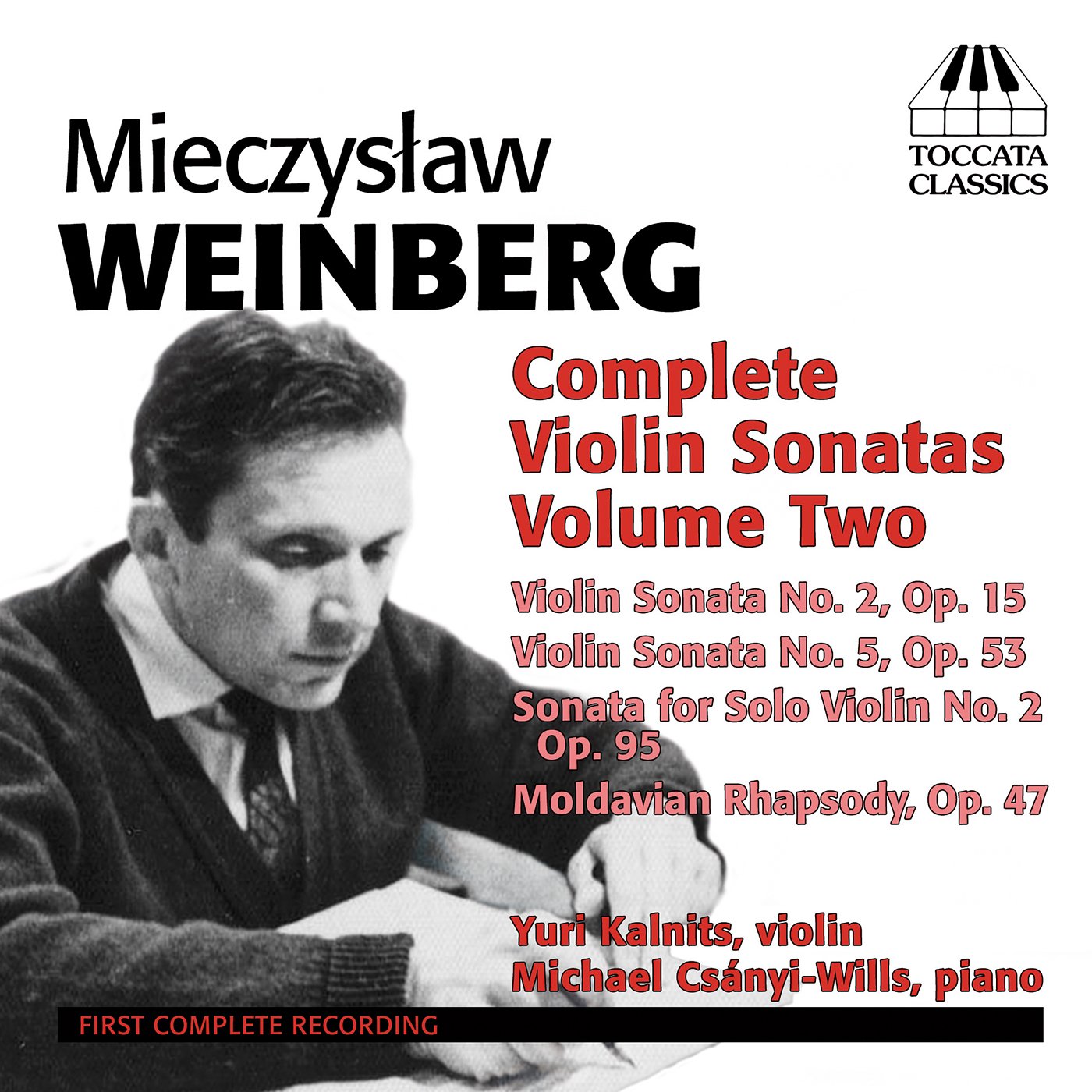
interview with Amaury du Closel: Link New Release There has been a new release on the Toccata label, 'Weinberg Complete Violin Sonatas, Vol. 2', with Yuri Kalnits on Violin and Michael Csányi-Wills on piano.
Available to buy from the Toccata website - Link. My review will follow shortly.
The Passenger in Houston, Texas
Weinberg's masterpiece The Passenger will be receiving its American premiere in January 2014, at the hands of the Houston Grand Opera. From their website:
Memory can comfort, torment-even terrify-but it is always with
us. As Faulkner wrote, "The past isn't dead. It isn't even
past." The horrors of the Second World War, still raw today, were fresh
in 1959 when Auschwitz survivor Zofia Posmysz wrote a play titled
The Passenger from Cabin 45 for Polish radio. The
play became the basis of the opera by Mieczyslaw Weinberg in
1967. En route to a new post with her husband, a German diplomat, Lisa
is unnerved by the sight of a woman-another passenger-who eerily
resembles Martha, one of the inmates Lisa tormented when she was an
SS overseer at Auschwitz. The action of the drama takes us from the stylish gentility of a
luxury liner's deck to the squalor of a death camp where cruelty,
despair, and unspeakable courage are evident in equal measure. This
American premiere will be one of the most important musical events
of the year.
The production is a revival of David Pountney's acclaimed staging of the opera, first seen at the Bregenz Festival, 2010. Michelle Breedt will be reprising her excellent performance as Liese, the ex-camp guard. Tickets are still available from the Houston Grand Opera website here.
PeerMusic Weinberg scores - previews available online
It
has come to my attention that PeerMusic has been uploading several
items from their catalogue for preview online, on the 'issuu' website.
PeerMusic's profile, with a full list of all their previews, can be
found here. Please see below for a list of Weinberg works available, with links.
These
scores represent a real treasure for Weinberg enthusiasts, giving
a small overview of Weinberg's Orchestral works, from almost his entire
career.
Now that I find myself beginning the second year of my doctoral studies, I feel it is time to create something of a mission statement for this blog, and for my work in general. I have now been writing solely on Weinberg for the last two years, and been enjoying his music for little over four years. Before then, I was unaware. I draw the reader to an important question, both for new listeners, and for critics of Weinberg's music:
"Why Weinberg?"
I hope to give an introduction and a defence for Weinberg's music. I absolutely welcome any conversation and comments, so do please get in contact with your thoughts.
My own reasons
As listeners, we are drawn to particular styles. It's only natural for us to enjoy music that is stylistically similar to that which we already enjoy. But when we approach the wide-reaching genre of 'Classical Music' for the first time, this may be daunting. Some of us are lucky enough to be raised in an atmosphere of listening and performing, working through a wide range of repertoire. Others come to listen later in life. Each listener shares one thing in common, however. A belief instilled that there is a pinnacle, a pantheon of greatness that is untouched, sealed and even sacred.
I don't wish to get bogged down in arguments around the musical 'canon'. My own gut reactions include terms like 'Elitist' and 'Exclusive' – such debates are well-worn in musicology. One thing is certain. Individual composers can and do get left behind. Music that is perhaps mediocre at best is bizarrely preserved, while pieces that were never given the attention they deserve are forgotten. Great music goes unheard, and great artists are lost forever. Such an issue is fundamental to our ways of thinking about Classical music, and revealing for how to challenge such notions in the future. There are a huge number of people fighting for the causes of a vast number of such 'under-appreciated' composers. And I rooted for Weinberg. Here's why I think you should too.
As a performer, and as a listener, I have a wide range of tastes. Outside of Art music, I heartily enjoy classic rock and English folk music. My favourite composers include Bach, Steve Reich and Stockhausen. My own listening in Art music has trended towards music of the Twentieth Century. No special reason, I just found myself drawn towards the comparatively exciting and daring sounds. As a result, I adore the music of Ives, Berg, Gershwin, Bartók, Stravinsky, Shostakovich, Britten, Prokofiev, Copland, Messiaen, Stockhausen, Cage, Schoenberg, Reich, Lutosławski, Martinů and a host of others. All this in addition to my loves from the pre-Twentieth-Century era. So why was I drawn to Weinberg in particular?
I was attracted by the similarity to several of my favourite composers. Weinberg's music frequently displays its influences in great clarity, making it readily accessible for lovers of Shostakovich and Bartók. There's also plenty to satisfy fans of Prokofiev, Britten and Berg. Even touches of Debussy and Zemlinsky. See my previous writing on works to introduce listeners to the wide world of Weinberg's music: 'Weinberg for beginners' (also contains a brief biography)
Weinberg and Shostakovich.
And this takes us to the first criticism to defend against. Critics have singled out Weinberg's clear influences as a sign of weakness or unoriginality. I have sought to dismiss these claims in several ways. Firstly, Weinberg was writing in the aggressive climate of the USSR Composer's Union, an organisation which imposed certain expectation upon artists. Tasked with producing socially useful art, composers were encouraged to write towards a standard of music exemplified by approved works. So if Weinberg's music is sometimes strikingly similar in sound, this can be excused as a result of the requirement for it to sound as such.
The case for defence is even greater with the similarity to Shostakovich's music. I have already written about the two composer's great friendship and interest in each other's works. An upcoming paper that I am working on seeks to set out mutual influence between the pair, often originating from Weinberg as opposed to Shostakovich. See my previous post, 'Weinberg and Influence'.
Another query to defend – "Why should I listen to Weinberg?" or "What makes this music so special?". I defend this quite simply: this music is frequently quite beautiful. It represents a continuation of a tradition long-thought to have abruptly stopped with the death of Shostakovich. This can be summed up as an observation of traditional means and forms, while seeking to express present-day anxieties with a great focus on melodic expansiveness. (That might seem overly complicated - just listen to some of the youtube clips in my above posts, and my meaning should become apparent). Instead of some kind of imitation of other great masters, Weinberg's music fights its own corner in a manner that demands attention. His opera 'The Passenger' is a demanding work, attracting audiences from all around the world. See this post on 'The Passenger', with clips.
His opera 'The Idiot' has been enjoying sell-out audiences since its Western premiere in Mannheim earlier this year. Weinberg's music is undergoing an undeniable renewal, with more and more releases and performances lined up.
In my own work, I hope to have several papers published shortly, and I will continue speaking at conferences, introducing and exalting the music of Weinberg. Over the short time that I have been writing on his music, I have borne witness to a change in opinion. The question that people have been asking has changed. Originally, it started with "Why Weinberg?". I hope that this blog has gone some way to address that. Now, the question has reversed to "Why haven't we heard this before?". With this change of attitude, I feel I do not have to apologise for writing on an obscure composer. Instead, I readily enjoy hearing new reactions to this music. They encourage me that it is music worth fighting for.