Showing posts with label Toccata Classics. Show all posts

Friday, 13 November 2015

November update

Hello folks - apologies for any lack of updates on this page, my thesis work has become extremely busy (see below). Here's some Weinberg-related news for the last few weeks.

Upcoming releases

Toccata Classics - Mieczysław Weinberg, Orchestral Music, Volume Two (Dmitry Vasilyev, Siberian Symphony Orchestra). Available from 4 December.

I'm tremendously looking forward to this release - featuring two premiere recordings, with Weinberg's last symphony, and an earlier symphonic work (recorded here in its premiere performance). The 22nd Symphony itself is fascinating - finished in the final few months of Weinberg's life, when he was bed-ridden with illness. It is dedicated to his wife, Olga Rakhalskaya, who approached the composer Kirill Umansky to orchestrate the work (Weinberg only managed to complete a piano short score, with a few instructions about orchestration). The Six Ballet Scenes paired on this disc is a fascinating work, containing some of the only surviving versions of several whole works that are now considered lost. Considering the success of the previous Toccata release of orchestral works, this CD is keenly anticipated.

Performances
The Detroit premiere of The Passenger has met with rave reviews - for a taste, see this interview with the conductor:
Conductor Steven Mercurio has tackled plenty of tough projects in his career, but Mieczyslaw Weinberg’s opera “The Passenger” posed a uniquely emotional challenge.
An opera about the Holocaust can do that.
Mercurio found that he couldn’t spend more than three hours at a time learning the score.
“Concentrating on life at Auschwitz was very fatiguing,” he says. “It was so disturbing that it weighed heavily on me, so I never worked on it at night because it would keep me up.”
While preparing it, Mercurio also was working on Verdi’s fire-and-brimstone laced “Requiem.”
“It was the only time I considered the ‘Requiem’ light,” Mercurio says. “It was like a sorbet after a heavy meal.”
Read the rest here.

Video links


The above video contains a concert and an excellent talk by Yuval Waldman, on Shostakovich and Weinberg's friendship. The event was organised by the YIVO foundation.

My own work
I am pleased to announce that my latest publication has been released - an article entitled 'Mieczysław Weinberg: Lines that have escaped destruction'.


The article is part of a volume released by the Council of Europe, based in Strasbourg, following an event in November 2013 titled 'Music in Concentration Camps'. The full title is:

Colloque 'Musique et camps de concentration', Amaury du Closel (ed.) (Strasbourg: Conseil de l'Europe, 2015). 

It is initially released on a PDF-CD, in a handsome release: 


As soon as I receive further information about how to acquire a copy, I'll be sure to post them on this page. 

Other than that, my thesis goes well. One more chapter left to tackle - then it'll be on a home-stretch of editing and revising, heading towards the final submission! In an effort to promote more scholarly work on Weinberg, I've uploaded a select bibliography of sources on his life and music - see here. It is my hope that scholars and researchers can share vital texts, and so start a dialogue. 

Tuesday, 11 February 2014

February Update

Upcoming releases
The month of February brings several exciting Weinberg releases, some already available, some new and some with world premiere recordings.

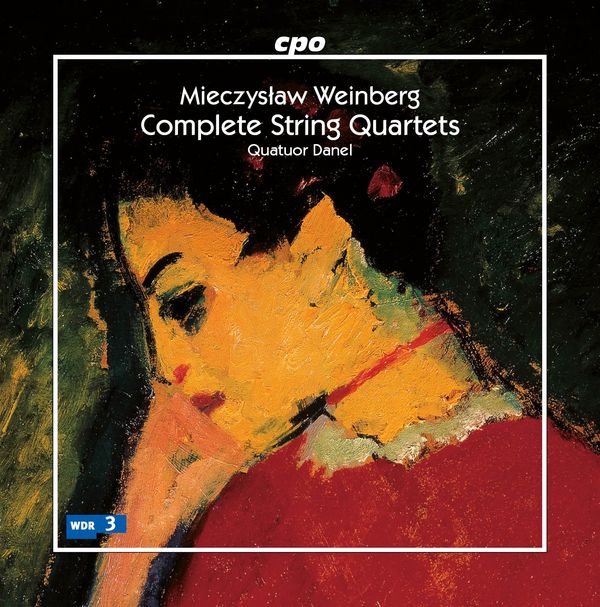
First of all, the CPO label will be issuing a boxset of Weinberg's String Quartets, as recorded by the Quatuor Danel. Seeing as these recordings form a cornerstone that I consult on a daily basis, I can't recommend these enough. The six-volume cycle will be packaged in one box-set, at the extremely attractive price of EUR 29.99. From the CPO's site: (link).

Mieczyslaw Weinberg’s genuinely awe-inspiring complete seventeen string quartets are now available in a box set in interpretations by the Belgian Danel Quartet that can only be described as a musical blessing. Inspired by Shostakovich’s widow Irina (and other factors), the Quatuor Danel began acquiring the scores of all seventeen Weinberg quartets in 1995 and after a number of years (2007 to 2012) has now finished its complete recording for cpo. The BBC Music Magazine immediately named the first volume the best chamber music CD in March 2008, and further prizes followed. klassik-heute. com wrote, »In content and skill the works are equal to good works by Shostakovich, but this does not at all mean that Weinberg was a Shostakovich imitator. The Danels perform with unabating, often almost urgent intensity.« And Weinberg’s teacher and friend Shostakovich never missed an opportunity to recommend the works of his friend and fellow musician Weinberg. They were brothers in spirit. Both worked in manifold genres and over a broad stylistic spectrum ranging from folklore (in Weinberg’s case, Jewish folklore in particular) to twelve-tone elements. In the field of the string quartet Shostakovich involved his pupil in a friendly competition and was very happy in 1964 to be the first of the two to write his No. 10. Our final volume received the highest marks from klassik-heute. com: »A full 10 for exciting music and its enthralling interpretation by an exciting ensemble.«

--------------------
There is also news of another upcoming release from the CPO label - 'Chamber Music for Strings'.

    Led by the same musician who brought us the 'Chamber Music for woodwinds' release a few years ago, Elisaveta Blumina, the release promises to feature the following works:

Piano trio op. 24;
Sonatina for Violin & Piano op. 46;
Sonata for Double Bass solo op. 108

If the previous cd is anything to go by, this should worth buying. 

---------------------
I mentioned world-premiere recordings above, and the latest disc from Toccata Classics promises just that.

This upcoming disc is listed as 'in preparation' on the Toccata website (with very little information provided besides that and the album cover, seen above). Works to be featured:

Symphony No. 21, 'Kaddish', Op. 152 [wth Veronika Bartenyeva, Soprano] (World Premiere recording)
Polish Tunes, Op. 47, No. 2 (Also a world premiere)

The Siberian Symphony Orchestra, under Dmitry Vasilyev.
I must admit, I'm particularly excited about this release, I'm always pleased with premiere recordings. This leaves just Symphonies 9, 11, 13 and 15 still to be recorded.

--------------
Of course, is you can't until these discs are released, I still heartily recommend Gidon Kremer and the Kremerata Baltica's 2-disc set, which was something of a revelation when I reviewed it here.

-------------

Here's a few of the latest youtube videos of Weinberg:

Linus Roth and José Gollardo play the Weinberg Sonatina, Op. 46:

A preview of the Naxos Symphony 12 recording: (see my review here).

-------------

My own work is ticking along nicely. I recently survived my latest PhD assessment panel. My writing is now focusing on analysis of the Weinberg Quartets - I'm currently up to 12 out of 17! In publication news, I am pleased to announce that my manuscript for a set of conference proceedings has been submitted, with the full text available hopefully from June of this year, with paper copies available some time in Winter. Until then, some of my academic work is available for you to read on my profile on Academia.edu - link.

Tuesday, 12 November 2013

Review: Complete Violin Sonatas, Volume Two (Yuri Kalnits and Michael Csányi-Wills, Toccata Classics)


This new release sees the long-awaited second volume in the Toccata Classics series of Weinberg's Violin Sonatas, with Yuri Kalnits on violin and Michael Csányi-Wills on piano (link to the Toccata website - complete with audio samples - here). On first impressions, the disc is attractively packaged and after several listens, I am more than convinced that this series is the one to opt for when it comes to Weinberg's violin works.


The first volume was released to rave reviews in 2011, and went on to win the prestigious Diapson d'Or award. The showcasing of excellent playing and choice of programming is extended onto this disc. With a third and final volume expected, the real strength of this series lies in its scope; the discs feature not only Weinberg's sonatas for violin and piano, but also the sonatas for solo violin, and several smaller works for good measure. 

This second volume features the second and fifth sonatas for Violin and Piano, the second solo sonata and the Rhapsody on Moldavian Themes for Violin and Piano. This huge variety gives Kalnits great opportunity to demonstrate his virtuosity on his instrument, while Csányi-Wills proves a sensitive and supporting accompanist.

The music

Weinberg wrote some thirty sonatas in total, a mixture of solo and ensemble with piano. Weinberg's writing for the violin was masterful from early on in his career, perhaps since his Father was a violin-player. Over the course of his life, Weinberg was able to work with some of the very best Soviet violinists, including David Oistrakh and Leonid Kogan.

- The first work featured on this disc is the Rhapsody on Moldavian Themes, Op. 47, No. 3. The original version was scored for orchestra, but Weinberg also produced this version. The published score features fingerings by Oistrakh himself. It is one of Weinberg's most appealing works, widely recorded and a favourite encore of Oistrakh.

At just under ten minutes, the work opens with an elegaic piano line. For the hushed opening, Kalnits and Csányi-Wills strike up a perfect balance, creating a hushed anticipation. A folk-inflected song theme emerges, the first of many to be elaborated on through the work. A slow but steady increase in tempo sees the violin soaring up to the heights for the first time on this disc - which Kalnits takes utterly in his stride. Indeed, these passages stand testament to the high recording quality - the balance is nothing below perfect throughout. At 4:15, the frantic and giddy scherzo-like central section of the work begins. The duo do justice to the near-manic mood, powering through to an ecstatic finish.

- Next up is the Second Sonata for Violin and Piano, Op. 15. The connections with Oistrakh continue here: the manuscript bears a dedication to him (almost certainly added years after it was first written) and Oistrakh gave the premiere performance in 1962. The language is similar to the First Sonata, written the previous year, though there are several indicators of an increasing sense of ambition. The piano has several opportunities to shine, such as at 2:30 in the first movement and Csányi-Wills does not neglect them. Following this passage a near-fugato dialogue between the duo begins, with effortless transition - this is clearly an excellent musical pairing. The introspective and searching Lento movement is here performed with energy, giving respite yet never failing to be gripping in interpretation. The lyrical mood is continued, now extended with a slightly more energetic folk-like episode. Fanning's liner notes point to similarities with the Third Quartet, Op. 14, immediately preceding the sonata. These include an ending that appears to lack conviction - Weinberg's full mastery of cyclic forms would be reached in a few years time.

- Compared with his First Sonata for solo violin, the second, Op. 95 is much more approachable. The first takes a caustic attitude, first heard in the Sonata for Two Violins, Op. 69. It takes a structure similar to a suite, to be noted from the movement titles. Kalnits has ample opportunity to showcase his talent as he weaves several lines at once, across several different techniques and textures. The work is dedicated to another great Soviet violinist, Mikhail Fikhtengolts. The seven movements of the work are inter-linked and named as follows:
Monody - Rests - Intervals - Repliques - Accompaniment - Invocation - Syncopations
They can accurately be described as a series of inter-linked studies - though it is much less demanding than Weinberg's first solo sonata - perhaps to the soloist's relief! (Though, of course, that work is tackled with full mastery on the First Volume).

- The final work on the disc is the Fifth Sonata for Violin and Piano, Op. 53, arguably the greatest of Weinberg's sonata works. Its mournful yet optimistic character can be ascribed to the fact that it was the first work Weinberg wrote after his release from prison in 1953. The work is dedicated to Shostakovich, perhaps as a result of his intervention on Weinberg's behalf during his imprisonment. The modal-inflected melody of the opening is portrayed tenderly by Csányi-Wills, as Kalnits soars high above later in the movement. The Allegro molto that follows is more fiendish, with a scurrying piano part that re-emphasises the modal inflection from beforehand. The third movement opens with a distinctive passage of complex violin double-stopping, soon joined by aggressive accents in the piano part. For the finale, Weinberg juxtaposes several tempo changes, beginning with a light and frantic violin line, before a funereal piano line interrupts, with hints of the opening movement, and a nod to Schubert and Debussy. An intense fugue for piano takes centreplace of this movement, similar to the Preludes and Fugues of Shostakovich, Op. 87. A heartfelt coda follows, rounding off this well-balanced work, and providing a moving close to this disc.

Overall, this disc represent a fantastic continuation of the series, with the partnership of Kalnits and Csányi-Wills continuing onto new heights. Comes highly recommended. 

Further Listening

- The obvious choice for further listening would be the first volume in the series, to be found here.


- Of further interest, see the Challenge Classics release of the near-complete works for Violin and Piano, with Linus Roth and José Gallardo (see my review here). While an excellent release, the Toccata series has the upper hand, with a sensitive balance, and the addition of the solo works alongside.