In February 2017, the conference 'Mieczysław Weinberg (1919-1996): A Rediscovery' will take place in Moscow, arguably the largest ever event devoted to Weinberg's life and music. The conference will unite performers, theatre directors and stage designers, academics, and figures from Weinberg's life, in an extended programme over two weeks. The core of this revolves around 16-19 February, with four days of papers, talks, and interviews. All of this is hosted in the Bolshoi Theatre, a venue that imparts a high level of prestige to the proceedings. The wider conference programme includes concerts, film screenings, and three stagings of Weinberg operas (including two separate stagings of The Passenger).
The conference is co-presented by the Bolshoi Theatre and the newspaper Muzykalnoe obozrenie.
The operas presented are:
The Idiot - Directed by Evgeny Arye, musical direction by Michał Klauza (in a production receiving its premiere on 13 February).
The Passenger - Directed by Sergey Shirokov, musical direction by Jan Latham-Koenig (a new production that received its premiere on 27 January).
The Passenger - Directed by Thaddeus Strassberger, conducted by Oliver van Dohnányi (presented by the Yekaterinburg State Academic Opera and Ballet Theatre, in a production that premiered in September 2016).
The academic side of the conference brings together over 40 scholars from across the world (the conference languages are Russian and English). The four days of the conference are organised as follows:
16 February
'Staging History of Mieczysław Weinberg's operas - The Idiot in Russia today'
17 Feburary
'The Passenger: Past and Present'
18 February
'The Life and Legacy of Mieczysław Weinberg: Chamber Works'
(followed by an evening concert of Weinberg's chamber music)
19 February
'Mieczysław Weinberg: Identity, Biography, Personality'
Highlights of the panel sessions include:
- the creative team behind the Bolshoi Theatre's production of The Idiot - A roundtable on The Passenger
- An interview and discussion with Zofia Posmysz, author of the novel, The Passenger, and herself a former Auschwitz prisoner.
- An interview and discussion with David Pountney, celebrated stage director, and main creative force behind the 2010 Bregenz Festival.
- A roundtable discussion with Weinberg's friends, colleagues, and family. The panel includes Weinberg's widow, Olga Rakhalskaya, and his second daughter, Anna Weinberg, as well as Tommy Persson, who has been a driving force behind much of the Weinberg revival in recent decades.
I am honoured to be speaking on 18 February, as part of a day of talks on Weinberg's Chamber Music. I will be presenting a paper titled '"An Encyclopedia of the Genre": Weinberg's String Quartets', which summarises some of the findings from my doctoral thesis.
For a full listing of the Conference schedule, please see the following link: Conference programme
Any questions should be directed to the conference email address: weinberg.moscow2017@gmail.com
There is an upcoming premiere for a new production of Weinberg's opera The Passenger, by Opera Frankfurt. The first performance will be on 1 March 2015. The production is directed by Anselm Weber and conducted by Leo Hussain.
From PeerMusic's press release:
A new production of the opera The Passenger by Mieczyslaw Weinberg is being premiered at the Opera Frankfurt on 1 March 2015.
Beforehand, a particular event has been arranged with Zofia Posmysz about her story the libretto is based on: The woman who has been the "Passenger" on 28 February 2015. 70 years after the rescue of concentration camp Auschwitz, this moving drama is newly staged as a plea against oblivion. Mieczyslaw Weinberg set in music what is rather beyond expression. "All who listen to a witness are going to be witnesses themselves." Elie Wiesel, Nobel peace laureate.
On the other side of the Atlantic The Passenger reaches after the Houston Grand Opera and the Lincoln Center Festival in New York in 2014, the Lyric Opera of Chicago now with its premiere on 24 February 2015.
David Pountney called his production "my most important cultural act". The director, who has been awarded the Cavalier Cross of the Republic of Poland, premiered the opera at the Bregenz Festival in 2010. Until its arrival in the US "his" passenger traveled over the Wielki Teatr in Warsaw and the English National Opera in London, where it was nominated for the Lawrence Olivier Award in the category of best new opera production.
The Baden National Theatre in Karlsruhe already presented a very successful new production of the opera The Passenger as German first performance in 2013.
We are wishing the Frankfurt staged Passenger a likewise huge success.
Further details for the production, including ticket bookings, can be found here.
Here is a run-down of the latest news in Weinberg-related circles, including concerts, releases, and other paraphernalia.
Upcoming Concerts
First of all, there are two upcoming productions of Weinberg's Opera The Passenger in the United States.
The first is presented by the Lyric Opera of Chicago, taking place February 24 -March 15, 2015. This is a presentation of the David Pountney production, first seen at the Bregenz Festival in 2010. The same production received its US premiere in January of this year, by Houston Grand Opera, before appearing at the Park Avenue Armory as part of the Lincoln Festival in July.
The Lyric Opera of Chicago will be featuring an exhibition on Weinberg's life and The Passenger, including photographs and written description, as well as documenting the development of Pountney's production. They have also uploaded the following video of a seminar and panel discussion on Weinberg's opera:
For further information and ticket details, follow this link to the Lyric Opera's page for The Passenger: link.
The recent programming on a Challenge records disc combined Weinberg's Violin Concerto alongside that of Benjamin Britten. As well as being an excellent album (see my review here), the combination of Weinberg and Britten proved a well-suited duo. There are numerous reasons for this, the most obvious also being the most simple: Britten's influence can often be heard in Weinberg's music, particularly in his Operas.
Britten and Shostakovich, 1966.
The close friendship between Britten and Shostakovich is well known. Britten was one of the few people to stand up for Shostakovich's opera 'Lady Macbeth of Mtsensk' after its British premiere in 1936. Shostakovich was so impressed with Britten's War Reqiuem that he held it up as an example to his composition students. During the late 1960s and early 1970s, the two composers visited each other. Britten and Peter Pears stayed with Rostropovich and Vishnevskaya for New Year's, 1966. Over the course of their stay, they often saw Shostakovich and his wife Irina. Peter Pears wrote of the visit in his diary:
25th December, 1966
Christmas dinner at Slava's [i.e. - Rostropovich's]... Dmitri and Irena Shostakovich were there, punctual as always... Shostakovich in good form, talkative, nervous, Irena gentle, quiet, a marvellous foil for him.
1st January, 1967
We were summoned for 10:00 pm at Dmitri's...We had a quick nip of vodka and...next came a meal around a long table groaning with drink and eats, and presents...a score of Dmitri's Stepan Razin for Ben, and a record of the same for me.
The Shostakovich's visited Britten at home in Aldeburgh in 1972, Shostakovich particularly excited to see the sketches for Death in Venice. Shostakovich wrote that had it not been for the language barrier that existed between himself and Britten, the two could have become close friends.
The musical parallels are close, with both composers adapting twelve-note rows into their music at around the same time, and each generously quoting the other's music. Notably - see Shostakovich's Fourteenth Symphony for the strong influence from Britten. With such a strong bond between the two composers, it was natural for Weinberg to be strongly familiar with Britten's music.
Admittedly, there isn't a scrap of recorded evidence to link the two. But it is certainly tempting to suggest that Weinberg would have met Britten during his stays in Moscow. We can certainly say that Weinberg and Shostakovich discussed Britten's music at length, and Weinberg's familiarity with Britten's work is evinced by his collection of scores and records. Shostakovich and Weinberg conversed about music on an almost daily basis. It is certainly tantalising to suggest that Shostakovich could have mentioned Weinberg's name to Britten.
Weinberg'sRequiem, Op. 96, owes a large amount to Britten's War Reqiuem, a work that Shostakovich loved (according to Yevtushenko, author of 'Babi Yar', a poem that Shostakovich used in his Thirteenth Symphony, Shostakovich listened to Britten's War Reqiuem on repeat, crying all the way through).
An immediately noticeable similarity between the two works is the use of boy's voices to depict innocence. In Britten's case, the boy's choir sing texts by war poet Wilfred Owen interspersed between the text of the requiem mass. Weinberg's Requiem uses a selection of poetry from authors including Garcia Lorca and Mikhael Dudkin, in a multi-national array that also echoes Britten's War Requiem. They differ in their complexity, however, as Weinberg's work is beyond the grasp of amateur ensembles. Partly as a result of this, Weinberg's Requiem was not performed until 2009, in Liverpool. Meanwhile, Britten's War Reqiuem was famously commissioned for the reopening of Coventry Cathedral, and was premiered to international acclaim in 1962, four years before Weinberg began writing his work.
It is in Weinberg's operas that the Britten influence becomes more telling. David Nice has rightly pointed out that 'by the late 1960s, when Weinberg completed The Passenger, one great composer of Russian operas, Sergei Prokofiev, was long dead, and the other, Shostakovich, had produced nothing completely new for the operatic stage in decades'. As such, Britten was the obvious leader in opera on the world stage at that time.
Weinberg waited until relatively late in his career before turning to opera. His first opera, The Passenger, is arguably is masterpiece (and you can read more about it in my article here), set in Auschwitz, in a triumph of humanist drama. Throughout, there are noticeable Britten-like passages, often built around chains of thirds. For instance, there is the following passage in The Passenger:
Strikingly reminiscent of the first sea interlude in Britten's Peter Grimes:
The similarities continue throughout Weinberg's other operas. For instance, there is Weinberg's use of folk songs and musical quotation, effortlessly woven into the music to emphasise aspects of the drama - a technique used extensively in Britten's operas. Perhaps the most notable of these is the Lamplighter's song in The Portrait - replete with characteristic Weinbergian fourths. The frequent use of Celesta in The Passenger also recalls Peter Grimes, and Weinberg's more extended use of percussion in The Passenger even anticipates Britten's Death in Venice.
To conclude, Britten's influence is easy to identify in Weinberg's music, as well as on a more abstract level, as they both shared similar humanistic ideals - in Britten's case, extending to his decision to be a conscientious objector during WWII. The question of how Weinberg came to know Britten's works is easily addressed when Britten's friendship with Shostakovich is taken into account, and the prescence of Britten's style in Weinberg's operas seems glaringly obvious if we consider that he was a world-leader on the operatic stage at that time (though, importantly, Weinberg would not have heard a Britten opera in concert in the Soviet Union during this time; his knowledge came through scores and recordings). Weinberg's debt to Britten is a fascinating trait - I intend to further this introductory article with a more thorough examination of Weinberg's operas, including The Portrait and The Idiot.
Those who've experienced The Passenger know it to be intense but also heartfelt. It was Weinberg's first opera and it stands out amongst his works, with reasonable claim to being his 'masterpiece'.
Poster for the 2010 premiere of 'The Passenger', Bregenz Festival.
(Images & video links in the post are taken from the Bregenzer Festspiele production in 2010 unless otherwise noted - this production was recorded and has been released on DVD and Blu-ray by Neos).
Background
The first thing to mark 'The Passenger' as striking is its subject matter: the opera is unique in its confrontation with the legacy of the Holocaust, and especially in its on-stage setting within Auschwitz itself (at least, partly - see below). Weinberg avoids crass illustration in his music, and instead opts for an intense humanism, communicating a great sincerity in his statements.
Of course, commemorative works were not unusual in Weinberg's output before 'The Passenger'. Directly before it, he wrote his 'Requiem', Op. 96, another work which would wait many years before being performed. Before that, there are his Sixth and Eighth Symphonies, both of which use chorus to moving effect. In one sense, Weinberg viewed all of his music as commemorative. He had lost his entire family during the Holocaust–he had fled from Poland eastwards to the USSR, leaving them behind. This loss left him with an urgency to justify his survival–a creative urge.
The story of 'The Passenger' started several years before Weinberg even encountered it, however, and to tell the tale of its conception, we must focus on a Polish author, Zofia Posmysz.
Zofia Posmysz camp photograph, Auschwitz.
Posmysz was 18 years old when she was arrested by the Nazi gestapo for accompanying an individual who was distributing political leaflets. She was sent to Auschwitz camp, where we was imprisoned for three years. During that time, she was witness to immeasurable cruelty and despair, but she also found hope. A young Polish officer by the name of Tadeusz risked his life to make her a medallion featuring Christ on the cross, a medallion which Posmysz wears to this day. During her incarceration, she nearly died from Typhoid, but she recovered and survived Auschwitz.
An incident in 1962 vividly returned her to life in the camp–and directly inspired the scenario that would go on to become 'The Passenger'. While visiting the Champs-Elysées in Paris, she overheard a group of German Tourists:
Suddenly I heard a voice. It was remarkably like the voice of our guard Frau Franz. Her voice always sounded so shrill… And now I could hear the same screams in the Place de la Concorde. I thought: ‘My God, it’s our prison guard!’ I looked in every direction and tried to find her but of course it wasn’t her. Even so, my heart missed a beat. And I thought: ‘If it had been her, what would I have done?’
Posmsyz confronted her past, and wrote a radio play in 1959 called 'Passenger from cabin 45'. By 1962, this had expanded into a book, 'Pasażerka'. Alongside this, a film was produced with the same name, partly filmed in Auschwitz itself. (The film itself was never completed).
A clip from 'Pasażerka', dir. Andrzej Munk, 1963. Production was cut short by Munk's death in 1962, but the fragmentary film was released with audio commentary layered on top, transforming it into a pseudo-documentary.
The book enjoyed moderate success, and it came to the attention of no less a composer than Dmitri Shostakovich as a scenario for an opera. Shostakovich had avoided opera since the 1930s however, and he passed the project along to Weinberg. Weinberg worked with librettist Alexander Medvedev, beginning a long-term collaborative partnership. Weinberg began work in 1967, and the opera was finished in June 1968. 'The Passenger' would have to wait many years to be heard, however. Shostakovich was a huge fan of the work, writing a preface to the published score, in which he says: '"The Passenger" is a unique work; I will never tire of hearing it'. The work encountered considerable difficulties, however. The work was scheduled to be produced at the Bolshoi theatre in 1968, but it was cancelled. In hindsight, it appears that the Soviet authorities were not keen on documents that did not focus on the plight of the Soviet people during the Second World War and the Holocaust. By the time of Weinberg's death in 1996, the work remained unheard, apart from a few renditions from the piano score, in private circles. Shortly before his death, Weinberg requested of Medvedev that if he ever heard the work performed, that he ought to listen twice, once for himself and once for Weinberg. Following the resurgence of interest in Weinberg's music (mostly stemming from the Western world), a concert performance of the opera was given on 25th December, 2006 in Moscow. Tragically, Alexander Medvedev died just a few days before the performance. On the success of this, the full staged premiere was given at the Bregenz festival in 2010, under the leadership of English Director David Pountney. (Pountney has subsequently been awarded the Cavalier’s Cross of the Order of Merit by Poland, for services to Polish culture). Runs of the opera followed in London and Barcelona, and this year sees performances in Texas and Berlin. It appears that 'The Passenger' is finally receiving the attention it deserves.
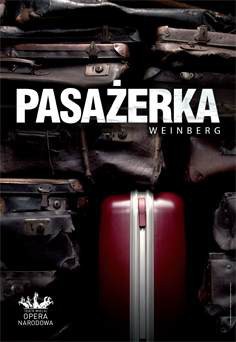
Poster from the 2010 Warsaw production.
Synopsis
Following Posmysz's book, the action in the opera takes place between two very different locations with distinct time-zones.
a) - aboard a passenger-ferry, sailing to Brazil, c. mid 1960s.
b) - Auschwitz prison camp, c. 1943.
Alongside this, there is an on-stage chorus at key moments in the opera, who represent our modern consciousness. The chorus sing solemn commentaries on the action happening onstage.
The whole opera has been uploaded to youtube, filmed at the Bregenz premiere:
Below is a summary of the plot, scene by scene.
Act 1
Scene 1 : Walter and his wife Liese are on their way to a new
life in Brazil where Walter will take up a diplomatic post. During the
journey Liese is struck by the appearance of a passenger she sees
indistinctly. The passenger reminds her of an inmate in Auschwitz over
whom she once presided and knows for certain to be dead. In shock she
reveals her hitherto undisclosed wartime past to her husband.
Scene 2 : In the concentration camp Liese and her superior
Overseer discuss the need to manipulate prisoners and find one amongst
each group who can be manipulated to lead the others easily. The male
officers drink and sing about how there is nothing to do but how they
are less likely to die than fighting on the front against the Russians.
Scene 3 : The women of the camp are introduced and each tells
of their background and origins. A Russian woman is bought in having
been beaten and tortured and the Kapo in charge discovers a note which
may cost her her life. Marta is selected by Liese to translate to Liese
but deliberately makes it out to be a love letter from her partner
Tadeusz, with whom she arrived into incarceration, but has not seen
these past two years. Liese believes the subterfuge. As the scene closes
Liese and Walter are seen on the boat in the present time trying to
come to terms with Liese's newly uncovered past.
Act 2
Scene 1 : Belongings of murdered prisoners are being sorted by
the women when an officer arrives to demand a violin so that the
Kommandant may have his favourite waltz rendered to him by a prisoner.
The prisoner Tadeusz is sent to collect the violin and arrives to
discover his fiancée Marta there. Their reunion is overseen by Liese who
decides to try and manipulate their relationship so that she may more
easily control Marta for her own purposes in more readily exerting
control over all the women.
Scene 2: Tadeusz is in his prison workshop fashioning
jewellery for the officers' private demands. In a pile of his sketches,
Liese recognises the face of Marta. Liese tries to get Tadeusz to do her
bidding also, but seeing that this would leave him indebted to Liese,
he declines although essentially this will cost him his life now.
Scene 3 : It is Marta's birthday and she sings a lengthy aria
to Death itself. Liese tells Marta that Tadeusz refused her offer and
that it will cost him dear, but Marta understands Tadeusz's stance. The
women sing more about what they will do when they return home after the
war, although it is obvious to most that they will never return alive.
There is a death-house selection, and the women are all led away as
their numbers are called. Marta resignedly follows although she has not
been selected for death. Liese stops her from joining the others and
taunts her that her time will come shortly so there is no need to hurry.
Liese's final taunt is that she will live to see Tadeusz's final
concert before he is too sent to the death-house as a result of her
report.
Scene 4 : In the present time on the boat, Walter and Liese
are still unsure as to whether the mystery woman whose appearance has so
upset Liese is really Marta. The porter Liese earlier bribed to
discover the woman's identity only revealed that she was British. He now
returns to add that although she is travelling on a British passport,
she is not English and is on deck reading a Polish book. Walter offers
to confront the mystery woman to set Liese's mind at rest before they
both decide they are letting their minds run away with themselves. They
both resolve to ascend to the salon to join the dancing. Liese dances
whilst her husband talks to another passenger. The mystery woman is seen
passing a play-request to the band leader. The band then play the same
tune that was once the camp Kommandant's favourite waltz. This musical
coincidence and the still unknown identity of the passenger further
convinces Liese that Marta is somehow alive and on the boat. Liese is
reduced to terror and shrinks from sight of the still unrevealed mystery
passenger retreating from her backwards down the stairs of the liner
into the horrors of Tadeusz's final moments.
Scene 5 : Tadeusz is dragged before the Kommandant to provide
him with his favourite waltz music. Instead he plays Bach's "Chaconne"
making a defiant purely musical protest at the Kommandant about the
descent from culture into depravity the camp represents. Thus he
deprives Liese of her plan to have him executed via her report and
deprives the Kommandant of his illusion that he can force people to play
him his favourite music under pain of death. Tadeusz seals his own fate
and, his violin being smashed, he is dragged off to his death. All the
while, Liese observes the scene whilst still in her ballgown.
Scene 6 : The stage becomes completely empty apart from Liese
still in her ballgown who slumps down sitting to the rear silently.
Marta enters. She is observed to be wearing non-prisoncamp clothing and
with her hair unshaven. She sings that the dead should never be
forgotten and they can never forgive. Liese can only observe, unable to
have Marta change her attitude and provide her the closure she selfishly
craves. The scene fades away musically as does the light and the opera
ends very quietly in total darkness.
Weinberg's music throughout is astonishingly powerful. There are subtle influences from Berg's Wozzeck and Britten's operas, but, overall, Weinberg's style is highly personal. There are passages of jazz, 12-tone music, as well as long instances of solo singing, such as when a female prisoner sings a Russian folk song from her youth. (The whole opera was uploaded onto youtube–which would have provided excellent musical examples for this post. Sadly, it has now been removed.)
If the opera is uploaded again, I shall edit this post to include numerous examples. Until then, here is a short promotional video, made for the 2011 London production:
Zofia Posmysz is alive and well (she will be 90 years old on 23rd August this year). She attended the premiere performance in 2010 and received a standing ovation when she took to the stage.
Zofia Posmysz, pictured in London, 2011.
------------------------------
UPDATE: November 2013
I am pleased to announce that The Passenger will be appearing in New York in summer 2014 - more details here. Furthermore, my article 'Weinberg and The Passenger' is to be published in a set of conference proceedings in the new year. When it is released, I will make it available to readers of this blog, one way or another.