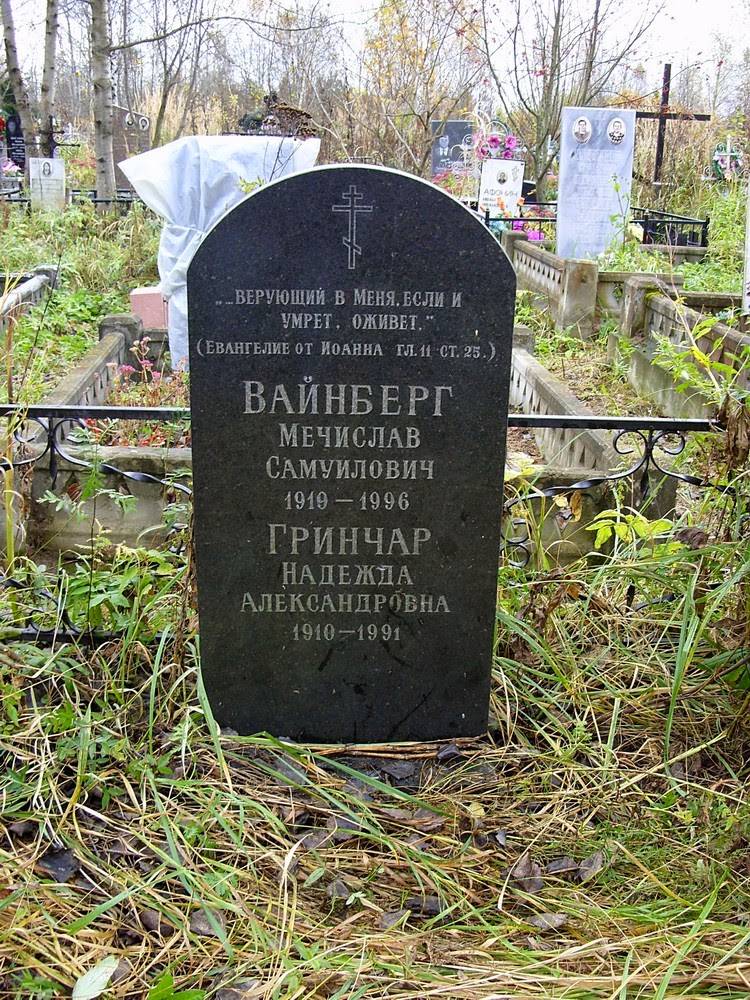
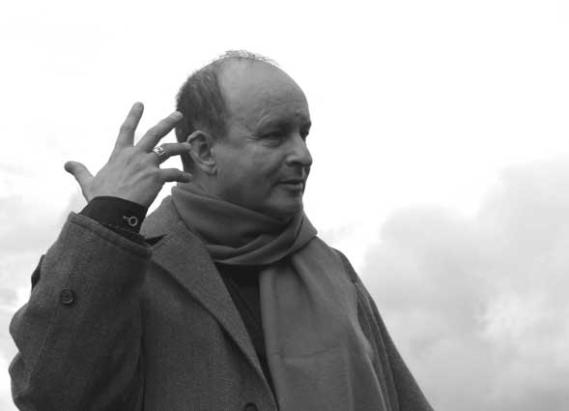
The Grave of Mieczysław Weinberg, with Nadezhda Grinchar (Weinberg's Mother-in-Law), 49, Domodedovo Cemetery.
In a quiet cemetery outside of Moscow lies Weinberg's final resting place in a Russian Orthodox grave, in accordance with his final wishes. The plot is also the resting place of Nadezhda Grinchar, mother of Olga Rakhalskaya, Weinberg's second wife.
The inscription quotes the Gospel of St. John, Chapter 11, Verse 25:
'He that believeth in me, though he were dead, yet shall he live'.
A lot of my writing on Weinberg's opera The Passenger has focused on critical reception, including my blog-article here and my colloquium article 'Weinberg and The Passenger', to be found on my academia.edu page here. Over the years that I have spent researching Weinberg's life and music, I have paid particular attention to the reception of The Passenger, being arguably his best, and (potentially) most controversial work. The Russian premiere in 2006 heralded Weinberg as 'a new direction for Russian opera', while David Pountney's Bregenz production in 2010 drew rave reviews across the board (the London reception, however, was noticeably mixed). Eyebrows were raised at the question of 'appropriateness' of the material, while others were quick to react to some author's labelling of the work as a 'masterpiece'.
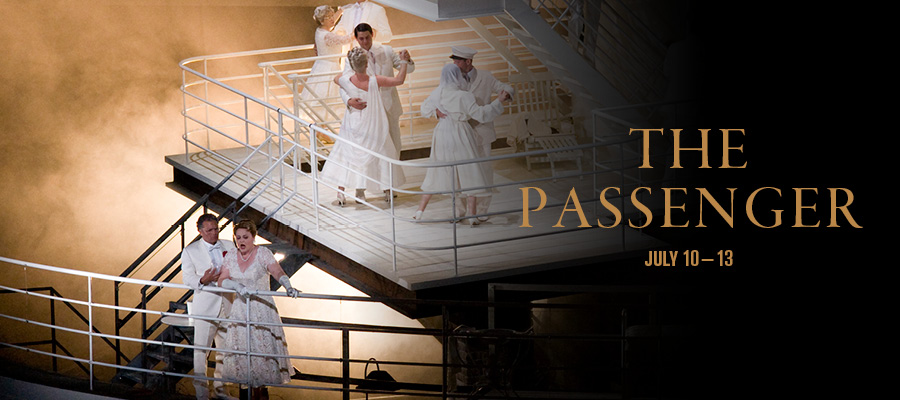
The American premiere in Houston in January of this year attracted a similar mix of reactions, though predominantly more positive. Thursday 10th July sees the New York premiere, at Park Avenue Armory. Before the opera has even opened, it appears to have divided critics, both freelance and online commentators. Some of this writing begins with an outright angry tone before moving to vitriol, and I couldn't avoid throwing my two cents into the debate (hence my choice of title, 'Wading in...').
The initial reactions appear to be based upon Park Avenue Armory's publicity for the opera, in particular, the loaded phrase 'Holocaust opera' (a phrase itself lifted from out of John Allison's 2011 review for the Daily Telegraph, link). The Park Avenue Armory landing page for the production grandly sells the 'landmark work' link, while their assistant artistic director Mena Mark Hanna produced an enthusiastic programme note, released on Huffington Post: (full link here)
'Mieczysław Weinberg's The Passenger... stands apart in its bold attempt to reenact the savagery of World War
II on the musical stage. The Polish composer and his Russian librettist,
Alexander Medvedev, produced an opera that not only seeks to write
poetry after Auschwitz, but also attempts to confront the grotesque
terror head-on. This opera is unlike any other work.'
Against this background of enthusiastic plugging for an upcoming production, I stumbled across the following article by Allan M. Jalon, writing for Tablet magazine, with the headline 'Lincoln Center presents an opera without Jews, set in Auschwitz' (full link). Jalon takes issue with the 'Holocaust opera' phrase used in various parts of the production's promotion materials to launch a thorough attack against the opera and its creators. Jalon's argument is set out in the opening paragraph:
'Beyond a few lines given to a Jewish character,
there’s no explicit Jewish presence in this concentration camp. Seeing
the work, it’s hard to believe: An opera set in the killing factory
known for subtracting Jews from the world, and it subtracts Jews.'
Jalon, of course, is right to point this out. And, for Western audiences unfamiliar with the conditions of Soviet life, this must come as a shock. All credit to Jalon, he has thoroughly researched the work, and is right to point out the near-minimal representation of the Jewish people in The Passenger. Jalon raises the wide-reaching questions, ones that The Passenger cannot answer on its own:
'Can art that excises the full picture of the
Nazis’ main group of victims be respected as a work of responsible
witness? Are there no limits to art’s freedom to navigate a subjective
path through its subject, when that subject is documented history?'
I strongly advise my readers to read Jalon's article in its entirety, for it presents a consistently adverse reaction to the opera, however well-researched it may be. Where I take strong issue is on two points: among Jalon's research, he interviewed Zofia Posmysz, author of the original book of The Passenger. Posmysz is now 91. Jalon's issue with the lack of Jewish representation of the novel is unleashed upon her during this interview:
Both the interviewer for OSTEUROPA and I asked Posmysz about the general absence of Jews in the various versions of her Aufseherin
Franz-Marta-Tadeusz story. “In your story, Jews just aren’t there,” the
German interviewer says pointedly. He or she—I couldn’t find a
byline—notes the scene with the Jewish baby in the barracks but presses
about why “both protagonists in the camp are stereotypical Poles:
Tadeusz and Marta.”
The characters in the novel, she added in the German interview, were
based on “the people whom I was closest to in the camp. I was very
closely bound to Marta and Tadeusz. That was my experience... Auschwitz was a horrible experience for mankind. I don’t deny that the
Jews were treated the worst, but many other people were sent to the gas
chambers. Think of the Romani.”
In Posmysz’s email to me, she stresses that “the only thing I have
the right to speak of” was the women’s camp, adding: “From the
perspective of a prisoner, Auschwitz was limited to the barracks, the
work brigade, to a cell in a bunker. People lived in small groups, going
back and forth between barracks was unsafe.” Writing her novel, she
says, she “presented the environment I knew best.”
Following this cornering by interview, Jalon goes on to mention Prof. Fanning's work on Weinberg's biography, detailing Weinberg's religious beliefs (or lack thereof) which, when combined with his attack on the non-Jewish perspective of The Passenger amounts to a crude attack on Weinberg himself:
'Fanning talks at length about the amount of music Weinberg wrote with Jewish content: symphonies and vocal work. After The Passenger,
he made an opera based on “Mazel Tov,” a comic tale by Sholem Aleichem.
It finally premiered in 1983. He apparently gave no indication of a
commitment to Judaism as a faith, engaged as he was with Jewish culture.
Meanwhile, he converted to the Russian Orthodox faith of his second
wife shortly before he died, at 76, in 1996, though Fanning says his
reason for his conversion remains unclear.'
Jalon's biting article prompted me to wade into the murky territory of online commenting on the article. I reproduce my response here in full:
I worry that your article is a 'simple response' to Weinberg's opera. The Passenger's success lies in its subtlety. The opera does not need
to overstate the almost exclusively Jewish-targeted nature of the
Holocaust; that is a fact of history. As a work of stage-drama, literal
depiction of atrocities is at best inappropriate, and at worst,
offensive. Your article appears to be demanding that The Passenger
would only be successful if it focused on explicitly depicting
Jewish-directed Nazi cruelty, rather than the more subtle multicultural
representation seen in the opera.
It is true that The Passenger does
not portray an exclusively Jewish experience; there are many
circumstances around its creation that influenced this fact. As you
rightly pointed out, Posmysz's background as a Catholic informed the
viewpoint that she imparted in her book
(could she have done anything but that, a narrative on her own
experiences?). Your rather subtle attack on Weinberg's absence of
practicing faith risks becoming a personal swipe on the composer
himself, rather than the opera. Weinberg's situation in the Soviet Union
strongly influenced any chance of portraying a Jewish experience. Many
of his works do reflect his Jewish heritage, but they only do so
explicitly into the late 1970s and after. Before then, Weinberg made
occasional use of Jewish melodies and some Jewish texts (texts which
were often altered afterwards, increasing the chances of publication in
the antisemitic Soviet state).
Weinberg had experienced Soviet
antisemitism first-hand, having been arrested in 1953, and having had
his Father-in-Law (Solomon Mikhoels) murdered by Stalin in 1948.
Weinberg had witnessed other composers, such as Alexander Weprik, being
arrested on charges of Jewish nationalism and being imprisoned for years
- Weinberg was lucky to have gotten away with only a few months
imprisonment. The chances of being sent to the Gulag in the late 1960s
when Weinberg was writing The Passenger were still relatively high. It
is understandable that he downplayed an exclusively Jewish identity -
if not to avoid suspicion, but also to increase the chances of it being
performed.
The multi-cultural viewpoint expressed through the opera
represents the multi-national team that produced it. Weinberg alone held
strong associations with Jewish, Polish and Russian identities. The
fact Weinberg had lost his close family to the Holocaust is a rather
crucial point of his biography, contributing to the emotional power of The Passenger - a fact that you only casually mention until the end of
your article. It stands to reason that if Weinberg had portrayed a
strongly Jewish viewpoint in the opera, he would have been effectively
portraying the deaths of his family on stage. By avoiding this, and
opting for a more subtle multinational perspective is, in my opinion, no
flaw whatsoever.
Of course, Jalon's thoughts were based on well-documented research, and his article is commendable on this point. However, monitoring the subsequent comments, other reader's thoughts on Jalon's article and The Passenger proved shocking. I shall quote these online comments below (though I will not credit their authors).
'...taking jews out of the production is just a big lie. The many Holocaust
deniers in the world will use this as proof that Jews were not special
victims of Nazi germany [sic].'
A rather amazing assumption, that Holocaust deniers would rely on a fictional work to get their 'proof'. While Holocaust denial is obviously an extremely serious issue, some of the rhetoric around the debate has lurched into fear of the denial itself in an effort to limit antisemitism in those territories at the frontline of an ongoing battle (in a very real sense). This stance echoes the Met's recent decision on John Adams' The Death of Klinghoffer
(where a broadcast was abandoned, on the grounds that the opera, while
judged not to be antisemitic, could 'encourage' antisemitism elsewhere -
see link here). In the 'Comments' box at the end of Jalon's article, one member of the public wrote:
'The opera is a lie and should be protested and boycotted. it attempts to
supplant the tragedy of european Jews and make believe that it was
chiefly gentiles that were the victims. this is a lie.'
Another gave the same thoughts in a slightly more eloquent summing up:
'Making the opera multinational would not have been a flaw - others
suffered at the hands of the Nazis as well - but limiting the portrayal
of the Jewish experience to one character is a huge flaw. Perhaps
Mieczyslaw Weinberg was comfortable with this portrayal at the time and
in the place in which he lived but to describe this as a Holocaust
opera definitely seems to be a misrepresentation. Removing or
minimizing the uniquely Jewish experience of the Holocaust is just one
form of Holocaust denial.'
These are by far the most extreme reactions to The Passenger so far; accusations of antisemitism and even Holocaust denial. I anticipate that my responses to such reactions will stimulate lively debate.
----------------------
For any readers interested, I shall be speaking at the conference 'Continuities and Ruptures: Artistic Responses to Jewish Migration, Internment and Exile in the Long Twentieth Century', on Tuesday 8 July, with a paper titled 'Commemorating the Past: Weinberg's experience as a Jewish migrant in the USSR' (Conference programme link). The full conference will be streamed for the general public to watch online (I shall provide a link soon), and hopefully to be watched back again the future. My talk will be at 9:30am (British time). I hope that several of the opinions that I have outlined above will start a stimulating discussion.
'The Passenger', in David Pountney's production at the Bregenz festival, 2010.
The popular BBC Radio 3 programme 'Composer of the week', presented by Donald Macleod, will be focusing entirely on Weinberg next week (starting 02/06/14). Weinberg was chosen by an open listener poll, with audiences invited to suggest their favourite 'obscure' composer. Apparently, Weinberg's name came out on top, leading to the week's broadcasts title of 'The greatest composer you've (probably) never heard of'. This will see five hour-length episodes, dedicated to Weinberg's life and works, featuring the broadcaster and Weinberg-enthusiast, Martin Anderson. More from the BBC's website:
'Over the past seven decades, Composer of the Week has delved into just
about every major composer in classical music, and plenty of less
well-known ones too. As the programme reached its 70th birthday last
year, Donald Macleod challenged listeners to come up with the name of a
deserving composer who had never previously been featured. Suggestions
flooded in, over four-and-a-half-thousand of them, and of these, more
than 20 made the case for an obscure Soviet composer of Polish-Jewish
origin, Mieczyslaw Weinberg. Weinberg's music is well represented on CD,
and as Donald heard more and more of it, his astonishment that he
hadn't come across it before grew commensurately. So all this week,
Donald Macleod explores the life and work of Mieczyslaw Weinberg, in the
company of writer, broadcaster and champion of unjustly neglected
composers, Martin Anderson.'
Find a link to the first page on the BBC website here. All five episodes of the series will be available to listen again on the BBC iPlayer website.
An interview has been published online, with Gavin Dixon talking to acclaimed Russian composer Alexander Raskatov (who, as you may know, was a close friend to Weinberg in his later years). Over the course of their conversation, they discuss Raskatov's recent works programmed at the Drogheda Festival. Of particular interest to readers of this blog, they begin to discuss Raskatov's work Monk's Music, which is dedicated to Weinberg. Raskatov recalls his close friendship with Weinberg, and then begins a poignant recollection of Weinberg's final years.
(From the website www.seenandheard-international.com, link below).
[Raskatov:] We were friends. When I was young, from
around 1980, I often visited Weinberg. He invited me. He played me his
music, I played him mine. We talked a lot. It was a fantastic time, and I
thought it would never end. He played an important role because he
always supported my music in all the Moscow institutions, the Union of
Composers, the Ministry of Culture and so on. He was old school, full of
old traditions. He had played four hands with Shostakovich, and he told
me many things about his friendship with Shostakovich. But he was an
extremely modest man. I came to him with my early Viola Concerto, which I
had dedicated to him – I’d written the dedication in very grand,
self-important language; I was young. I played it for him and he was
very touched. He said: ‘you know Sasha this is the third composition
which is dedicated to me’ I asked what the first two were, he said: ‘the
Tenth Quartet of Dmitri Dmitriyevich [Shostakovich] and then the Cello
Sonata of Boris Tchaikovsky; and now you are the third one.’ Anyway,
during the 80s we met dozens of times. I helped him to organise the
recording of his opera Portrait. We always had a lot of things to discuss.
[GD:] Listening to Raskatov talk about Weinberg’s final years, it’s clear his neglect was keenly felt.
[Raskatov:] When I left Russia, my departure was
probably provoked by his illness. In 1993 I came to his house. He was
very, very ill – he was dying really in poverty. He wasn’t able to buy
important medicines for his treatment. It all cost money, and our Union
of Composers, our government was unable to help him. I spoke to Elena
Vassilieva about this composer who was so ill, and she sent some money.
She told me to just give it, from one French singer to a composer, it
might help a little bit. And I came to him and I told him I had some
money for him. And he asked: ‘Sasha, is it your money?’ I said: ‘No, it
is not mine, just take it.’ And he cried. When I saw this I thought, if
this composer, who wrote so many symphonies, quartets, and operas, is in
such a helpless situation, and the country cannot do anything for him,
what can there be here for us younger composers? So it was something
very painful that I felt. He never knew it, but that was a turning point
for me. It showed me the real situation of music in the 1990s. I left
and soon after he died. I received a letter from his wife. I regret very
much that I left without saying adieu. And I felt that I was obliged to
somehow commemorate his existence, to dedicate something to him. And as
he was a great master of string quartets I decided this genre would be
the best for his memory.
Naxos: 2014, Vladimir Lande (Conductor), Andrew Balio (Trumpet), St. Petersburg Chamber Choir, and St. Petersburg State Symphony Orchestra. Liner notes - Richard Whitehouse.
Naxos continue their admirable effort in releasing Weinberg's symphonies, with the Eighteenth, Op. 138, the second of the trilogy 'On the Threshold of War'. Also included is the ever-popular Trumpet Concerto, Op. 94, with Andrew Balio as soloist. Considering that the same ensemble's previous release of Weinberg's Twelfth Symphony was less than a success (see my review here), this latest CD goes some way to win back their reputation as interpreters of Weinberg's symphonic works.
Trumpet Concerto, Op. 94
I. Etudes
II. Episodes
III. Fanfares
Weinberg's trumpet concerto was dedicated to Soviet trumpeter Timofei Dokshitser, who premiered the work with Kirill Kondrashin and the Moscow Philharmonic Orchestra in 1968. It's sense of playfulness and energy have both contributed to its enduring appeal to soloists and audiences alike (indeed, it has become a staple of Russian trumpet exams). With several commercial recordings available, this new reading provides a fresh contribution, with Andrew Balio giving an admirable performance in the cheeky solo part.
The opening scalic passages of the 'Etudes' movement almost sound like defying raspberries blown in the face of the orchestra, establishing the central dialogue of the concerto - the joke-like trumpet soloist versus the more austere voice of the orchestra (a dialogue perhaps familiar from Shostakovich's First Piano Concerto). The final movement of the concerto is particularly memorable, with its quotations from Mendelssohn, Rimsky-Korsakov and Stravinsky, providing a collage of notable Trumpet passages. The unity of the work inspired Shostakovich to dub the Trumpet Concerto, with only a hint of over-exaggeration, 'a Symphony for trumpet and orchestra'.
The recording here is warm, with a generally good balance. Any untidyness to be found in the strings is immediately offset by the charisma of Balio as soloist, if anything only emphasising the 'cheeky' side to the trumpet part.
Symphony No. 18, Op. 138, 'War - there is no word more cruel'
I. Adagio - Allegro
II. 'He was buried in the Earth'
III. 'My dear little berry, you do not know the pain that is in my heart'
IV. 'War - there is no word more cruel'
Weinberg's symphonic trilogy 'On the Threshold of War' was one of the great achievements of his later career, though its presence on the concert platform has been notably absent since its premiere performances. With the efforts of the Neos label and now Naxos, the whole trilogy is widely available, and a remarkable work it proves to be.
Lande and the St. Petersburg State Symphony Orchestra have released Weinberg's Nineteenth Symphony, the concluding part of the trilogy. My review of that purely orchestral work can be found here. In this excellent reading, Lande proves that the Eighteenth is really the key central section of this great work. Any of the unstability present in their previous reading of the Twelfth symphony is thankfully absent.
The warm opening of the first movement sets the tone - remarkably warm and moving, becoming all the more powerful with the brass entry. This opening movement acts as an overture to the work, with the really moving passages present in the choral work, with the St. Petersburg Chamber Choir giving an excellent performance - try the opening of the second movement, 'He was buried in the Earth' and see what I mean. The third movement is the most moving for me, 'My dear little berry', sung by female voices. The final movement gives a solemn epilogue, to words by Aleksandr Tvardovsky:
War - there is no word more cruel.
War - there is no word more sad.
War - there is no word more holy.
In the sorrow and the glory of these years.
There is and there could not be
Any other word on our lips.
This recording gives an excellent reading of Weinberg's ultimately optimistic message - that the pains of war do nothing to extinguish the beauty of human spirit. An excellent addition here (compared to the Naxos recording of Weinberg's Eighth Symphony) is the inclusion of translations for the sung texts. Combined with Mr. Whitehouse's liner notes, a good background is given to fully understand the work. In my opinion, the quality of this release balances out any quibbles to be found in their previous Weinberg disc. Heartily recommended, principally for the programming of Weinberg's Eighteenth.
Recommended other listening:
There are several excellent recordings of the Trumpet Concerto widely available, so I will only link to one available to listen to on youtube:
This is the Neos label release, to be found to buy on Amazon - link.
For another recording of the Eighteenth Symphony, there is the Olympia recording with the forces that premiered the work, the USSR Radio Symphony Orchestra, with Vladimir Fedoseyev conducting (though this CD is now something of a collector's item).
Otherwise, the following two releases complete the symphonic trilogy and are available for purchase:
Neos - Weinberg Symphony No. 17, Weiner Symphoniker, Vladimir Fedoseyev - Link
Naxos (Lande & St. Petersburg State Orchestra) - Symphony No. 19 - Link