Thursday, 19 February 2015

New web article - Prof. Danuta Gwizdalanka on new Weinberg research

A new article has been released and the kind people at culture.pl have brought it to my attention. Authored by the brilliant Prof. Danuta Gwizdalanka, the article features new documentary evidence that brings several aspects of Weinberg's biography into question.

Link here - 'Unknown facts from Mieczyslaw Wajnberg's biography'

Gwizdalanka will be well-known to Shostakovich fans - she has authored several books on his life and music. She is also married to the composer Krzysztof  Meyer, who has himself written widely on Shostakovich. Both of them have also written on Weinberg's music - Meyer has spoken often about his respect for Weinberg, while Gwizdalanka is the author of the Polish-language book Mieczysław Wajnberg: kompozytor z trzech światów [Mieczysław Wajnberg: Composer of three worlds]. Her book is an excellent introduction to Weinberg's biography and it documents several new discoveries on Gwizdalanka's part - new evidence that is included in this culture.pl article.

Her book also catalogues the various discrepancies between spellings of his name - see my article here on the same topic. To summarise, the 'Wajnberg' option appears to be becoming more and more compelling the deeper I dig.

Weinberg's birth certificate and conservatoire application - courtesy UMFC archives, posted on culture.pl.
In addition to this spelling, Gwizdalanka also found evidence that throws Weinberg's date of birth into question - his application to join the Warsaw conservatoire, which lists his birthday as 17 January 1919 - instead of the more familiar 8 December 1919. She also found the copy of Weinberg's birth certificate that he requested in the the 1980s (the building that housed the original was destroyed during the war).

All of this is certainly extremely interesting (though I am perhaps tempted to conclude that Weinberg lied about his age in order to join the Warsaw conservatoire - especially since he celebrated his birthday on the 8 December date throughout his life).

Whatever you think of these documents, and the 'Wajnberg' spelling (I find myself increasingly tempted), Gwizdalanka's article certainly provides great food for thought.

Wednesday, 28 January 2015

January Update

Greetings to all readers, happy new year for 2015.

Here's a round-up of the latest Weinberg-related events, releases and resources for January 2015.

Releases
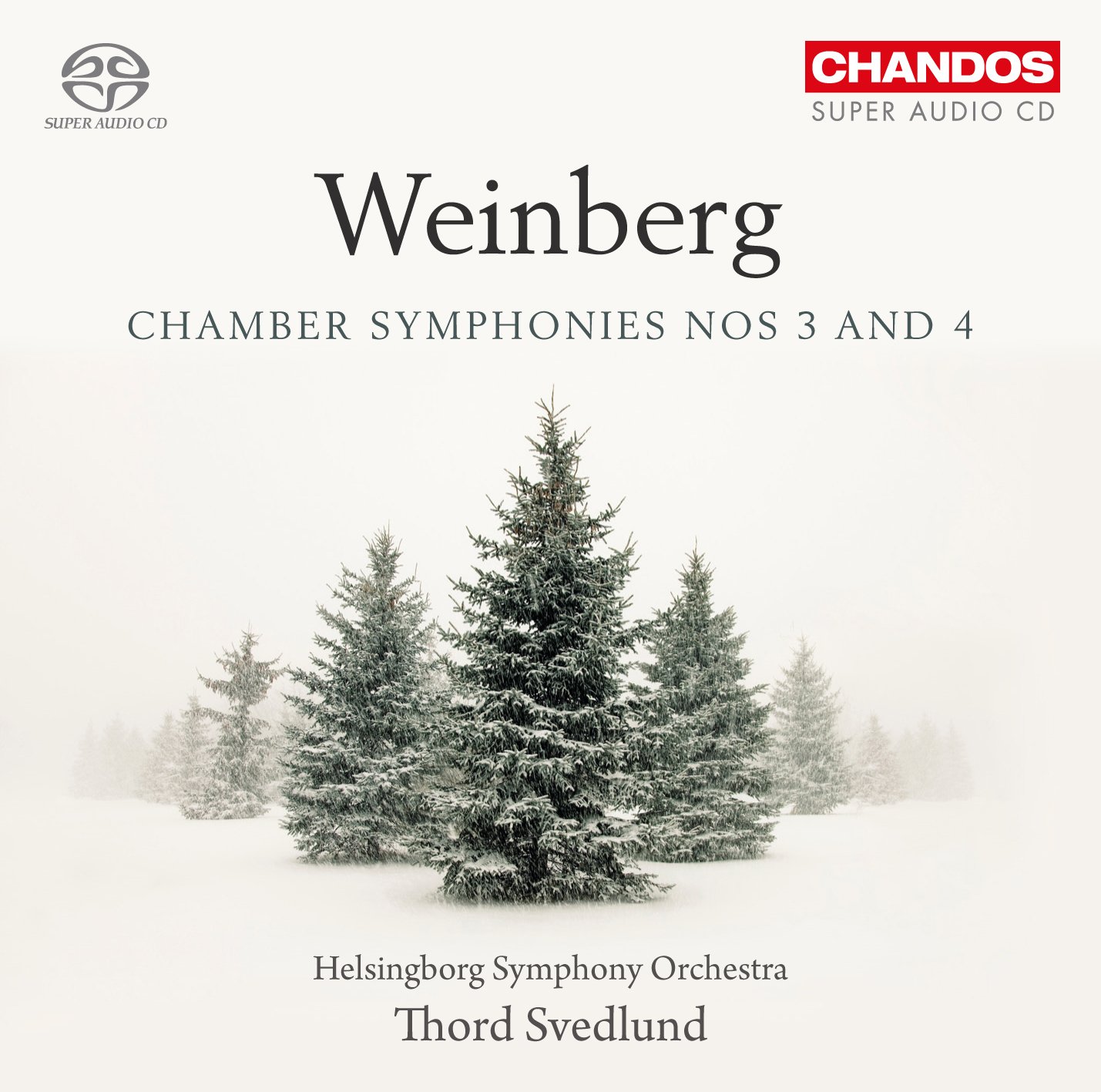
Weinberg - Chamber Symphonies Nos. 3 & 4, Helsingborg Symphony Orchestra, conducted by Thord Svedlund, Chandos records.

Tuesday, 27 January 2015

New production of 'The Passenger' in Frankfurt

There is an upcoming premiere for a new production of Weinberg's opera The Passenger, by Opera Frankfurt. The first performance will be on 1 March 2015. The production is directed by Anselm Weber and conducted by Leo Hussain.

From PeerMusic's press release:

A new production of the opera The Passenger by Mieczyslaw Weinberg is being premiered at the Opera Frankfurt on 1 March 2015.

Beforehand, a particular event has been arranged with Zofia Posmysz about her story the libretto is based on: The woman who has been the "Passenger" on 28 February 2015. 70 years after the rescue of concentration camp Auschwitz, this moving drama is newly staged as a plea against oblivion. Mieczyslaw Weinberg set in music what is rather beyond expression. "All who listen to a witness are going to be witnesses themselves." Elie Wiesel, Nobel peace laureate.

On the other side of the Atlantic The Passenger reaches after the Houston Grand Opera and the Lincoln Center Festival in New York in 2014, the Lyric Opera of Chicago now with its premiere on 24 February 2015.

David Pountney called his production "my most important cultural act". The director, who has been awarded the Cavalier Cross of the Republic of Poland, premiered the opera at the Bregenz Festival in 2010. Until its arrival in the US "his" passenger traveled over the Wielki Teatr in Warsaw and the English National Opera in London, where it was nominated for the Lawrence Olivier Award in the category of best new opera production.

The Baden National Theatre in Karlsruhe already presented a very successful new production of the opera The Passenger as German first performance in 2013.

We are wishing the Frankfurt staged Passenger a likewise huge success.
Further details for the production, including ticket bookings, can be found here

Thursday, 15 January 2015

What's in a name? The case for Weinberg, Wajnberg, or Vainberg?

The story of Weinberg's music since his death in 1996 has often started with one key issue: how to spell his name. This might seem obvious, but in Weinberg's case, it is wrought with problems. There are several options, each with their own line of reasoning:

         Weinberg
         Wajnberg
         Vainberg
         Vajnberg
         Wainberg

This might not seem like much of an issue, but when it comes to things like searching archives or record labelling, the significance becomes apparent. As you might have noticed, I stick to the 'Weinberg' spelling, but even I am beginning to have my doubts about this option.

Of course, David Fanning's monograph on the composer uses the 'Weinberg' spelling, as does the Osteuropa 2010 issue, and the majority of western CD releases. 

In this article, I'll quote several authors on their reasoning behind their choice of spelling, before providing some further examples. The final choice, I believe, rests with the reader.

Tuesday, 6 January 2015

RMA Research Students' Conference, Bristol

I will speaking as part of this year's Royal Musical Association Research Students' Conference, held at Bristol University. My paper is titled '"Keepin' it Real?" Psychoanalysis and Socialist Realism', utilising several ideas from my current work on my thesis project (abstract below). I will speaking on Friday 9 January at 10:50 in the Albert's room at the music department of Bristol University.

'Keepin' it Real?' Psychoanalysis and Socialist Realism
Socialist Realism was an aesthetic doctrine enforced throughout the Soviet Union from the mid-1930s onwards. It was broadly defined as art that ‘depicts reality in its revolutionary development’. Socialist-realist art reflected the long-term goals of Soviet communism - not necessarily the everyday reality of life for Soviet citizens. In music this translated into works appealing to as broad an audience as possible, with emphasis on tunefulness, accessibility, and folk traditions. The complex layers of meaning in socialist realist music have often been noted. It can, however, be all too easy to dismiss socialist-realist music, opting instead for works that pushed against the trend. This is where my link between socialist-realist music and psychoanalysis emerges.
Utilising the writings and theories of Lacan, Žižek, and other post-Freudians, psychoanalysis has been gaining attention and significance as a fruitful and useful method for cultural-analysis, including music. Psychoanalysis questions constructions of concepts such as self, dialogue, society, and meaning, all through the gaze of a multitude of thinkers. It has proved particularly suited to music observed to be rich in  psychological meaning – including composers such as Schoenberg and Scriabin. Its methods are ideally suited to application for the joint world of politics-meets-kitsch that is socialist realism.
In this paper, I will be outlining some basic definitions of socialist realism, and of psychoanalysis. With these in place, I formulate an outline approach for analysis of socialist-realist works through the guise of various post-Freudian methodologies.