Showing posts with label Britten. Show all posts

Wednesday, 9 April 2014

Britten and Weinberg

The recent programming on a Challenge records disc combined Weinberg's Violin Concerto alongside that of Benjamin Britten. As well as being an excellent album (see my review here), the combination of Weinberg and Britten proved a well-suited duo. There are numerous reasons for this, the most obvious also being the most simple: Britten's influence can often be heard in Weinberg's music, particularly in his Operas.

Britten and Shostakovich, 1966.

 The close friendship between Britten and Shostakovich is well known. Britten was one of the few people to stand up for Shostakovich's opera 'Lady Macbeth of Mtsensk' after its British premiere in 1936. Shostakovich was so impressed with Britten's War Reqiuem that he held it up as an example to his composition students. During the late 1960s and early 1970s, the two composers visited each other. Britten and Peter Pears stayed with Rostropovich and Vishnevskaya for New Year's, 1966. Over the course of their stay, they often saw Shostakovich and his wife Irina. Peter Pears wrote of the visit in his diary:

25th December, 1966
Christmas dinner at Slava's [i.e. - Rostropovich's]... Dmitri and Irena Shostakovich were there, punctual as always... Shostakovich in good form, talkative, nervous, Irena gentle, quiet, a marvellous foil for him.
1st January, 1967
 We were summoned for 10:00 pm at Dmitri's...We had a quick nip of vodka and...next came a meal around a long table groaning with drink and eats, and presents...a score of Dmitri's Stepan Razin for Ben, and a record of the same for me.
The Shostakovich's visited Britten at home in Aldeburgh in 1972, Shostakovich particularly excited to see the sketches for Death in Venice. Shostakovich wrote that had it not been for the language barrier that existed between himself and Britten, the two could have become close friends.

The musical parallels are close, with both composers adapting twelve-note rows into their music at around the same time, and each generously quoting the other's music. Notably - see Shostakovich's Fourteenth Symphony for the strong influence from Britten. With such a strong bond between the two composers, it was natural for Weinberg to be strongly familiar with Britten's music.

Admittedly, there isn't a scrap of recorded evidence to link the two. But it is certainly tempting to suggest that Weinberg would have met Britten during his stays in Moscow. We can certainly say that Weinberg and Shostakovich discussed Britten's music at length, and Weinberg's familiarity with Britten's work is evinced by his collection of scores and records. Shostakovich and Weinberg conversed about music on an almost daily basis. It is certainly tantalising to suggest that Shostakovich could have mentioned Weinberg's name to Britten.

Weinberg's Requiem, Op. 96, owes a large amount to Britten's War Reqiuem, a work that Shostakovich loved (according to Yevtushenko, author of 'Babi Yar', a poem that Shostakovich used in his Thirteenth Symphony, Shostakovich listened to Britten's War Reqiuem on repeat, crying all the way through).


An immediately noticeable similarity between the two works is the use of boy's voices to depict innocence. In Britten's case, the boy's choir sing texts by war poet Wilfred Owen interspersed between the text of the requiem mass. Weinberg's Requiem uses a selection of poetry from authors including Garcia Lorca and Mikhael Dudkin, in a multi-national array that also echoes Britten's War Requiem. They differ in their complexity, however, as Weinberg's work is beyond the grasp of amateur ensembles. Partly as a result of this, Weinberg's Requiem was not performed until 2009, in Liverpool. Meanwhile, Britten's War Reqiuem was famously commissioned for the reopening of Coventry Cathedral, and was premiered to international acclaim in 1962, four years before Weinberg began writing his work. 

It is in Weinberg's operas that the Britten influence becomes more telling. David Nice has rightly pointed out that 'by the late 1960s, when Weinberg completed The Passenger, one great composer of Russian operas, Sergei Prokofiev, was long dead, and the other, Shostakovich, had produced nothing completely new for the operatic stage in decades'. As such, Britten was the obvious leader in opera on the world stage at that time.

Weinberg waited until relatively late in his career before turning to opera. His first opera, The Passenger, is arguably is masterpiece (and you can read more about it in my article here), set in Auschwitz, in a triumph of humanist drama. Throughout, there are noticeable Britten-like passages, often built around chains of thirds. For instance, there is the following passage in The Passenger:


Strikingly reminiscent of the first sea interlude in Britten's Peter Grimes:


The similarities continue throughout Weinberg's other operas. For instance, there is Weinberg's use of folk songs and musical quotation, effortlessly woven into the music to emphasise aspects of the drama - a technique used extensively in Britten's operas. Perhaps the most notable of these is the Lamplighter's song in The Portrait - replete with characteristic Weinbergian fourths. The frequent use of Celesta in The Passenger also recalls Peter Grimes, and Weinberg's more extended use of percussion in The Passenger even anticipates Britten's Death in Venice.

To conclude, Britten's influence is easy to identify in Weinberg's music, as well as on a more abstract level, as they both shared similar humanistic ideals - in Britten's case, extending to his decision to be a conscientious objector during WWII. The question of how Weinberg came to know Britten's works is easily addressed when Britten's friendship with Shostakovich is taken into account, and the prescence of Britten's style in Weinberg's operas seems glaringly obvious if we consider that he was a world-leader on the operatic stage at that time (though, importantly, Weinberg would not have heard a Britten opera in concert in the Soviet Union during this time; his knowledge came through scores and recordings). Weinberg's debt to Britten is a fascinating trait - I intend to further this introductory article with a more thorough examination of Weinberg's operas, including The Portrait and The Idiot.

Tuesday, 25 March 2014

Review: Linus Roth - Britten and Weinberg Concertos


Challenge Classics CC72627, Violin Concertos by Benjamin Britten and Mieczysław Weinberg, Linus Roth (soloist), with the Deutsches Symphonie-Orchester Berlin, conducted by Mihkel Kütson. Liner notes by Jens F. Laurson. 

Another admirable release by the violinist Linus Roth, building on the foundation laid by his previous 3-disc album with the pianist José Gallardo - see my review here. Roth's playing is faultless throughout, and the detractingly cold sound from the previous recording is absent here, with the Deutsches Symphonie-Orchester Berlin providing a lush cushion for Roth's soloistic antics. The release also has the selling point of being a SACD disc, should you have suitable equipment to enjoy it (which I don't; being a humble student, such tech is well out of my price range).

The disc features the excellent programming of combining Britten and Weinberg; while the close connections between Britten and Shostakovich have often been noted, the influence on Weinberg is an underexplored topic itself. Keep your eyes posted over the next few weeks, I have a blog-post/article in the works on this very topic. 

Britten
I must profess that the Britten violin concerto, Op. 15, is not a work that I am familiar with. Indeed, aside from his stage works and music for choir, I am admittedly scant on recordings of Britten. I am an avid fan of his Piano Concerto, however, and it is with reference to this work that I plunged headlong into this recording. Reading from Jens F. Laurson's excellent liner notes, I see that it is a relatively early work, one of the first written after Britten had arrived in the US, 1939. 
   The music owes a great deal to the violin concerto by Berg, with several passages sounding strikingly similar. Overall, however, it is a charming work of great drama, with both tender and assertive moments. The opening Moderato con moto movement gives a tender opening, ripe with material for development. The vivace middle movement is my personal favourite, with a sweeping orchestral line recurring throughout. The final passacaglia movement is strongly reminiscent of Shostakovich, and serves as perhaps the strongest link to Weinberg's own musical language. 
   The solo part for the Britten, while virtuosic, also demands a great sense of leading a drama. Roth fills the position of orator admirably, with little doubt as to his coolness in the role. Balance across the orchestra is excellent, giving a well-polished sound, particularly emphasised in the 'punching' gestures to be heard in the middle movement. The recording throughout is nuanced and warm, paying attention to the delicacies of Britten's orchestration, as well as the ferocity of his punctuating motifs throughout. If anything, this encourages me to seek out Britten's other concerto works. 

Weinberg
Next I turn to a work that I am much more familiar with, Weinberg's Violin Concerto, Op. 67. Written in 1959 and dedicated to Leonid Kogan, it is a world apart from his Violin Concertino, which readers may be familiar with, owing to the spate of recordings released recently. If the concertino can be said to represent a cheerful attitude in the face of adversity, then the 1959 work is a serious soloistic piece, rich with drama. It was premiered by Kogan in 1961, with Kondrashin conducting. A star in his own right, Kogan had a reputation for his strongly pro-Soviet leanings - though this may be a result of his international success, which he whole-heartedly attributed to the support of the Soviet government (similar to Weinberg's own enthusiasm). The concerto is marked by its near-relentless solo part, which barely rests for more than a moment, particularly in the first movement. In its four-movement structure, the work harks back to the classical Concerto, a parallel reinforced by Weinberg's inclusion of a Mozart quote in the Adagio third movement (a theme taken from the 'little' G minor Symphony). My previous experience of this work stems from Kondrashin and Kogan's formidable recording, made soon after the premiere performance. After then, recordings have been few and far between (but include a Naxos-label CD featuring Ilya Grubert on violin). With an interpretation as strong as Roth and Kütson's here, it is my hope that this CD will act as a case for other soloists to take up this work. 
   Shostakovich wrote to his friend Isaak Glikman in 1960, mentioning Weinberg's Violin Concerto:
I am very impressed by M.S. Vainberg’s Violin Concerto... It is a magnificent work. And I am weighing my words.
Of course, Shostakovich's own violin concertos are apt for comparison with Weinberg's own, particularly Shostakovich's First Violin Concerto, written 1947-48.
   The first movement opens with a strident gesture, quickly answered by the soloist. This immediately establishes the soloist-ensemble dialogue over the course of the work - that the Violin solo really does lead the music, in a brawling drama that is fully sustained over the course of the whole Concerto. Roth's handling of the virtuosic part is excellent throughout, never rising above a controlled restrain through the most fiendish passages, while also extremely tender in the Adagio movement.

Overall, I cannot fault this recording, particularly the lush sound engineering. I can only hope that this disc can serve as a persuasive case to encourage other violinists to take up both of these works - but especially the Weinberg.

LINKS TO BUY:

The Challenge Records website - here (also featuring more information about the disc)
Amazon.co.uk - link.

Recommended comparative listening

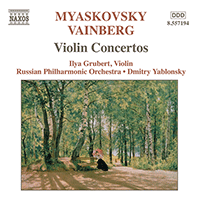
Naxos, Miaskovsky and Vainberg, Violin Concertos, Russian Philharmonic Orchestra, Dmitri Yablovsky cond., Ilya Grubert (Violin). Link here.

Melodiya - Vainberg, Violin Concerto and Symphony No. 4, Moscow Philharmonic Orchestra, Kiril Kondrashin cond., Leonid Kogan (Violin).
 - A really splendid recording, still setting the bar to which all others must live up to. The actual disc is rather tricky to find, though the recording has helpfully been uploaded onto youtube:


---------------------
And for those eager for more media from Mr. Roth, see this excellent youtube video, discussing the album:


P.S. - keep posted for my upcoming feature on Britten and Weinberg. D.E.