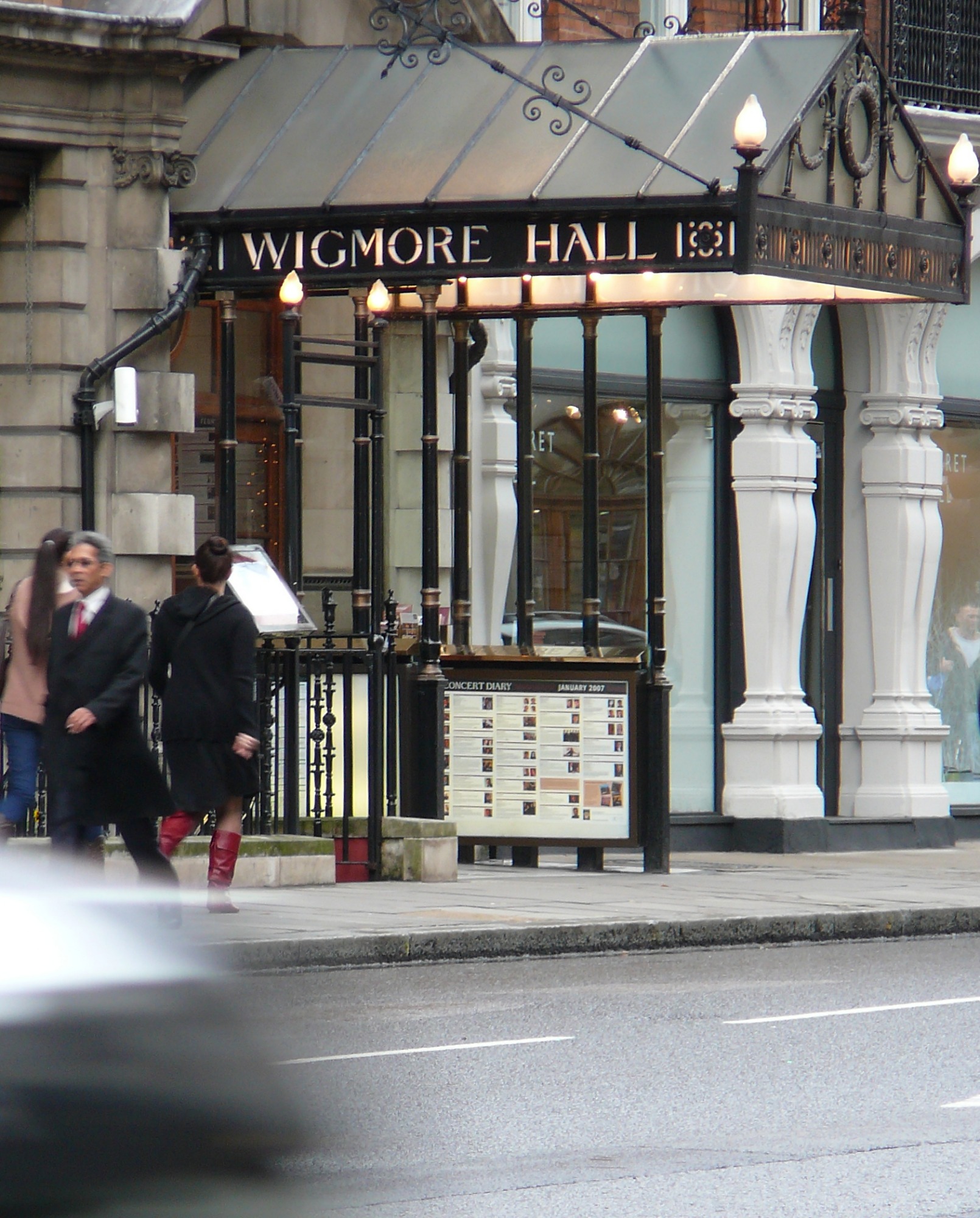
In the latest news relating to Weinberg's centenary year, I'm delighted to include details of the Weinberg season occurring at London's Wigmore Hall, beginning in October. The Wigmore Hall is one of the most famous venues for chamber music in the world, so it is wonderful that so much Weinberg will be performed there over the next few years.
In what it is certainly the most ambitious overview of Weinberg's chamber music ever attempted, the Wigmore Hall have announced that the Quatuor Danel will be performing a double-cycle of Weinberg and Shostakovich over two season, finishing in 2021. The Danels are, of course, the pioneers of Weinberg's String Quartets through their CPO recordings, and also their performances and work as part of their residency at the University of Manchester. The first concert will be on Thursday 24 October, with more throughout the 2019/20 and 2020/21 seasons.
Furthermore, Saturday 26 October brings an intensive day of events in the form of a Weinberg Focus Day. There will be three concerts of chamber music, featuring acclaimed violinist Linus Roth, including works for solo violin, violin and piano, piano trio, and song cycles. The day will also include a talk and launch event for my book Music behind the Iron Curtain. I will also be introducing each concert.
Further details can be found on the Wigmore Hall's website here and here. These look set to be incredibly exciting concerts and certainly a measure of how the Weinberg revival has come.
Dear readers - apologies for any lack of input on this blog over recent weeks - my academic work has started to fill almost all of my time (see below!). However, here's a few links to relevant events, releases and general titbits from the world of Weinberg to keep you going.
Releases
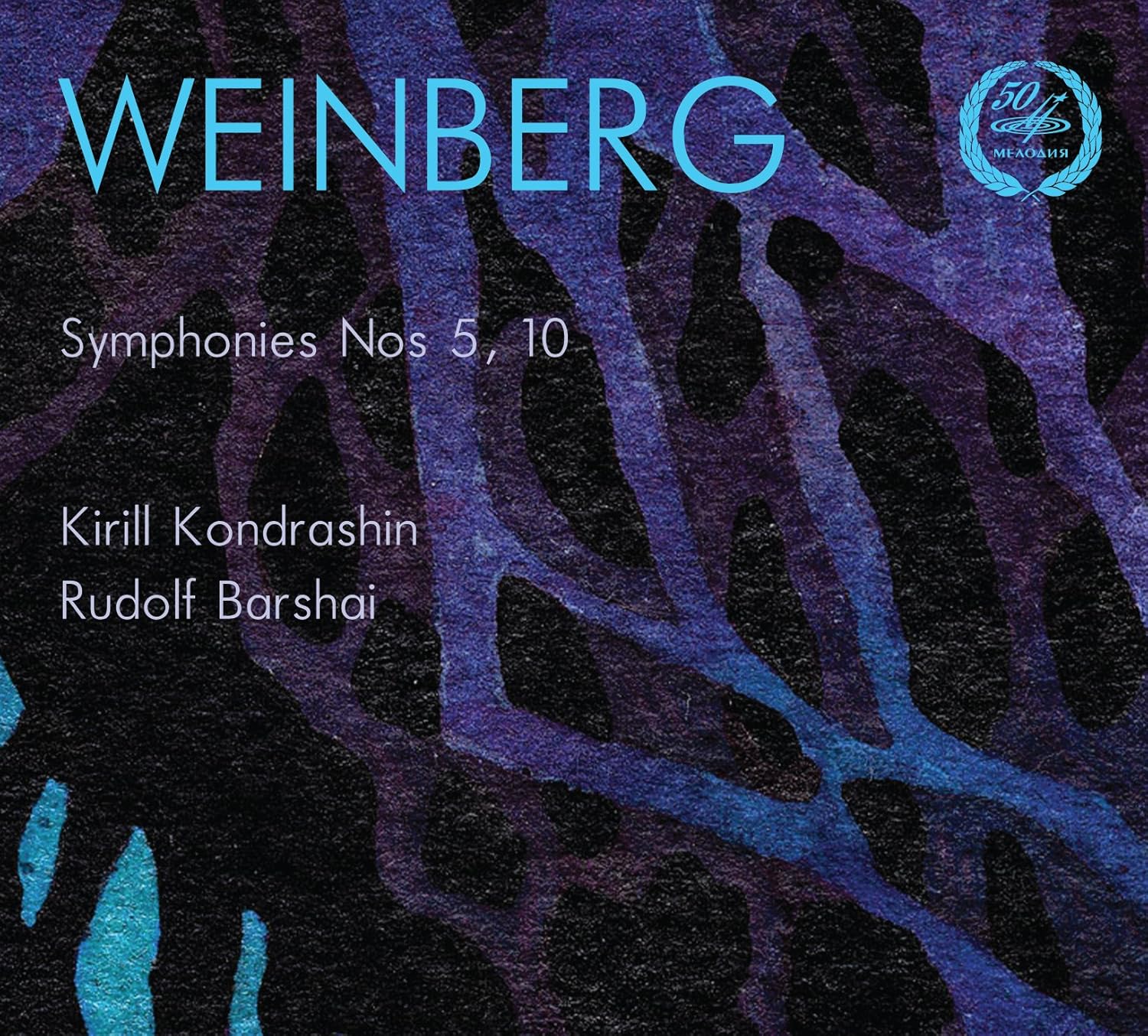
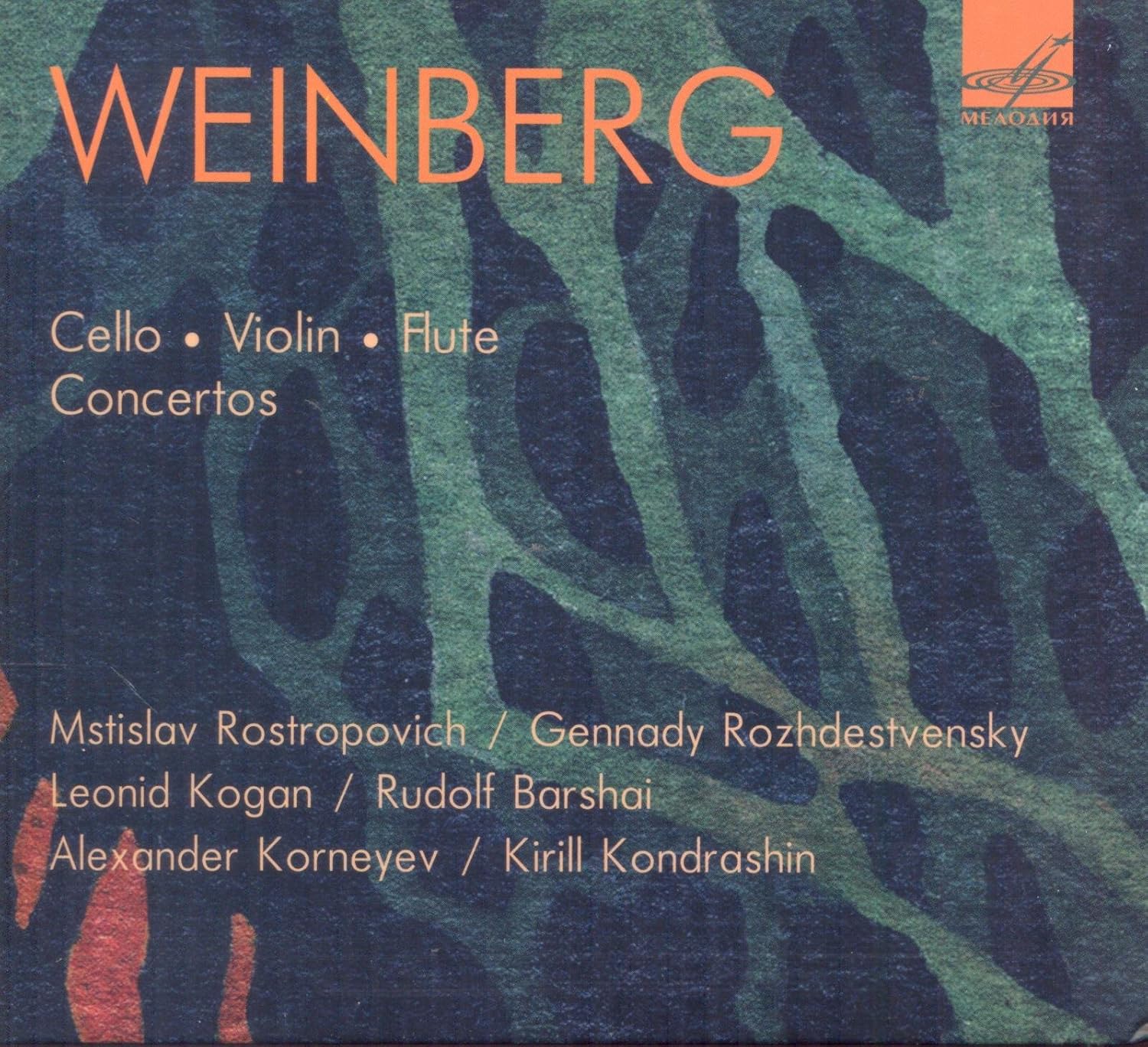
Probably the biggest story in recent Weinberg releases is the Russian label Melodiya opening their archives further, with two new CDs that are well worth investigating:
Melodiya - Weinberg Symphonies 5 & 10
Melodiya - Weinberg Concertos for Cello, Violin, and Flute
Of course, all of this music has previously been released long ago by Melodiya, but such releases have since become collector's items. With these new editions with an affordable price and attractive packaging, there is much to enjoy. The star factor of such artists as Kondrashin, Rostropovich, Kogan, Barshai, and more, is the icing on the cake.
An exciting new organisation has been created, with Irina Shostakovich as honorary president: the International Mieczysław Weinberg Society. The violinist Linus Roth, well-known to Weinberg enthusiasts for his excellent recordings, has played a large role in founding the group. Their website can be found here. They list the following mission statement:
The International Weinberg Society was founded
to promote the music of Mieczysław Weinberg, to bring attention to his
works, to encourage musicians to perform his music and make him known to
a wider audience.
Its mission is to organise concerts, lectures, exhibitions and
multidisciplinary events which are focused on Weinberg´s music and life,
his close connection to Dimitri Shostakovich and his importance to
classical music in the 20th century.
One of the Society´s objectifs is to contribute to the financing of
recordings of his music, as well as the publication and translation of
articles and books about his life.
This new organisation appears to be one to watch - it has the approval of numerous Weinberg supporters, including Tommy Persson, Thomas Sanderling, David Pountney, PeerMusic, Sikorski, The International Shostakovich Society, and many more. Any organisation dedicated to furthering recordings and publications on Weinberg's life and works has my full support and approval.
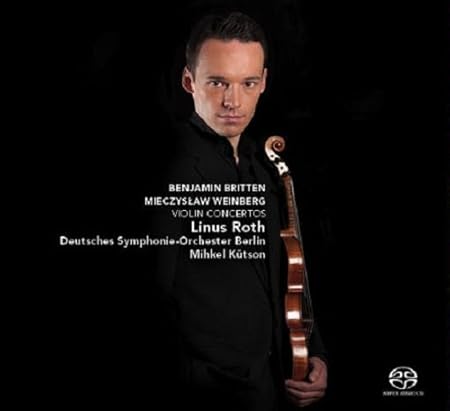
Challenge Classics CC72627, Violin Concertos by Benjamin Britten and Mieczysław Weinberg, Linus Roth (soloist), with the Deutsches Symphonie-Orchester Berlin, conducted by Mihkel Kütson. Liner notes by Jens F. Laurson.
Another admirable release by the violinist Linus Roth, building on the foundation laid by his previous 3-disc album with the pianist José Gallardo - see my review here. Roth's playing is faultless throughout, and the detractingly cold sound from the previous recording is absent here, with the Deutsches Symphonie-Orchester Berlin providing a lush cushion for Roth's soloistic antics. The release also has the selling point of being a SACD disc, should you have suitable equipment to enjoy it (which I don't; being a humble student, such tech is well out of my price range).
The disc features the excellent programming of combining Britten and Weinberg; while the close connections between Britten and Shostakovich have often been noted, the influence on Weinberg is an underexplored topic itself. Keep your eyes posted over the next few weeks, I have a blog-post/article in the works on this very topic.
Britten
I must profess that the Britten violin concerto, Op. 15, is not a work that I am familiar with. Indeed, aside from his stage works and music for choir, I am admittedly scant on recordings of Britten. I am an avid fan of his Piano Concerto, however, and it is with reference to this work that I plunged headlong into this recording. Reading from Jens F. Laurson's excellent liner notes, I see that it is a relatively early work, one of the first written after Britten had arrived in the US, 1939.
The music owes a great deal to the violin concerto by Berg, with several passages sounding strikingly similar. Overall, however, it is a charming work of great drama, with both tender and assertive moments. The opening Moderato con moto movement gives a tender opening, ripe with material for development. The vivace middle movement is my personal favourite, with a sweeping orchestral line recurring throughout. The finalpassacaglia movement is strongly reminiscent of Shostakovich, and serves as perhaps the strongest link to Weinberg's own musical language.
The solo part for the Britten, while virtuosic, also demands a great sense of leading a drama. Roth fills the position of orator admirably, with little doubt as to his coolness in the role. Balance across the orchestra is excellent, giving a well-polished sound, particularly emphasised in the 'punching' gestures to be heard in the middle movement. The recording throughout is nuanced and warm, paying attention to the delicacies of Britten's orchestration, as well as the ferocity of his punctuating motifs throughout. If anything, this encourages me to seek out Britten's other concerto works.
Weinberg
Next I turn to a work that I am much more familiar with, Weinberg's Violin Concerto, Op. 67. Written in 1959 and dedicated to Leonid Kogan, it is a world apart from his Violin Concertino, which readers may be familiar with, owing to the spate of recordings released recently. If the concertino can be said to represent a cheerful attitude in the face of adversity, then the 1959 work is a serious soloistic piece, rich with drama. It was premiered by Kogan in 1961, with Kondrashin conducting. A star in his own right, Kogan had a reputation for his strongly pro-Soviet leanings - though this may be a result of his international success, which he whole-heartedly attributed to the support of the Soviet government (similar to Weinberg's own enthusiasm). The concerto is marked by its near-relentless solo part, which barely rests for more than a moment, particularly in the first movement. In its four-movement structure, the work harks back to the classical Concerto, a parallel reinforced by Weinberg's inclusion of a Mozart quote in the Adagio third movement (a theme taken from the 'little' G minor Symphony). My previous experience of this work stems from Kondrashin and Kogan's formidable recording, made soon after the premiere performance. After then, recordings have been few and far between (but include a Naxos-label CD featuring Ilya Grubert on violin). With an interpretation as strong as Roth and Kütson's here, it is my hope that this CD will act as a case for other soloists to take up this work.
Shostakovich wrote to his friend Isaak Glikman in 1960, mentioning Weinberg's Violin Concerto:
I am very impressed by M.S. Vainberg’s Violin Concerto... It is a magnificent
work. And I am weighing my words.
Of course, Shostakovich's own violin concertos are apt for comparison with Weinberg's own, particularly Shostakovich's First Violin Concerto, written 1947-48.
The first movement opens with a strident gesture, quickly answered by the soloist. This immediately establishes the soloist-ensemble dialogue over the course of the work - that the Violin solo really does lead the music, in a brawling drama that is fully sustained over the course of the whole Concerto. Roth's handling of the virtuosic part is excellent throughout, never rising above a controlled restrain through the most fiendish passages, while also extremely tender in the Adagio movement.
Overall, I cannot fault this recording, particularly the lush sound engineering. I can only hope that this disc can serve as a persuasive case to encourage other violinists to take up both of these works - but especially the Weinberg.
LINKS TO BUY:
The Challenge Records website - here (also featuring more information about the disc)
Amazon.co.uk - link.
Recommended comparative listening
Naxos, Miaskovsky and Vainberg, Violin Concertos, Russian Philharmonic Orchestra, Dmitri Yablovsky cond., Ilya Grubert (Violin). Link here.
Melodiya - Vainberg, Violin Concerto and Symphony No. 4, Moscow Philharmonic Orchestra, Kiril Kondrashin cond., Leonid Kogan (Violin).
- A really splendid recording, still setting the bar to which all others must live up to. The actual disc is rather tricky to find, though the recording has helpfully been uploaded onto youtube:
---------------------
And for those eager for more media from Mr. Roth, see this excellent youtube video, discussing the album:
P.S. - keep posted for my upcoming feature on Britten and Weinberg. D.E.
Coming May 2014 - the next installment in the Naxos Weinberg Symphonies series, featuring Vladimir Lande and the St. Petersburg State Symphony Orchestra and Chamber Choir (Lande and the Orchestra having already featured on three Naxos Weinberg releases previously).
Performing the 18th Symphony, Op. 138 'War, there is no word more cruel', and the Trumpet Concerto, Op. 94, featuring Andrew Balio.
(My thanks go to Claude Torres for drawing my attention to this release).
My work is ticking along nicely, with my attention now on writing my thesis itself, focusing on the context and analysis of Weinberg's Seventeen String Quartets.
I am also very happy to announce that I have an article coming out in the Musical Times hopefully by the end of this year, entitled 'Weinberg, Shostakovich, and the Influence of Anxiety'. See abstract below:
The close friendship between Weinberg and Shostakovich is well documented, particularly concerning their string quartets. The pair discussed their works during compositional gestation, and a friendly ‘competition’ for writing quartets started between them in the 1950s. Each was ‘winning’ at different points in time, but Weinberg was the ultimate victor with seventeen by the time of his death in 1996. The strong influence of Shostakovich in Weinberg’s music has been grounds for criticism and even dismissal, but what is less known is the truly reciprocal nature of their creative relationship. Weinberg was thirteen years his junior, but his first quartet predates Shostakovich’s by a year. Weinberg’s early work was prolific, having written six quartets by the time of Shostakovich’s third in 1946. Examining Shostakovich’s scores following these works reveals a great exchange of ideas between the two friends, with an undeniable influence from Weinberg in several pieces. With examples from the music of both composers, this article maps out a network of mutual influence. Such an unusual case study fits uneasily within several theorists' conceptions of artistic influence, none more than Harold Bloom and his book The Anxiety of Influence. Building on Weinberg and Shostakovich's example, I argue that Bloom's theory is not only ill-suited to their friendship, but indicative of a wider out-dated trend across theoretical thinking in the arts.
Upcoming releases
The month of February brings several exciting Weinberg releases, some already available, some new and some with world premiere recordings.
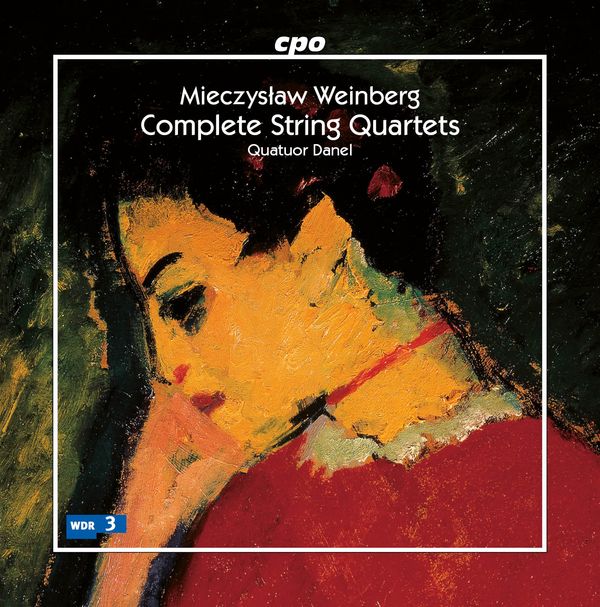
First of all, the CPO label will be issuing a boxset of Weinberg's String Quartets, as recorded by the Quatuor Danel. Seeing as these recordings form a cornerstone that I consult on a daily basis, I can't recommend these enough. The six-volume cycle will be packaged in one box-set, at the extremely attractive price of EUR 29.99. From the CPO's site: (link).
Mieczyslaw Weinberg’s genuinely awe-inspiring complete seventeen string
quartets are now available in a box set in interpretations by the
Belgian Danel Quartet that can only be described as a musical blessing.
Inspired by Shostakovich’s widow Irina (and other factors), the Quatuor
Danel began acquiring the scores of all seventeen Weinberg quartets in
1995 and after a number of years (2007 to 2012) has now finished its
complete recording for cpo. The BBC Music Magazine immediately named the
first volume the best chamber music CD in March 2008, and further
prizes followed. klassik-heute. com wrote, »In content and skill the
works are equal to good works by Shostakovich, but this does not at all
mean that Weinberg was a Shostakovich imitator. The Danels perform with
unabating, often almost urgent intensity.« And Weinberg’s teacher and
friend Shostakovich never missed an opportunity to recommend the works
of his friend and fellow musician Weinberg. They were brothers in
spirit. Both worked in manifold genres and over a broad stylistic
spectrum ranging from folklore (in Weinberg’s case, Jewish folklore in
particular) to twelve-tone elements. In the field of the string quartet
Shostakovich involved his pupil in a friendly competition and was very
happy in 1964 to be the first of the two to write his No. 10. Our final
volume received the highest marks from klassik-heute. com: »A full 10
for exciting music and its enthralling interpretation by an exciting
ensemble.«
--------------------
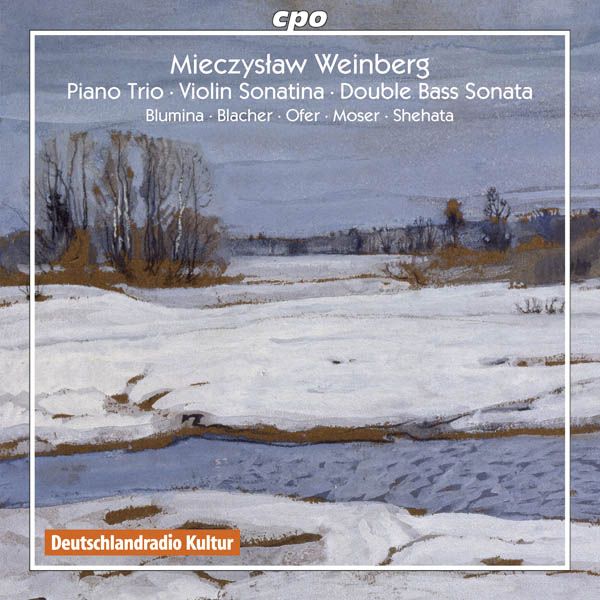
There is also news of another upcoming release from the CPO label - 'Chamber Music for Strings'.
Led by the same musician who brought us the 'Chamber Music for woodwinds' release a few years ago, Elisaveta Blumina, the release promises to feature the following works:
Piano trio op. 24;
Sonatina for Violin & Piano op. 46;
Sonata for Double Bass solo op. 108
If the previous cd is anything to go by, this should worth buying.
---------------------
I mentioned world-premiere recordings above, and the latest disc from Toccata Classics promises just that.
This upcoming disc is listed as 'in preparation' on the Toccata website (with very little information provided besides that and the album cover, seen above). Works to be featured:
The Siberian Symphony Orchestra, under Dmitry Vasilyev.
I must admit, I'm particularly excited about this release, I'm always pleased with premiere recordings. This leaves just Symphonies 9, 11, 13 and 15 still to be recorded.
--------------
Of course, is you can't until these discs are released, I still heartily recommend Gidon Kremer and the Kremerata Baltica's 2-disc set, which was something of a revelation when I reviewed it here.
-------------
Here's a few of the latest youtube videos of Weinberg:
Linus Roth and José Gollardo play the Weinberg Sonatina, Op. 46:
A preview of the Naxos Symphony 12 recording: (see my review here).
My own work is ticking along nicely. I recently survived my latest PhD assessment panel. My writing is now focusing on analysis of the Weinberg Quartets - I'm currently up to 12 out of 17! In publication news, I am pleased to announce that my manuscript for a set of conference proceedings has been submitted, with the full text available hopefully from June of this year, with paper copies available some time in Winter. Until then, some of my academic work is available for you to read on my profile on Academia.edu - link.
Hello readers, I hope all is well. This is my update for January 2014. As I'm sure you are aware, The Passenger premiered in Houston, Texas on Saturday 18th January, and I eagerly await a plethora of reviews. Below is a selection of those already published:
David Clarke, Broadway World - link 'the only appropriate superlative to describe HGO's US premiere of The Passenger is brilliant'.
Scott Cantrell - Dallas Morning News - link 'Sadly, the opera could use a lot of editing and tightening... three hours, with one intermission, seemed interminable'.
D.L. Groover - Houston Press - link 'Weinberg's forgotten opera is everything contemporary opera should be... a shattering experience'.
I shall update the above list, hoping to keep a balance between critical and praise-ridden reviews.
If my predictions are correct, The Passenger will go down a storm with US audiences and critics, but only time will tell. Future US runs are planned for New York in July, and Chicago in 2015.
Melody Moore and Michelle Breedt in 'The Passenger', Houston Grand Opera 2014.
-----------------
I hope you'll find the youtube videos below interesting.
1. Linus Roth discusses his upcoming release, featuring the Britten and Weinberg violin concertos.
2. Gidon Kremer and Martha Argerich perform Weinberg Sonata for Violin and Piano No. 5, Op. 53 (live recording).
----------------
I'd like to plug an updated version of the University of Manchester's webpage about Weinberg research at the University (link). The page sums up the wider impact of Professor Fanning's research, and details several exciting projects for the future.
-----------------
My own work is plodding along well, with another big panel meeting assessment for next week. I am submitting a literature review chapter for the meeting, in which I detail approaches to analysis that I wish to apply to Weinberg's quartets. I'll keep you posted with updates.
I also mentioned in December that I was lucky enough to be accepted to speak at the University of Leeds conference 'Music, Memory and Migration in the Post-Holocaust Jewish Experience', taking place July 2014. Please find the abstract for my paper below:
Commemorating the Past: Weinberg’s Experience as a Jewish Migrant in the USSR
Weinberg’s background is unique among Soviet composers; he fled eastwards from Poland in 1939 and was accepted into the USSR. He established a successful career for himself, working with the most prominent Jewish musicians of his day and praised as ‘the leading Soviet-Jewish composer’. Having narrowly escaped Nazi Germany, Weinberg fell victim to Stalinist antisemitism and was imprisoned for several months in 1953. Upon his release, he made it his life’s mission to commemorate those who had fallen victim to atrocities.
Jewish themes in Weinberg’s music serve a dual purpose; to commemorate victims of the Holocaust, including his parents and sister, and to reassert his Jewish heritage, despite his displacement to a less-than hospitable climate. An internal struggle can be traced across his music, to reconcile between the need to celebrate his heritage as well as to celebrate the USSR as his ‘saviours’ from the Nazis. In this paper, I explore the experience of Jewish composers in the Soviet Union through Weinberg’s case study. I also outline Weinberg’s commemorative works including, most controversial of all, his opera The Passenger. The opera is provocative, not least because the on-stage action is set in Auschwitz itself. This provides fresh challenges for modern-day audiences and critics alike. The Passenger also calls into question the appropriateness of commemoration through depiction, alongside Weinberg’s struggle to represent his displacement through music.
While it is certainly difficult to watch, the only appropriate superlative to describe HGO's US Premiere of THE PASSENGER is brilliant
While it is certainly difficult to watch, the only appropriate superlative to describe HGO's US Premiere of THE PASSENGER is brilliant.
Just a quick note, to mention another upcoming release to add to your New Year's list.
Challenge Records have announced that Mr. Linus Roth is continuing his engagement with Weinberg's music with another disc to be released in January, pairing Weinberg's Violin Concerto, Op. 67, with Britten's youthful Violin Concerto, Op. 15. With the Deutsches Symphonie-orchester Berlin and Mikhel Cütson conducting.
To be released in January. Expect good things.
For more info, see the Challenge Records website here.
See my review of Roth's three-disc set of the complete works for Violin and Piano - review link.
This latest recording brings us several treasures in an exquisitely presented anthology set.
Almost everything about this release is verging on the realm of extraordinary. A 3-disc boxset of Weinberg works is a first, to begin with. Then there was the press announcement, just six days ahead of release at the end of last month. Furthermore, reading through the liner notes, we see that the 3 hours of material on this release was recorded over just six days in January - February at the start of this year. Even more, Linus Roth plays a Stradivari violin on this recording, a contributing factor to his excellent tone throughout. Of course, the world premiere recordings of Sonatas 2 and 6 go without saying. Currently, this set is tucked away on the internet, though I am sure it will emerge into the mainstream markets. I am so sure of this because this is one of the best recordings I have heard for a long while.
The set opens with Weinberg's fifth sonata for violin and piano, a work that could lay a reasonable claim to being one of the masterpieces of his chamber music. The combination of gentle rocking textures in the first movement is perfectly contrasted by the searching Allegro molto second movement. Roth takes the demanding violin part all in his stride - complete with fiendish double and triple stopping passages. Of course, Weinberg's writing in these works sets the two instruments on an equal footing, Gallardo's piano part every bit as difficult as the violin's.
Weinberg's fourth sonata is a direct predecessor to the character of the fifth, opening with a contemplative first movement before a fiery middle movement. The range of dynamic contrast and playfulness on display here does full justice to Weinberg's demanding writing.
The Rhapsody on Moldavian themes, Op. 47, is a rarer work to hear (having not been recorded since the 1960's). A favourite of David Oistrakh's, Roth rises above the daunting challenge of this work. Listen out for the spirited Jewish-inflected dancing throughout (especially just after the four minute mark).
The Third Sonata begins with a searching character, but shifts to more searching themes in its remaining movements. It has long proved a rich source for the tender lyricism that sets Weinberg apart from his contemporaries. The balance between the two players is generally excellent throughout this set, but occasionally the piano can sound dull in comparison to the violin - arguably a minor fault of recording than anything to do with the performances. My particular favourite moment in this first work is the Allegretto cantabile third movement, here performed with a pleasing rubato.
The Sonatina Op. 46 is a sister-work to the Sonatina for Piano, Op. 49, although in this case, the music is much more fully developed (in the piano Sonatina, a wide combination of themes fizzle out of energy before they achieve synthesis - here, the work is a fully realised piece). The pair perfectly sum up the wistful character of this piece, which demands a certain innocence in its interpretation. The Lento movement is particularly beautiful (and perhaps owing a debt to the Shostakovich cello sonata, slow movement).
And onto the first premiere of this set - the Second Sonata, Op. 15. Capturing something of the childlike innocence of the Second String Quartet, this work presents Weinberg during his first forays into maturity with the instrumental sonata form, and indeed, the beginnings of mastery for writing for the violin. It opens with tender high notes beneath a churning piano, which increases in intensity towards the minor mode. Weinberg's thematic development is excellent here, abandoning classical sonata structures for his first movement, which instead resembles a rhapsody in character. The Lento movement explores the lower registers of the piano with a heavily romantic mood in the violin soloist (similar to that heard in the Aria for String Quartet, Op. 9). Indeed, this movement could be compared to Schubert in its singing character, as well as the great contrasts established between major and minor modes. The final movement takes a slightly sedate pace at first, increasing in textural complexity to give the sense of climax to finish the work. Roth and Gallardo prove admirable pioneers for the work.
The opening of Weinberg's First Sonata gives the pair the chance to demonstrate their impeccable ensemble work. Beginning with gentle octaves, before a piano counterpoint against the violin briefly creates a three-part texture, perfectly balanced in this recording. The biting character of this whole movement is perfectly maintained with virtuosic control. However, the tender love-song of the Adagietto is not neglected, but performed with beautiful elegance.
The Sonata No. 6 is here numbered Op. 136bis, since the Op. 136 was assigned to both the Fourth Solo Viola sonata and this work. The most elegant solution seemed to be to dub this work 'Op. 136bis'. It begins with an extended passage for solo violin, placing us firmly in Weinberg's harmonic language of the 1980's, with all the tonal and post-tonal structures that that includes. The violin line is punctuated with several double-stopping chords, establishing a two-part texture resembling a demonic Bach. The piano only joins in in answer to painfully high notes in the violin, almost continuing the line in conversation. A densely rhythmic dialogue begins between the two, interrupted with tritone chords in the violin. This world premiere certainly presents a work that proves a challenging listen. The Adagio continues the pained character, with a constant focus on the minor mode, though within more tonally-centered means than those seen in the opening movement. The pain throughout distorts into outright anger in the final movement, with connotations of violence in the near-wailing violin line. A struggle is acted between the two parts, with wrestling counterpoint and violent cluster chords in both voices. Roth and Gallardo prove themselves adept even in this most challenging of works.
To finish the set, Weinberg's set of pieces written still in Warsaw, at the age of 14/15. Without opus number, they portray a great sense of ambition in the young composer, firmly grounded in the impressionistic style that marks his very earliest works. Influence of Debussy and Szymanowski can be heard throughout these three pieces - Weinberg had not undertaken any composition tuition at this point, so took his inspiration from the piano music that he loved. The Nokturn that opens the set builds in character, from the rhapsodic opening, towards to Lisztian textures - perhaps betraying the young writer's lack of experience in writing for solo violin, however. The Scherzo movement certainly owes a great deal to the fast sections from Bartók and Prokofiev, with a youthful energy, further exacerbated by triplet rhythms and dotted accompaniment in the high register of the piano. The final movement's opening figuration in the violin still further betrays the composer's inexperience in writing for the violin - the alternating chords are simply lifted from a standard piano texture. The movement continues dreamily, with a Debussy-esque lack of centre and movement. For a young composer's first forays into the form, these pieces show great promise, and they prove an excellent trio to finish this set.
------------------------------
Altogether, then, these discs are remarkable. The performances of both artists are virtuosic and commendable, while the recording quality is generally excellent - though with one or two issues between balance as I have mentioned above. The premiere recordings couldn't be handled more expertly. I recommend this recording to anyone with an interest in Chamber music, or in twentieth-century music in general. In addition to all this - I cannot fault the price, a 3-disc set for the price of one CD! Jens F. Laurson also provides generally excellent liner notes, complete with footnotes. I would also hold it up as an excellent introductory set into the music of Weinberg - while it contains great contrasts between the pieces (including a near-thirty year gap between the 5th and 6th sonatas!!), I believe it sums up the main elements of Weinberg's perfectly in an accessible and attractive 3-disc set, suitable for all listeners.