Thursday, 28 May 2015

Biographies of Weinberg's parents

The following biographies are taken from the six-volume book 'Leksikon fun Yidishn Teater', edited by Zalmen Zylbercweig, published between 1931 and 1969. There is an online project to translate the whole work into English, which can be found at the following website. 

The biographies make for fascinating reading, though they should be read with the following warning. Zylbercweig's book is well-known for its inaccuracies, reflecting the difficult circumstances with which it was written. The Yivo Encyclopedia page on Zylbercweig has the following caveat about the book: 


Zylbercweig’s encyclopedia, a monument to his extraordinary dedication, reflects both his scholarly limitations and the difficult conditions of his work. The volumes have been insufficiently edited and contain errors and imprecise data. Even more problematic is the matter of sources. Although he provides bibliographies of varying degrees of accuracy at the end of each article, much of Zylbercweig’s information is based on his subjects’ personal communications, often about their own careers. The longer articles typically consist of lengthy citations from insufficiently identified sources that can be traced, if at all, only with great effort. However, the Leksikon is also a vast source of social and cultural documentation.
Michael C. Steinlauf, writting for the Yivo Encyclopedia of Jews in Eastern Europe - link. 

Bearing that in mind, I here reproduce both biographies in their English translation, with a few of my own notes afterwards.

Sunday, 19 April 2015

International Mieczysław Weinberg Society founded


An exciting new organisation has been created, with Irina Shostakovich as honorary president: the International Mieczysław Weinberg Society. The violinist Linus Roth, well-known to Weinberg enthusiasts for his excellent recordings, has played a large role in founding the group. Their website can be found here. They list the following mission statement:
The International Weinberg Society was founded to promote the music of Mieczysław Weinberg, to bring attention to his works, to encourage musicians to perform his music and make him known to a wider audience.
Its mission is to organise concerts, lectures, exhibitions and multidisciplinary events which are focused on Weinberg´s music and life, his close connection to Dimitri Shostakovich and his importance to classical music in the 20th century.
One of the Society´s objectifs is to contribute to the financing of recordings of his music, as well as the publication and translation of articles and books about his life.
This new organisation appears to be one to watch - it has the approval of numerous Weinberg supporters, including Tommy Persson, Thomas Sanderling, David Pountney, PeerMusic, Sikorski, The International Shostakovich Society, and many more. Any organisation dedicated to furthering recordings and publications on Weinberg's life and works has my full support and approval. 

Tuesday, 24 March 2015

Shmuel Weinberg's recordings


Shmuel Weinberg (1882-1943) was born in Chișinău, Moldova. He taught himself to play violin from the age of 7, and joined a touring theatre group in 1899, serving as violinist, conductor, and chorus master. The group toured round Eastern Europe, including an extended residency in Vilna. In 1914, Shmuel took up an invitation to join a troupe in Lodz, and two years later joined the Warsaw Jewish Theater. With this company, Shmuel conducted the orchestra for plays, evenings of music hall songs, and comedy revues. Shmuel wrote the music for several of the theatre's productions.

The Orchestra was of a good standard and focused mainly on incidental music, song accompaniments, and settings of Yiddish folk songs. 

Wednesday, 11 March 2015

Weinberg String Quartet No. 16, Op. 130 - Programme Note

Here's the programme note that I provided for the Quatuor Danel's concert at the Manchester Grammar School, 27/02/15:


Mieczysław Weinberg (1919-1996)
Quartet No. 16, Op. 130

I. Allegro
II. Allegro
III. Lento
IV. Moderato

The last time Weinberg saw his younger sister, Ester, she was limping into the distance, heading back to their parents’ house. In September 1939, the two siblings had fled from the Nazi invasion of Warsaw, heading east towards the USSR. Ester soon turned back because her shoes hurt her feet. Weinberg continued alone, and went on to reach the safety of the USSR. His parents and sister were later murdered in the holocaust.
            When Weinberg came to write his Sixteenth Quartet in 1981, he dedicated it to the memory of his sister, who would have turned sixty that year. It features a marked return to his Jewish heritage, as well as a new renewed interest in Bartók. The first movement opens with a striking passage for first violin and the lower voices give a chorale-like accompaniment that recurs throughout. The viola gives the second theme, with emphasised minor inflections. A process of thematic ‘darkening’ threatens to disintegrate the development section, an agitated feeling that lingers into the recapitulation. Even towards the movement’s close, ‘darkened’ versions of both themes provide a fractured sense of unease.
            A contorted scherzo and trio is presented in the second movement, with a character reminiscent of Bartók’s late quartets. The scherzo consists almost entirely of Weinberg’s signature musical motif, alternating fourths, with staggered entries evoking a clockwork mechanism. Towards the scherzo’s close, a contrasting lyrical theme with Lombard rhythms is given in the first violin. The trio section that follows is comparatively restrained and nostalgic. A ghost-like quality is sustained by an unusually wispy articulation - sul tasto, senza vibrato. The scherzo repeat interrupts this moment of tranquility, reintroducing the clock-like ticking from the movement’s opening.
            Weinberg’s mastery for solo string writing is deployed to full effect in the third movement. The first violin opens with a mournful singing line. The cello enters in a fugato-like texture, before the remaining two parts join also. A brief climax is reached before the procedure is repeated, with the first violin and cello starting once more. The viola and second violin enter in a similar manner, though with no climactic trajectory the second time round. A sombre sense of moral outrage is suggested during the movement, only to ebb away towards its close.
            The finale provides an uneven conclusion and brings Jewish thematic elements to the centre of attention. It opens with a sprightly waltz, together with an ‘Oom-pah-pah’ accompaniment. The waltz theme reaches a screaming climax, before the cello harks back to the second movement’s Lombard rhythm. The waltz and Lombard themes are juxtaposed together, before the music subsides to leave just the first violin – harking back to the beginning of the piece. A series of slow alternating chords brings the work to a gentle yet uneasy close.  
             
Daniel Elphick

The performance was a great success - the programme included Mendelssohn's Sixth Quartet (also dedicated to the memory of his sister) - and Schubert's Death and the Maiden - a rather nifty bit of programming!

Tuesday, 10 March 2015

March Update

This is just a quick post to link to some relevant news, photos, and an update on my work.

Performances

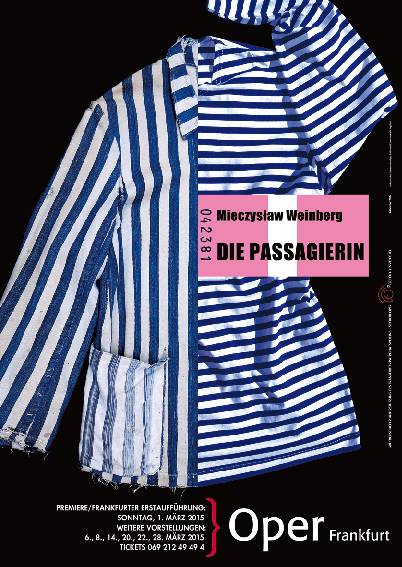
Perhaps the biggest news story in Weinberg circles is the success of 'The Passenger', with two different productions currently playing around the world at the moment. One is in Frankfurt, which been playing to rave reviews.


The other is at the Lyric Opera in Chicago, and has been receiving enormous amounts of praise. Quotes include:

'...the most amazing opera I have ever seen'.

'What a gift Zofia Posmysz and Mieczyslaw Weinberg have given to the world...'

'An overwhelmingly powerful production and performance'.

- Link to a wonderful storify collection of tweets and posts here.

The last performance in Chicago will be on 15 March - the next US run will be in Florida, 2016. The Passenger's wave of success continues. 

Reviews include: 

'Weinberg's music is most impressive in the quiet moments... while there are reservations to be had about the opera itself, the Lyric Opera has done itself proud with this show...'
- Lawrence A. Johnson, writing for Chicago Classical review - link.

'Miecyzslaw Weinberg, the most famous, prolific composer you’ve probably never heard of (1919-96), achieves something that in my many years of working with the Spielberg Shoah Project, I never imagined I would encounter: a work that, on the one hand, gets the cruel facts right, and, on the other, uses them to address universal ideas of morality, memory and love.'
- Anon, The Times Weekly - link.

'Nothing in Lyric Opera's searing production of Mieczyslaw Weinberg's The Passenger is more dramatic than the cover of the program, with its strip of three photos of writer Zofia Posmycz, whose novel was the opera's inspiration. '
- Deanna Isaacs, writing for Chicago Reader - link.

(For a much more negative review...)
'The question on my mind as I listened to the second act of Mieczyslaw Weinberg’s opera “The Passenger” at the Lyric Opera Tuesday night was: Am I listening to great musical art?
The answer, unfortunately, was “no.”'
- Bill Sweetland, writing for Newcity Stage - here.

An interesting point that I've picked up on - and that I'd love confirmation for from any readers who've attended the Lyric Opera performances - is that Marta appears to be billed as 'Marta/Zofia'. The portrayal of Marta literally as Zofia Posmysz always struck me as a flaw in Pountney's otherwise brilliant production - if they've now been so blatant as to write this in the programme, I'm surprised.

Photographs

Two previously unknown photos of Weinberg:

From a Sovetskaya Muzïka article, published 1960

From a Muzïkalnaya Akademiya article, published 1994
My own work
Progress on my thesis is going well (four chapters down out of six!). In addition, I have two different writing projects on the go at the moment - a report on Weinberg research for the DSCH journal, to be published in July, and a review of several recent Weinberg scores, to be released by Winter 2015.

I've been enjoying my teaching commitments this semester - including the chance to finally lecture on Weinberg's quartets! I've also been writing programme notes for the Quatuor Danel - including for a performance of Weinberg's Sixteenth Quartet, and for an upcoming performance of Tchaikovsky's String Sextet.

I also recently spoke at the Manchester PubHD event - where Doctoral Researchers get to summarise their work to a room of listeners in a pub. See their charming summary of my work below:

Our first speaker was Daniel Elphick, who spoke for ten minutes on Weinberg’s String Quartets.  We got to hear a brief history of Weinberg’s life, the society in which he grew up, and how the culture of the time reflected his music, and how his music is in turn culturally relevant. Some of Daniel’s work is about making Weinberg’s work available to present-day musicians, so that we can hear his music played again now.  Speaking of which, Daniel played excerpts from the String Quartets during his talk to illustrate the concepts he was presenting – this really livened things up, and thanks to the understanding nature of the landlord, we were allowed to play some more of this music during the interlude before the next speaker.

See the full report here. My thanks go to the organisers of the event - there are branches of PubHD in Manchester, Nottingham, and Leicester. 
The question on my mind as I listened to the second act of Mieczyslaw Weinberg’s opera “The Passenger” at the Lyric Opera Tuesday night was: Am I listening to great musical art?
The answer, unfortunately, was “no.”
- See more at: http://newcitystage.com/2015/02/27/review-the-passengerlyric-opera-of-chicago/#sthash.447cwLv4.dpuf