Weinberg 100: 2
One of the first major centenary celebrations of 2019 takes place 24-27 January at the University of Manchester, UK. This is an academic conference, running alongside a series of concerts (including a complete Quartet cycle performed by the University's quartet-in-residence, the Quatuor Danel).
The programme includes a veritable who's-who of Weinberg experts, including his family and friends. I've pasted the full programme below; full details (including booking) can be found here.
Thursday 24 January
1.10 Quatuor Danel concert (buffet lunch available before and after)
2.15 Opening of Weinberg Exhibition, in association with The Polish Cultural
Institute, Manchester and the Adam Mickiewicz Institute, Warsaw
2.30 Quatuor Danel with Dr Daniel Elphick (Royal Holloway, London). Workshop on
reconstructing the original version of Weinberg’s String Quartet No. 1.
3.15 Open session on ‘Weinberg and Performance’
4.00 coffee break
4.30 David Fanning and Michelle Assay: ‘Weinberg research: Present and Future’
5.30 dinner
7.30 Quatuor Danel concert
Friday 25 January
9.30 Verena Mogl (University of Hamburg) ‘Weinberg’s early years’, Antonina
Klokova (Humboldt-University, Berlin) ‘title tbc’, Aleksander Laskowski (Adam
Mickiewicz Institute, Warsaw) ‘ Weinberg and Tuwim’
11.00 coffee break
11.30 Inessa Dvuzhilnaya (Grodno, Belarus) ‘Weinberg in Minsk’, Christoph Flamm
(Musikhochschule Lübeck) ‘Weinberg’s piano-chamber music’.
1.00 Quatuor Danel concert (buffet lunch available before and after)
2.30 Nicky Gluch ‘Shamor V’zachor: Observing and Remembering Mieczysław
Weinberg’; Yelena Prokhorova (‘European Cultural Initiative’ named after M.
Weinberg, Berlin) ‘The violin and its a musical-theatrical role in the artistic work of
Weinberg’, Virginie Constant (Paris) ‘Weinberg’s works for cello’
4.00 coffee break
4.30 Concert: Songs by Weinberg and Shostakovich (Rosalind Dobson and Michelle
Assay)
5.30 dinner
7.30 Quatuor Danel concert
Saturday 26 January
9.30 Bret Werb (Holocaust Museum, Washington DC) ‘Weinberg in Washington’,
Levon Hakobian (State Arts Research Institute, Moscow) ‘Weinberg as a Bronze Age
Figure’, Stefan Weiss (Musikhochschule, Hannover) ‘“And music made tongue-tied
by prosody ...”: Mieczysław Weinberg’s Opus 33 in the history of Russian settings of
Shakespeare’s sonnets’
11.00 coffee break
11.30 Daniel Elphick (Royal Holloway, London) ‘Weinberg and Polish-Russian
relations’, Agnieska Nowok-Zych (Karol Szymanowski Academy of Music, Katowice,
Poland) ‘Three life stories – one joint truth. Weinberg, Tuwim, Broniewski:
inspirations and parallels’.
1.00 Quatuor Danel concert (buffet lunch before or after)
2.30 Dmitry Abaulin (Stanislavsky and Nemirovich-Danchenko Theatre, Moscow),
‘Weinberg at the Stanislavsky and Nemirovich-Danchenko Theatre’, Tommy Persson
(Gothenburg) ‘Weinberg’s last years’
4.00 coffee break
4.30 Concert: Weinberg Sonata for Double bass solo (Robert Carrillo Garcia) and
Piano Sonata No. 6 (Michelle Assay)
5.45–7.15 dinner
7.30 Quatuor Danel concert
Sunday 27 January
10.00 interview with Victoria Bishops: ‘Letters from my father’
11.00 coffee break
11.30 round-table discussion
12.15 buffet lunch
1.00 Quatuor Danel concert (including Piano Quintet with David Fanning)
3.30 end of event
Monday, 7 January 2019

Thursday, 3 January 2019
Weinberg 100: 1

2019 marks the centenary of Weinberg's birth, with numerous events, concerts, and recordings set to mark the event. On this blog, I will begin a series of posts to mark the centenary, with 100 throughout the year. Some of these will be short features, such as photos, key works, or re-posts of older articles on this blog. Others will be previously unpublished sources and photos, posted here to promote further research and scholarship on Weinberg and his music.
For now, watch this space. Here's a performance of Weinberg's first opus-numbered work, the Lullaby for piano:
Monday, 26 November 2018
Review: CBSO Weinberg Weekend

Thanks to the ongoing efforts of conductor Mirga Gražinytė-Tyla,
the City of Birmingham Symphony Orchestra are continuing their exploration of
Weinberg’s music. It was a pleasure for me to stay in the city, as it is my ‘home
turf’ from childhood (well, I’m from between Dudley and Wolverhampton,
but the CBSO was the nearest orchestra in my formative years). Ahead of next
year’s centenary, they hosted a series of concerts and talks last weekend,
featuring sterling performances from all concerned. Here’s my brief review of the concerts:
Friday 23 November:
Gidon Kremer plays Weinberg’s 24 Preludes for Solo Cello (arr. Kremer)

Kremer has an outstanding reputation, closely associated
with composers like Schnittke, Silvestrov, and Gubaidulina. He has been
promoting Weinberg’s music for several years now, with several excellent
recordings on the ECM label. Kremer himself has arranged Weinberg’s 24 Preludes for solo violin, resulting
in an extremely demanding work. The Preludes themselves are tightly structured,
ascending chromatically through the keys. Kremer maintains this structure,
though this makes the act of arrangement more difficult (the easy route might
have been to transpose the key to suit the violin better; as it stood, Kremer
merely changes octave, preserving Weinberg’s original design). Kremer’s
performance was accompanied by a slideshow of photos by Lithuanian photographer
Antanas Sutkus, which alternate between humour and tragedy of Soviet life, with
a significant focus on childhood. Kremer’s performance was virtuosic and often
moving, and the combination with images was convincing (though I was left
wondering whether it was absolutely necessary – the Preludes could arguably ‘stand’
on their own).

Saturday 24 November:
11am: Gidon Kremer and Kremerata Baltica: Bach, Weinberg,
Schubert, and Silvestrov

The Saturday morning concert was given by Kremerata Baltica,
a youthful ensemble led by Kremer, though he describes it ‘a musical democracy’.
They continue to be one of the most innovative and exciting ensembles
performing today: you can expect surprise at every concert. They began with Bach’s
Chaconne in D minor for violin,
arranged for string orchestra by Kremer (itself an arrangement of Ferruccio
Busoni’s famous piano transcription of the piece). The opening was immediately
surprising: the orchestra took their seats, but a recorded solo violin began
with those infamous double-stopped chords. The orchestra continued, but the
ghostly recording interjected at key moments throughout. The connection with
Weinberg is apparent, as the Chaconne figures
at the dramatic climax of his opera The
Passenger. They then moved into Weinberg’s Concertino for Violin and String Orchestra, with Kremer giving a
fine performance as soloist, though their ECM recorded version offers far
greater warmth (perhaps a reflection of Birmingham Town Hall’s dry acoustic).
The concert then concluded with an intriguing arrangement: combining Schubert
with Silvestrov. That is, alternating, movement-by-movement, between the
movements of two pieces by two very different composers. It helped that the
Schubert was for the full ensemble of Kremerata Baltica, and the Silvestrov was
for violin and piano (his Five Pieces for
Violin and Piano, dedicated to Kremer), so a clear contrast was provided,
in addition to the massive contrast in character between the two pieces. The
effect was mixed, though the Silvestrov arguably came out the better in my
opinion, helped by Georgijs Osokins sensitive piano accompaniment. Overall,
this provided a more contemplative start to the day.
Saturday 24 November:
7pm: CBSO with Kremerata Baltica, Gidon Kremer, Maria
Makeeva, cond. Mirga Gražinytė-Tyla: Weinberg and Shostakovich

By far the most substantial event of the weekend was a
colossal orchestral concert, with the CBSO and Kremerata Baltica joining
forces. The programme was immediately striking, as the CBSO paired Weinberg’s
Symphony No. 21 with Shostakovich’s Symphony No. 15, two symphonies that
present extremely bleak and sombre themes. Weinberg’s 21st,
subtitled ‘Kaddish’, is dedicated to the victims of the Warsaw Ghetto, and
various quotations support this, from use of Mahler’s Des Knaben Wunderhorn, through to a reworking of Weinberg’s Fourth
String Quartet of 45 years earlier, and haunting solo piano quotes from
Chopin’s First Ballade that permeate a brooding canvas of mourning. The Chopin
reference and clear Klezmer sections strengthen the depiction of pre-war
Warsaw, and the piece’s dedication to the victims of the Ghetto. Various other
quotes from Weinberg’s oeuvre surface, and can surely be read as reflective of
his life’s work, especially as it is explicitly a memorial piece. One of the
key moments comes in the final section, as a wordless boy soprano intones a
mournful sighing motif, answered by a wordless soprano (Maria Makeeva) (itself suggestive of
loss between mother and child). The work was certainly positively received by
the audience, with a huge number of ovations and curtain calls. The work was
recorded for the option of future release, so watch this space.
Usually, it
would be alarming to think that Shostakovich’s Fifteenth Symphony could be the ‘light
relief’ of any concert, but it proved to be such here. The opening movement,
described as a ‘Toyshop’ by the composer, was performed with remarkable aplomb
the by the gathered forces of the CBSO and Kremerata Baltica, while the quotations from Rossini'sWilliam Tell were handled with a subtlety that is unusual in most performances. The
following movements switch to a far bleaker outlook, with star turns for solo
cello and trombone in between Mahler-esque funeral dirges by the brass. The
Scherzo was taken at something of a ‘safe’ tempo, though its sarcastic
character was still easily conveyed. The finale of the Shostakovich is perhaps
the most baffling movement of all, with Wagner and Glinka quotes contained
within, presenting a culmination of his recognisably ‘Shostakovichian’ mode of
despondency through major-key (or ‘happy’) music.
The concert
itself was a triumph, and Gražinytė-Tyla was captivating as leader of the
orchestra. Every cue was flawless in execution, and the orchestra (and
audience) are clearly held in awe with every movement.
The Weinberg weekend itself was a great success, and I look
forward to future CBSO concerts with his music (next is 31 March 2019, with
Kremer in Weinberg’s Violin Concerto, and the Fourth Suite from the Ballet The Golden Key - further info here). Long may Gražinytė-Tyla’s
leadership of the CBSO continue, as well as their engagement with Weinberg’s
music.
D.E.
Thursday, 19 April 2018
Żelazna 66 - Weinberg's childhood home in Warsaw
In my report from my trip to Warsaw, I included a photograph of Weinberg's childhood home, 66 Żelazna street (on the corner of Krochmalna). Since then, I have researched more of the history of the building, how it came to be still standing, and I also found several more photographs from various sources.

History
The tenement house was built in 1911, designed by one Henryk Spigelmann. Elements of an original 'art-nouveau' style can be seen in some of the tilework detail in the entranceway (shown in photos below). Before the war, the street was full of similar buildings. The street itself is in the 'Wola' district, the heart of the old Jewish district of the city. Szmuel Weinberg and his wife, Sarra, moved here some time before the First World War (some accounts claim 1914).
During the Second World War, the building became part of the Warsaw Ghetto. It was only a few metres away from the infamous 'bridge crossing' of the ghetto, which linked the large and small sections of the ghetto with a walkway over the busy Chłodna street. The buildings in this district were filled with the city's Jewish population from late 1939-1943. The Ghetto uprising ended with the burning of almost the entire district, block-by-block. Considering the violence that occurred in the larger Warsaw Uprising and the following destruction of almost the entirety of Warsaw by retreating Nazi forces, it is near-miraculous that the building survives at all.
Author Leopold Tyrmand described the building in his 1955 novel Zly:

Writing in 2002, Weinberg's friend composer Grigori Frid describes this picture:
In the present day, the building lies dilapidated, though listed in the city's list of monuments. It is marked 'unsafe', though there were apparently plans to modernise and convert the flats, with an intial proposed deadline of 2013.
The fate of this building remains unclear. Were it to be converted, however, I would suggest that it would be appropriate to install some kind of plaque to Weinberg's memory.
Here's several more photos from the building, inside and outside.


The tenement house was built in 1911, designed by one Henryk Spigelmann. Elements of an original 'art-nouveau' style can be seen in some of the tilework detail in the entranceway (shown in photos below). Before the war, the street was full of similar buildings. The street itself is in the 'Wola' district, the heart of the old Jewish district of the city. Szmuel Weinberg and his wife, Sarra, moved here some time before the First World War (some accounts claim 1914).
During the Second World War, the building became part of the Warsaw Ghetto. It was only a few metres away from the infamous 'bridge crossing' of the ghetto, which linked the large and small sections of the ghetto with a walkway over the busy Chłodna street. The buildings in this district were filled with the city's Jewish population from late 1939-1943. The Ghetto uprising ended with the burning of almost the entire district, block-by-block. Considering the violence that occurred in the larger Warsaw Uprising and the following destruction of almost the entirety of Warsaw by retreating Nazi forces, it is near-miraculous that the building survives at all.
Author Leopold Tyrmand described the building in his 1955 novel Zly:
During his 1966 return trip to Poland as a foreign visitor to the Warsaw Autumn Festival (one of only two visits outside the USSR), Weinberg returned to his childhood home, shown in this photo:
He stopped at the corner of Żelazna and Krochamalna, he looked around, then looked up. The shabby wall of the house was strewn with iron balconies; it was wide and high here (...) In the door, behind the glass, hung a glass plaque, in blue letters: "Warsaw e Gastronomic Establishments - 'Słodycz' Bar - IV.

Writing in 2002, Weinberg's friend composer Grigori Frid describes this picture:
Weinberg's experience during his 1966 visit was an upsetting one, in that it brought the realisation that extremely little of the city that he grew up in had actually survived the war.
In front of me is a black and white amateur photo. An old stone house with peeling paint in some places. The door is closed. In the dark aperture, stair steps are visible. It is visibly autumn: in the foreground - a stunted tree with sparse leaves. Before the entrance there is Metek in an unbuttoned raincoat, without a tie, looking slightly to the side. Next to him is an unknown man in a dark suit. On the back of the photo with is handwritten the inscription in Polish: 'Warszawa, Zelazna ul. 66', and in parentheses in Russian: 'the house where I was born'.
In the present day, the building lies dilapidated, though listed in the city's list of monuments. It is marked 'unsafe', though there were apparently plans to modernise and convert the flats, with an intial proposed deadline of 2013.
The fate of this building remains unclear. Were it to be converted, however, I would suggest that it would be appropriate to install some kind of plaque to Weinberg's memory.
Here's several more photos from the building, inside and outside.


 |
| Żelazna in 1942. |


Links for photographs:
http://warszawskieunikaty.blox.pl/t/621496/Henryk-Spigelman.html
http://warszawawobiektywie.waw.pl/2008/10/zelazna-66/
https://chlodna20.wordpress.com/2007/01/30/zelazna-66/
http://warszawa.fotopolska.eu/1178367,foto.html
http://fotoblog.marchewka.waw.pl/?p=374
https://www.facebook.com/pg/fotografiawarszawy/photos/?tab=album&album_id=1218540218272568
Friday, 9 February 2018
Warsaw photos
I've just got back from another research trip, this time to Warsaw.
Of course, this is a city with strong links for Weinberg research, in that Weinberg lived the first nineteen years of his life here, before fleeing the Nazi invasion in 1939. See below for a few photos from my trip.
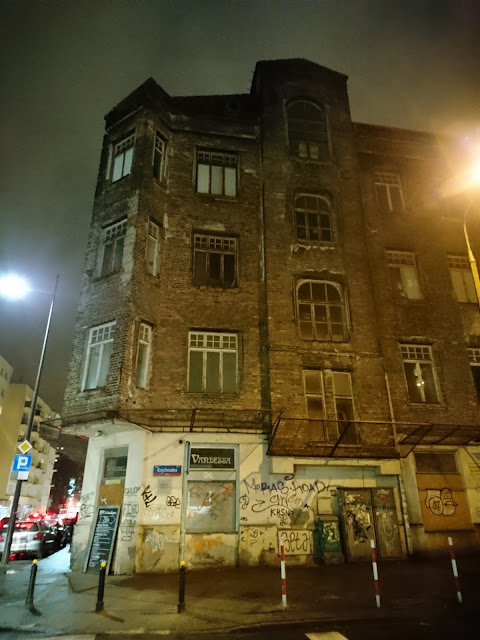
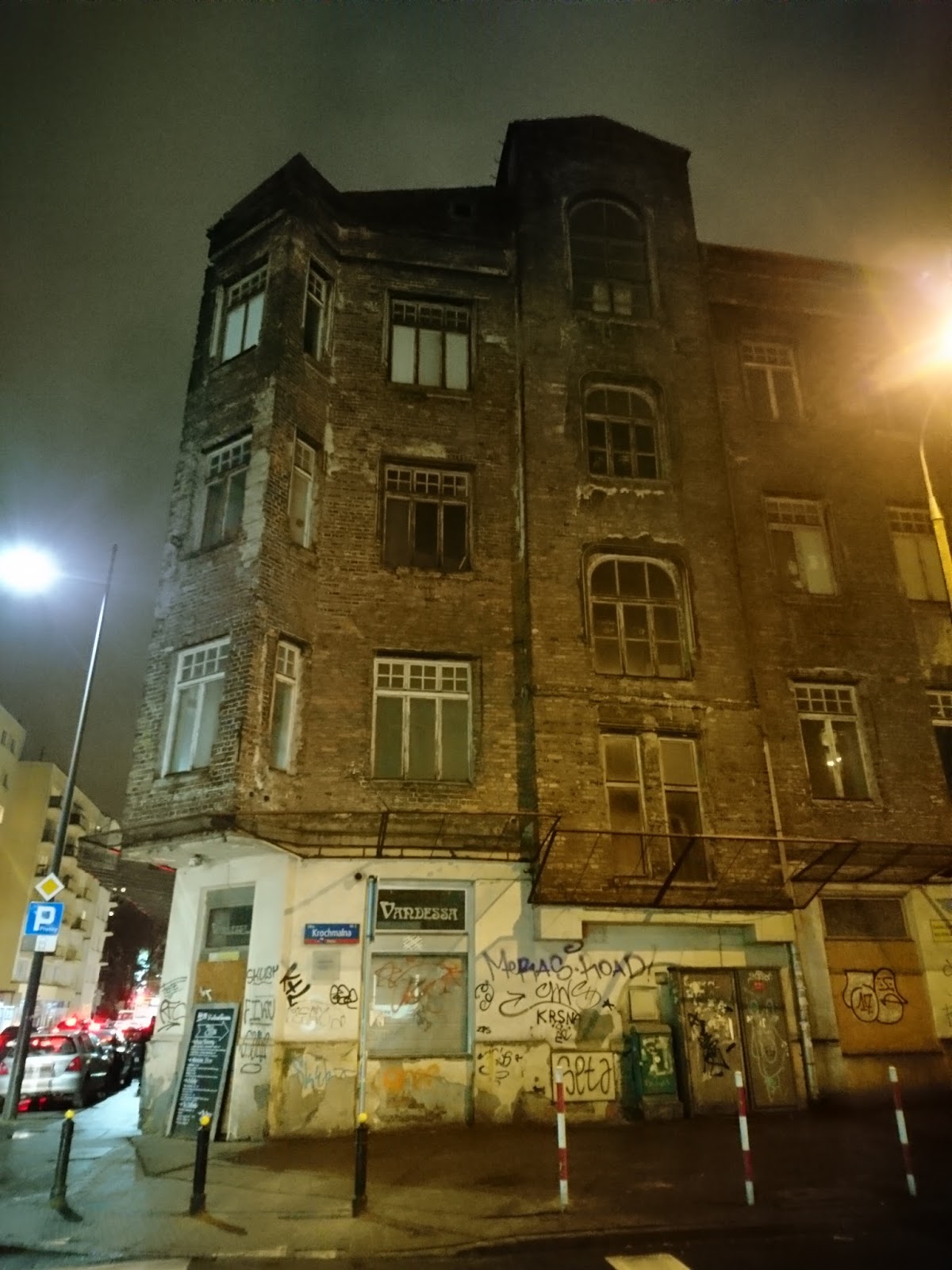
This is 66 Żelazna Street in Warsaw, the building where Weinberg lived 1919-1939. It's near the Wola district, an area that became part of the Warsaw Ghetto during the war. It's remarkable that it's still standing today, seeing as how much of Warsaw was flattened by the end of the war. It's looking in a sorry state, and is marked as an 'unsafe building'. I anticipate that it will be knocked down soon.


During my research trip, I was lucky to meet with two composers, Paweł Szymański, and Paweł Mykietyn. Both were extremely kind in agreeing to meet, and generous with their time. Combine this with several library visits, and I have plenty of material to be getting on with for the 'Parallel Worlds' Weinberg book.
Perhaps the most exciting part of my trip was a rare opportunity to visit Lutosławski's home at 39 Śmiała Street. I was very honoured to meet with Marcin Bogusławski (Lutosławski's stepson) and his wife Gabriela Bogusławska. We had a long discussion, with Marcin reminiscing about his stepfather and his working methods. Here are a few photos from the house:
All-in-all, an extremely exciting trip. Watch this space for further photos/news.
Of course, this is a city with strong links for Weinberg research, in that Weinberg lived the first nineteen years of his life here, before fleeing the Nazi invasion in 1939. See below for a few photos from my trip.
This is 66 Żelazna Street in Warsaw, the building where Weinberg lived 1919-1939. It's near the Wola district, an area that became part of the Warsaw Ghetto during the war. It's remarkable that it's still standing today, seeing as how much of Warsaw was flattened by the end of the war. It's looking in a sorry state, and is marked as an 'unsafe building'. I anticipate that it will be knocked down soon.


 |
| The flat where Grażyna Bacewicz lived, 35 Koszykowa Street. |
 |
| The flat where Karol Szymanowski lived, 47 Nowy Świat (Joseph Conrad actually lived in the same building, several decades earlier). |
During my research trip, I was lucky to meet with two composers, Paweł Szymański, and Paweł Mykietyn. Both were extremely kind in agreeing to meet, and generous with their time. Combine this with several library visits, and I have plenty of material to be getting on with for the 'Parallel Worlds' Weinberg book.
Perhaps the most exciting part of my trip was a rare opportunity to visit Lutosławski's home at 39 Śmiała Street. I was very honoured to meet with Marcin Bogusławski (Lutosławski's stepson) and his wife Gabriela Bogusławska. We had a long discussion, with Marcin reminiscing about his stepfather and his working methods. Here are a few photos from the house:
 |
| The plaque outside Lutosławski's house. |
 |
| Lutosławski's desk (and some of his books). |
 |
| The other end of Lutosławski's study. |
All-in-all, an extremely exciting trip. Watch this space for further photos/news.
Subscribe to:
Posts (Atom)