Tuesday, 25 March 2014

Review: Linus Roth - Britten and Weinberg Concertos


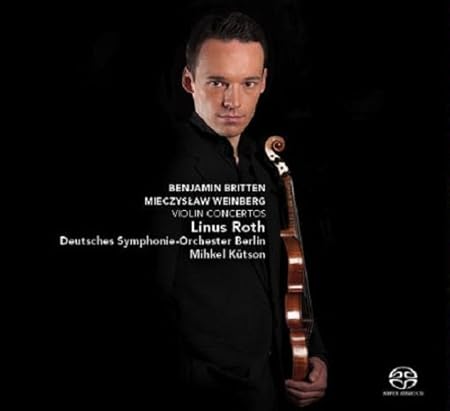
Challenge Classics CC72627, Violin Concertos by Benjamin Britten and Mieczysław Weinberg, Linus Roth (soloist), with the Deutsches Symphonie-Orchester Berlin, conducted by Mihkel Kütson. Liner notes by Jens F. Laurson. 

Another admirable release by the violinist Linus Roth, building on the foundation laid by his previous 3-disc album with the pianist José Gallardo - see my review here. Roth's playing is faultless throughout, and the detractingly cold sound from the previous recording is absent here, with the Deutsches Symphonie-Orchester Berlin providing a lush cushion for Roth's soloistic antics. The release also has the selling point of being a SACD disc, should you have suitable equipment to enjoy it (which I don't; being a humble student, such tech is well out of my price range).

The disc features the excellent programming of combining Britten and Weinberg; while the close connections between Britten and Shostakovich have often been noted, the influence on Weinberg is an underexplored topic itself. Keep your eyes posted over the next few weeks, I have a blog-post/article in the works on this very topic. 

Britten
I must profess that the Britten violin concerto, Op. 15, is not a work that I am familiar with. Indeed, aside from his stage works and music for choir, I am admittedly scant on recordings of Britten. I am an avid fan of his Piano Concerto, however, and it is with reference to this work that I plunged headlong into this recording. Reading from Jens F. Laurson's excellent liner notes, I see that it is a relatively early work, one of the first written after Britten had arrived in the US, 1939. 
   The music owes a great deal to the violin concerto by Berg, with several passages sounding strikingly similar. Overall, however, it is a charming work of great drama, with both tender and assertive moments. The opening Moderato con moto movement gives a tender opening, ripe with material for development. The vivace middle movement is my personal favourite, with a sweeping orchestral line recurring throughout. The final passacaglia movement is strongly reminiscent of Shostakovich, and serves as perhaps the strongest link to Weinberg's own musical language. 
   The solo part for the Britten, while virtuosic, also demands a great sense of leading a drama. Roth fills the position of orator admirably, with little doubt as to his coolness in the role. Balance across the orchestra is excellent, giving a well-polished sound, particularly emphasised in the 'punching' gestures to be heard in the middle movement. The recording throughout is nuanced and warm, paying attention to the delicacies of Britten's orchestration, as well as the ferocity of his punctuating motifs throughout. If anything, this encourages me to seek out Britten's other concerto works. 

Weinberg
Next I turn to a work that I am much more familiar with, Weinberg's Violin Concerto, Op. 67. Written in 1959 and dedicated to Leonid Kogan, it is a world apart from his Violin Concertino, which readers may be familiar with, owing to the spate of recordings released recently. If the concertino can be said to represent a cheerful attitude in the face of adversity, then the 1959 work is a serious soloistic piece, rich with drama. It was premiered by Kogan in 1961, with Kondrashin conducting. A star in his own right, Kogan had a reputation for his strongly pro-Soviet leanings - though this may be a result of his international success, which he whole-heartedly attributed to the support of the Soviet government (similar to Weinberg's own enthusiasm). The concerto is marked by its near-relentless solo part, which barely rests for more than a moment, particularly in the first movement. In its four-movement structure, the work harks back to the classical Concerto, a parallel reinforced by Weinberg's inclusion of a Mozart quote in the Adagio third movement (a theme taken from the 'little' G minor Symphony). My previous experience of this work stems from Kondrashin and Kogan's formidable recording, made soon after the premiere performance. After then, recordings have been few and far between (but include a Naxos-label CD featuring Ilya Grubert on violin). With an interpretation as strong as Roth and Kütson's here, it is my hope that this CD will act as a case for other soloists to take up this work. 
   Shostakovich wrote to his friend Isaak Glikman in 1960, mentioning Weinberg's Violin Concerto:
I am very impressed by M.S. Vainberg’s Violin Concerto... It is a magnificent work. And I am weighing my words.
Of course, Shostakovich's own violin concertos are apt for comparison with Weinberg's own, particularly Shostakovich's First Violin Concerto, written 1947-48.
   The first movement opens with a strident gesture, quickly answered by the soloist. This immediately establishes the soloist-ensemble dialogue over the course of the work - that the Violin solo really does lead the music, in a brawling drama that is fully sustained over the course of the whole Concerto. Roth's handling of the virtuosic part is excellent throughout, never rising above a controlled restrain through the most fiendish passages, while also extremely tender in the Adagio movement.

Overall, I cannot fault this recording, particularly the lush sound engineering. I can only hope that this disc can serve as a persuasive case to encourage other violinists to take up both of these works - but especially the Weinberg.

LINKS TO BUY:

The Challenge Records website - here (also featuring more information about the disc)
Amazon.co.uk - link.

Recommended comparative listening
Naxos, Miaskovsky and Vainberg, Violin Concertos, Russian Philharmonic Orchestra, Dmitri Yablovsky cond., Ilya Grubert (Violin). Link here.

Melodiya - Vainberg, Violin Concerto and Symphony No. 4, Moscow Philharmonic Orchestra, Kiril Kondrashin cond., Leonid Kogan (Violin).
 - A really splendid recording, still setting the bar to which all others must live up to. The actual disc is rather tricky to find, though the recording has helpfully been uploaded onto youtube:


---------------------
And for those eager for more media from Mr. Roth, see this excellent youtube video, discussing the album:


P.S. - keep posted for my upcoming feature on Britten and Weinberg. D.E.

Thursday, 20 March 2014

March update

A quick selection of upcoming releases, events and Weinberg-related resources around the web.

Album releases
I am awaiting the following discs, reviews will be posted over the coming weeks:

 
Linus Roth (Violin) with the Deutsches Symphonie-Orchester Berlin, con. Mihkel Kütson

Linus Roth plays violin concertos by Britten and Weinberg. Amazon.co.uk link here.


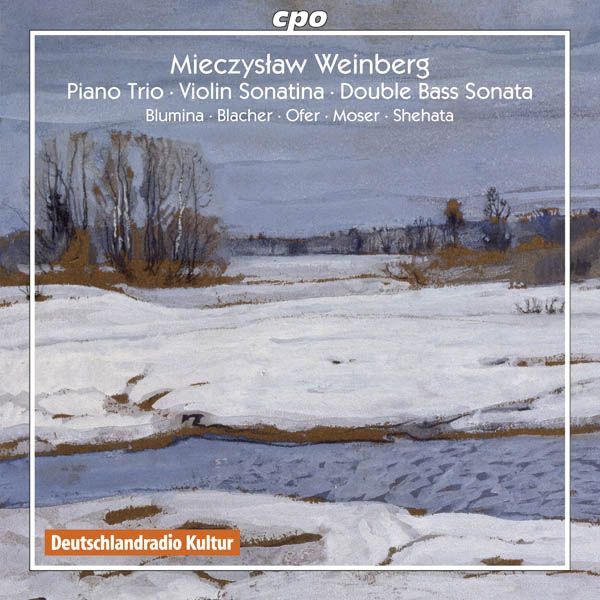
Weinberg chamber music for Strings, featuring the Piano Trio, Violin Sonatina and the rarely heard Double Bass Sonata. CPO label.

Available on the jpc.de website here.


Coming May 2014 - the next installment in the Naxos Weinberg Symphonies series, featuring Vladimir Lande and the St. Petersburg State Symphony Orchestra and Chamber Choir (Lande and the Orchestra having already featured on three Naxos Weinberg releases previously).

Performing the 18th Symphony, Op. 138 'War, there is no word more cruel', and the Trumpet Concerto, Op. 94, featuring Andrew Balio.

(My thanks go to Claude Torres for drawing my attention to this release). 

Weinberg links around the web

'Crusading for Weinberg': Linus Roth talks to Edward Seckerson (Youtube)

'Russia's third great composer' - Norman Lebrecht has Weinberg as disc of the week

Zaubersee Festival, Lucern 28th May-1st June 2014, with a focus on Weinberg's music

My own work

My work is ticking along nicely, with my attention now on writing my thesis itself, focusing on the context and analysis of Weinberg's Seventeen String Quartets.

I am also very happy to announce that I have an article coming out in the Musical Times hopefully by the end of this year, entitled 'Weinberg, Shostakovich, and the Influence of Anxiety'. See abstract below:


The close friendship between Weinberg and Shostakovich is well documented, particularly concerning their string quartets. The pair discussed their works during compositional gestation, and a friendly ‘competition’ for writing quartets started between them in the 1950s. Each was ‘winning’ at different points in time, but Weinberg was the ultimate victor with seventeen by the time of his death in 1996. The strong influence of Shostakovich in Weinberg’s music has been grounds for criticism and even dismissal, but what is less known is the truly reciprocal nature of their creative relationship. Weinberg was thirteen years his junior, but his first quartet predates Shostakovich’s by a year. Weinberg’s early work was prolific, having written six quartets by the time of Shostakovich’s third in 1946. Examining Shostakovich’s scores following these works reveals a great exchange of ideas between the two friends, with an undeniable influence from Weinberg in several pieces. With examples from the music of both composers, this article maps out a network of mutual influence. Such an unusual case study fits uneasily within several theorists' conceptions of artistic influence, none more than Harold Bloom and his book The Anxiety of Influence. Building on Weinberg and Shostakovich's example, I argue that Bloom's theory is not only ill-suited to their friendship, but indicative of a wider out-dated trend across theoretical thinking in the arts.


Tuesday, 11 March 2014

Weinberg links around the web

This is simply a list of links for my recommended websites around the net, all related to Weinberg in some way.

Peer Music's page on Weinberg
PeerMusic, one of the main publishers of Weinberg's music. Their pages on Weinberg include a biography, select discography, a worklist and notes on a selection of Weinberg's works. There are also links to buy sheet music. (The equivalent pages on their German website offer a more extensive selection of sheet music to purchase - see link here ).

Sikorski's page on Weinberg
Similarly, Sikorski publishing's page on Weinberg is also informative, with a wide selection of sheet music to hire/purchase, and a particularly feature detailing upcoming performances.

Peermusic's page on ISSUU
ISSUU is a platform for publishers to share documents, allowing free reading access (but no download function). Peermusic have uploaded a wide selection of Weinberg scores, all free to read, including symphonies and chamber music.

Weinberg.net - an excellent resource
From what I gather, a site run by an enthusiastic admirer of Weinberg's music, providing an excellent collection of information, articles, weblinks, reviews and news.

Weinberg Discography - maintained by Claude Torres
An indispensable resource for Weinberg enthusiasts online. Mr. Torres's discography is fastidiously detailed, and updated extremely frequently, with details for each of Weinberg's works, organised by opus number. Also features a thorough catalogue of Weinberg's music, including works for film.

Weinberg timeline
Put together by the late Ian MacDonald, with the late Per Skans, this timeline provides a wealth of information. Mostly accurate, a few opus numbers missing, and a small handful of errors, but useful nonetheless.

Weinberg spotify collection
For users of the music streaming software Spotify, a user called Ulysses has compiled a chronological collection of all the Weinberg recordings available on their service. Extremely useful for those readers eager to hear more of Weinberg's music.

The International Mieczysław Weinberg Society
A recently established group seeking to promote Weinberg's life and works with concerts, recordings, and publications. Run by international violinist Linus Roth, with Irina Shostakovich as honorary president.

--------------

I'm sure I shall be adding to this list of recommended links. If you run a website that you would like me to feature, please do not hesitate to get in touch. D.E.

Tuesday, 11 February 2014

February Update

Upcoming releases
The month of February brings several exciting Weinberg releases, some already available, some new and some with world premiere recordings.

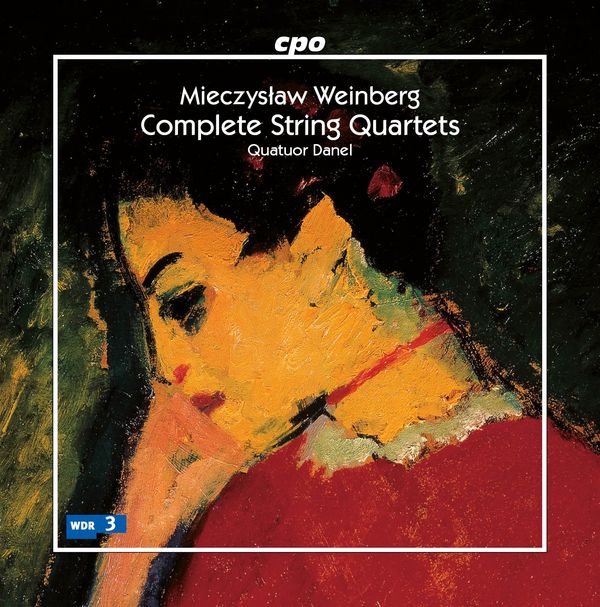
First of all, the CPO label will be issuing a boxset of Weinberg's String Quartets, as recorded by the Quatuor Danel. Seeing as these recordings form a cornerstone that I consult on a daily basis, I can't recommend these enough. The six-volume cycle will be packaged in one box-set, at the extremely attractive price of EUR 29.99. From the CPO's site: (link).

Mieczyslaw Weinberg’s genuinely awe-inspiring complete seventeen string quartets are now available in a box set in interpretations by the Belgian Danel Quartet that can only be described as a musical blessing. Inspired by Shostakovich’s widow Irina (and other factors), the Quatuor Danel began acquiring the scores of all seventeen Weinberg quartets in 1995 and after a number of years (2007 to 2012) has now finished its complete recording for cpo. The BBC Music Magazine immediately named the first volume the best chamber music CD in March 2008, and further prizes followed. klassik-heute. com wrote, »In content and skill the works are equal to good works by Shostakovich, but this does not at all mean that Weinberg was a Shostakovich imitator. The Danels perform with unabating, often almost urgent intensity.« And Weinberg’s teacher and friend Shostakovich never missed an opportunity to recommend the works of his friend and fellow musician Weinberg. They were brothers in spirit. Both worked in manifold genres and over a broad stylistic spectrum ranging from folklore (in Weinberg’s case, Jewish folklore in particular) to twelve-tone elements. In the field of the string quartet Shostakovich involved his pupil in a friendly competition and was very happy in 1964 to be the first of the two to write his No. 10. Our final volume received the highest marks from klassik-heute. com: »A full 10 for exciting music and its enthralling interpretation by an exciting ensemble.«

--------------------
There is also news of another upcoming release from the CPO label - 'Chamber Music for Strings'.

    Led by the same musician who brought us the 'Chamber Music for woodwinds' release a few years ago, Elisaveta Blumina, the release promises to feature the following works:

Piano trio op. 24;
Sonatina for Violin & Piano op. 46;
Sonata for Double Bass solo op. 108

If the previous cd is anything to go by, this should worth buying. 

---------------------
I mentioned world-premiere recordings above, and the latest disc from Toccata Classics promises just that.

This upcoming disc is listed as 'in preparation' on the Toccata website (with very little information provided besides that and the album cover, seen above). Works to be featured:

Symphony No. 21, 'Kaddish', Op. 152 [wth Veronika Bartenyeva, Soprano] (World Premiere recording)
Polish Tunes, Op. 47, No. 2 (Also a world premiere)

The Siberian Symphony Orchestra, under Dmitry Vasilyev.
I must admit, I'm particularly excited about this release, I'm always pleased with premiere recordings. This leaves just Symphonies 9, 11, 13 and 15 still to be recorded.

--------------
Of course, is you can't until these discs are released, I still heartily recommend Gidon Kremer and the Kremerata Baltica's 2-disc set, which was something of a revelation when I reviewed it here.

-------------

Here's a few of the latest youtube videos of Weinberg:

Linus Roth and José Gollardo play the Weinberg Sonatina, Op. 46:

A preview of the Naxos Symphony 12 recording: (see my review here).

-------------

My own work is ticking along nicely. I recently survived my latest PhD assessment panel. My writing is now focusing on analysis of the Weinberg Quartets - I'm currently up to 12 out of 17! In publication news, I am pleased to announce that my manuscript for a set of conference proceedings has been submitted, with the full text available hopefully from June of this year, with paper copies available some time in Winter. Until then, some of my academic work is available for you to read on my profile on Academia.edu - link.

Tuesday, 4 February 2014

Review: 'Mieczysław Weinberg', Gidon Kremer & Kremerata Baltica

This album sets a new high-water mark for the ongoing Weinberg revival.


Gidon Kremer is one of the most famous violinists of our time; the announcement of an all-Weinberg release from him and his Chamber Orchestra of Baltic musicians made for high expectations. Over the course of his career, Kremer has been a pioneer for programming Soviet and/or Russian music, including the likes of Schnittke, Pärt, and Sylvestrov. In a series of concerts towards the end of last year, Kremer toured with Martha Argerich, performing works by Weinberg and Beethoven.

This 2-CD set presents something of a retrospective, moving from chamber music works on the first disc to two orchestral pieces on the second disc. Particularly notable is the range of works chosen: music from Weinberg's tuneful and heartfelt earlier period, and also more intricate, 'difficult' works from later in his career. The running order goes as follows:

CD 1
Sonata No. 3 for Solo Violin, Op. 126 (1979)

Trio for Violin, Viola and Cello, Op. 48 (1950)

Sonatina for Violin and Piano, Op. 46 (1949)

CD 2

Concertino for Violin and String Orchestra, Op. 42 (1948)

Symphony No. 10, Op. 98 (1968)

From quick inspection, three of these works are from one close-knit period, 1948-50, yet they are adequately distinct from one another to still present something of a Weinberg 'portrait'. More impressive is the brave decision to open with Weinberg's Third Sonata for solo violin, a thoroughly challenging work for both performer and listener. Striking from the very opening is Kremer's complete command of the music - with his detailed knowledge of Russian/Soviet repertoire, Kremer appears to effortlessly slip into Weinberg's demanding style and idiosyncrasies. One could be forgiven for feeling emotionally drained after Kremer's roller-coaster performance to open the record. To follow with the warm and melodic Trio for violin, viola and cello is a stroke of programming genius. 
   
   Kremer is joined by Daniil Grishin (viola) and Giedrė Dirvanauskaitė (cello) for the Trio. Over the course of the work, it is plain to tell that the insightful interpretation of Weinberg's style is not limited to the Kremerata Baltica's concertmaster alone - Grishin and Dirvanauskaitė prove themselves more than capable. Excellent ensemble is complimented by a warm and responsive recording, perfectly balanced against the cold and frantic character of the solo sonata that preceded. (If the Baltica ever needed ideas about further Weinberg works to record, I would suggest that they turn their attentions to any of the 17 string quartets, judging by the standard of this trio performance).

   For the Sonatina for violin and piano, Kremer is joined by Daniil Trifonov on piano, himself an up-and-coming superstar. At the age of 22, Trifonov is already making waves, praised by Martha Argerich, with recordings on the Deutsche Grammaphon label. In combination, Trifonov and Kremer transform this Sonatina into a multi-layered performance that showcases both of their talents excellently. In particular, the 'Lento' middle movement is poignant and beautiful in their hands. 

   For the second disc, the rest of the Kremerata Baltica join, beginning with the Concertino for violin and string orchestra. This work has received particular attention in recent recordings, this disc making it three different versions released over the last six months. Needless to say, Kremer's turn as orchestral soloist is his shining moment for the whole album. A perfect balance between restraint and heart-felt passion marks Kremer's version as outstanding (I'm especially a fan of the choice of tempi compared to other recordings - with a very close adherance to Weinberg's demanding indications in the score). Needless to say, Kremer's cadenza is breathtaking. 

  For the final work on the album, an altogether more demanding piece. Weinberg's Tenth Symphony, written 1968, reflects his forays into twelve-note writing and experimentation with large-scale forms. The five-movement piece requires multiple listens to penetrate its confrontational sound-world - though once achieved, it is hugely rewarding. The mood tends towards slow and pensive - particularly in the opening movement. Special mention needs to made of Giedrė Dirvanauskaitė's solo cello playing, with complemented by Daniil Grishin on viola and Danielis Rubinas on Double Bass, with smaller ensemble playing that balances extended solo passages. This recording is easily the best of Weinberg's Tenth. It would appear that a large amount of intensive rehearsal time went into the preparation for this release. 

 Programme notes are supplied by Wolfgang Sandner (translated by Bradford J. Robinson), and take a rather poetic tone in setting the scene for Weinberg's biography and his wider Soviet context. Perhaps the only 'dubious' item in the set is the inclusion of Kremer's reading of the solo violin sonata. Dedicated to the composer's father, Kremer divides the work into seven sections, each with a programmatic title. Perhaps Kremer can be forgiven for such a borderline-questionable reading, particularly since his performance speaks worlds more than such arbitrary labels ever could.

------------------------

I opened this review with the grand assertion that this album sets a new high-water mark for the Weinberg revival. To clarify, I don't expect an overnight upsurge in his music. Rather, such a nuanced and controlled recording by musicians at the top of their game acts as a perfect showcase for Weinberg, one that aspiring future artists will have to refer back to. What's more, the excellent choice of programming serves as a brave introduction, making no bones about the sometimes difficult but always emotional character of the music. If anyone asks for a suitable recording to 'introduce' Weinberg, this has to be the go-to one for me from now on.
   With the American premiere of The Passenger, and Kremer's American tour playing Weinberg's music, I hope that this recording will go down a storm. Kremer and the Baltica are touring the states until Feb 8th, many concerts featuring one of the orchestral works from this release. If you have the opportunity, I urge you to go. I, meanwhile, will be patiently hoping that they will visit the UK.

Do visit the Kremerata Baltica website for details of their touring schedule - here

And I heartily recommend that you pre-order the album itself - (amazon.co.uk link)